The Census Bureau has a new tracking program (Census Explorer) which allows users to follow the demographic changes in cities and towns across America. Here is what the Star Tribunereported on Tuesday (emphasis mine):
Yussuf Shafie admits it wasn’t easy being among the first Somali immigrants to arrive in Burnsville’s schools.
Yussuf Shafie opened his Burnsville African restaurant in 2012. Photo by John Gessner
“It wasn’t as diverse as it is today, I’ll tell you that. It was hard to communicate with peers and stuff.”
But now that there’s a “huge Somali population” in the area, he says, things are going swimmingly at his year-old Tawakal Restaurant in the suburb’s downtown. Nor is the place just for immigrants; it functions as an easy point of contact for all kinds of cultures.
“It’s open to everyone who has a wallet,” he cheerfully declares. “If you have a wallet, we can get along!”
He is part of what one analyst on Tuesday called a “dramatic shift” of immigrants out of the central cities after the U.S. Census Bureau released its latest batch of data tracing demographic change.
Burnsville and Eagan emerge among the state’s top 10 destinations for East Africans, while nearby Shakopee is among the leaders for Southeast Asians. Eden Prairie is the state’s leading home for immigrants from India.
“We recently did an analysis showing that every big minority group is now majority suburban,” said University of Minnesota demographer Will Craig.
[…..]
Those moves are visible in a new online mapping program the Census Bureau unveiled on Tuesday, called Census Explorer.The program allows people to easily trace key changes in their own neighborhoods from 1990 to 2000 to today.
And, come to think of it, we have been told over and over again that immigrants are re-building the inner cities in places like Buffalo or Erie, PA, this news would indicate that is just a bunch of spin and that the immigrants want to get out of the cities as fast as they can. This news also means that ‘Welcoming America’ (Tom Negri and David Lubell) are selling Cleveland a bill of goods when they want Cleveland to seek more immigrants to re-build that city. Sure looks like the immigrants will be out of there soon too!
The photo is from Sun This Week, here. Just FYI Burnsville has a new mosquetoo!
Heretofore it was assumed that Somali kids in the Minneapolis area had a higher rate of autism then white kids, but this new study says the difference is slight. Our earlier postings all focused on Somali community activists blaming America for autism that they claim they never had in Africa—like the whole vaccination controversy that has been pretty much debunked in scientific circles. Some families reportedly went back to Africa in disgust.
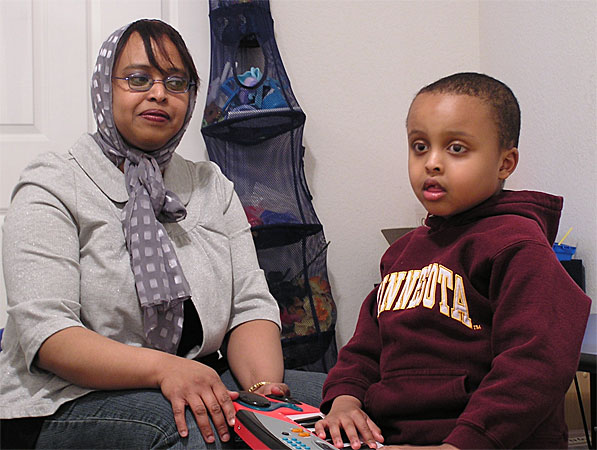
Minnesota Somali woman with autistic son
My unscientific earlier guess centered on the lack of Vitamin D Somali mothers (covered from head to toe in a northern climate) likely received during pregnancy, but these statistics don’t fit that theory well as American blacks do not have the same levels of autism as the Somalis or the white people in the study.
My other theory, also just a guess! is based on the possible genetic affects of in-breeding in polygamous families. Here are all of our previous posts on Somalis and autism.
So why, according to the new study, is it hitting Somali kids harder (not that there are significantly more cases!)—-the Somali kids’ IQs are lower and so the condition manifests itself more starkly than those with higher IQs. This of course raises the question, not answered here: what is the average IQ of the Somali population as a whole compared to the white population? Uh oh!
Autism might not be any more prevalent among Somali-heritage children in Minneapolis than it is among white children in the city, but the severity of the developmental disorder appears harsher in this minority group.
In a much-anticipated report released Monday, University of Minnesota researchers found statistically similar rates of autism symptoms among 7- to 9-year-olds in Minneapolis, regardless of whether they were Somali or white. But all of the Somali-heritage children with autism also had related intellectual disorders — defined as scoring 70 or less on IQ tests — compared with a third of autistic children in the study overall.
“Somali children are much more likely to also have an intellectual disability, which means their symptoms, their characteristics, the ways in which autism presents itself in these children are very different,”said Amy Hewitt, the lead author of the study and a senior research associate in the university’s Institute on Community Integration.
Concerns about the prevalence of autism among Somali children surfaced among parents in 2008, and were validated in 2009 when a report from the Minnesota Department of Health found that Somali preschoolers were two to seven times more likely to receive autism services from the Minneapolis public school system.
The U study, released Monday, was an outgrowth of that Health Department report, and is the largest examination ever in the United States of autism prevalence among Somali immigrants’ children.
Rather than counting the number of children signed up for autism services, or even who have received a diagnosis of the developmental disorder, the researchers examined medical records from thousands of participating families and evaluated whether children met the medical criteria for autism — regardless of whether it had been diagnosed.
The net result was that one in 32 Somali children in the study met the diagnostic criteria for autism, compared with one in 36 white children. The rates were notably lower at one in 62 for non-Somali black children in Minneapolis, and one in 80 for Hispanic children. The rates for the Somali and white children were higher than national averages as well.
It is a good thing we have Obamacare now to pay for all this on-going medical treatment for refugees!
Photo is from this story, one of many, where Somalis were demanding answers about why their kids were afflicted with autism at a higher rate (or so they thought) than white American kids.
Ataka leader Bozhinov: we have a lot of our own poor people to take care of! Photo: Dmitry Kostyukov for The New York Times
George Soros and his open-society one-worlderswill have their hands full as the unexpected (maybe not so unexpected!) flowering of the political right is coming sooner and faster than it might have if there wasn’t such a drive on (led by the UN) to pressure Europe to take in Muslims, most recently the Syrian Muslims.
Here the New York Timeswrings its proverbial hands over Bulgaria’s growing right wing power in a “news” piece filled with words meant to prejudice readers toward a leftwing view of the situation.
In fact, one interesting thing about the European rightwing is that although they are against unfettered immigration, they still believe in the social safety net that most socialist countries of Europe offer their citizens. But, here is the crux of it and it comes late in the article:
“We are not a party of xenophobes,” he (Ataka leader) said. “But Bulgaria has lots of poor people of its own that need taking care of before refugees.”
Whether it’s Europe, Canada or the US, the average citizen asks these same logical questions as I said here last week in the post about Canadian health care.
One of the most troubling questions for community members in a city or town where large numbers of refugees are arriving is—why are we doing this when we have our own needy people not being cared for?
I hear it all the time. It goes something like this: ‘we have people (Americans/our neighbors) going hungry, homeless in the streets, or the elderly in need of attention and care and yet we can bring in tens of thousands of impoverished people from elsewhere in the world? Why are our own needy so much less attractive?’
Here is the New York Times(anti-rightwing ‘opinion’ piece with my emphasis!):
SVILENGRAD, Bulgaria — After spreading turmoil and desperate refugees across the Middle East, Syria’s brutal civil war has now leaked misery into Europe’s eastern fringe — and put a spring in the step of Angel Bozhinov, a nationalist activist in this Bulgarian border town next to Turkey.
The local leader of Ataka, a pugnacious, far-right party, Mr. Bozhinov lost his seat in the town council at the last municipal elections in 2011 but now sees his fortunes rising thanks to public alarm over an influx of Syrian refugees across the nearby frontier.
Membership of the local branch of Ataka, he said, had surged in recent weeks as “people come up to me in the street and tell me that our party was right.” Ataka, which means attack, champions “Bulgaria for Bulgarians” and has denounced Syrian refugees as terrorists whom Bulgaria, the European Union’s poorest nation, must expel.An Ataka member of Parliament has reviled them as “terrible, despicable primates.”
The Socialist led government is corrupt and survives with the help of the rightwing which has given the rightwing leverage to push for things like the new border fence (mentioned later in the story).
The influx of Syrian refugees has sown divisions across the European Union as the refugees add burdens on governments still struggling to emerge from years of recession. But Bulgaria is perhaps the most fragile of all the European Union’s 28 members. Modest as the numbers of refugees are here, the entry of nearly 6,500 Syrians this year has overwhelmed the deeply unpopular coalition government and added a volatile element to the nation’s already unstable politics.
The arrival of the refugees and public fury over the stabbing of a young Bulgarian woman by an Algerian asylum seeker “has opened the floodgates” for far-right nationalists, said Daniel Smilov of the Center for Liberal Strategies, a policy research group in Sofia, the capital. “They see this as their big chance.” [Note, it’s not just Syrians trying to get through Bulgaria, but African Arabs like the alleged stabber in this case—ed]
No matter how inflammatory its message or small its numbers, Ataka has had outsize leverage since inconclusive parliamentary elections in May left it critical to the survival of Bulgaria’s new socialist-led government, which has been besieged for months by protesters demanding its resignation over complaints of cronyism and corruption.
[….]
Like many populist parties in Western Europe, Ataka mixes right-wing calls for law and order and restrictions on immigration with economic policies that veer sharply to the left.
Ataka: Illegal migrants are Islamists and scroungers!
Ataka’s one constant has been its vicious rhetoric against foreigners and minorities. Alfa Television, a station operated by Ataka, denounces the refugees as radical Islamists and scroungers who will only bring violence and deeper poverty to Bulgaria.
[….]
Mr. Bozhinov, the Ataka leader in Svilengrad, said he had nothing against legal immigrants. But he fumed against those who sneaked across the thinly guarded border from Turkey, seeing them as a threat to Bulgaria’s and Europe’s security and economic well-being. They should be either sent back or moved on to richer countries willing and better equipped to take them, he said.
“We are not a party of xenophobes,” he said. “But Bulgaria has lots of poor people of its own that need taking care of before refugees.”
Whether it is Bulgaria or America, that legitimate sentiment runs deep!
Somalis protest in Oslo: Some children taken out of families because of allegations of child abuse.
We told you previously that George Soros’ Open Society Foundation is doing a seven-city tour of Europe to report on how Somalis are doing in their new homes. Our earlier report on their recommendations for Helsinki is here.
The seven cities are: Amsterdam, Copenhagen, Helsinki, Malmo, Leicester, London, and Oslo.
And, why they picked Somalis of all the immigrant groups flooding Europe, I don’t know. My guess is that since the Somalis can be fractious, maybe they are worried that Somalis will hurt their one-world goal more than other ethnic groups might due to their trouble assimilating.
Here is some of what the researchers recommend—it all involves Norway spending more money to train Somalis to do some sort of work and to push for their inclusion into the still discriminatory Norwegian society. They also say Norway has to get away from this idea of “formal qualifications” for employment, and they recommend boosting the ethnic based community organizing groups (we have Somali ethnic community organizing groups all over the US largely paid for with taxpayer dollars to organize Somalis for engagement in the political process and to sign them up for the social services they are entitled to! Never heard of it, see our whole category on ECBOs here).
There doesn’t seem to be a word that I see in the summary of the report about Somalis needing to try harder to fit in!
OSLO— Developing Oslo’s vibrant and dynamic Norwegian-Somali civil society organizations and strengthening their engagement with the city of Oslo is key to Norwegian-Somalis’ full and equal participation as residents of Oslo.
Poverty remains one of the single greatest barriers to Norwegian-Somali inclusion in Oslo. This leads to challenges in education, employment, housing and health and is further exacerbated by negative portrayals of Somalis within the Norwegian media.
The report Somalis in Oslo, launched today by the Open Society Foundations, finds that the emphasis on formal qualifications within the Norwegian labour market together with discrimination in hiring processes are leading to high rates of Somali exclusion from employment in Oslo. To overcome the gap between the demands of the Norwegian labour market and the limited formal qualifications that many Somalis have upon entering Norway, the report recommends better emphasis be placed by employers and employment agencies on making more out of the actual skills and experiences of individuals. [What might those be?—ed]
[…..]
Somalis in Oslo recommends that the city of Oslo, which has developed robust policies for managing inclusion, and others concerned with inclusion such as the Norwegian Labour and Welfare Administration, the Directorate of Integration and Diversity and the Ministry of Children, Equality and Social Inclusion, strengthen their engagement with Somali and other minority communities. The research advises that Norwegian-Somali civil society organizations build their skills and improve collaboration to help better cross-community engagement. To tackle unemployment among Norwegian-Somalis, the research recommends government and civil society organizations address language needs, invest in mentor programs and offer help to Norwegian-Somalis on recruitment and employment practices.
See all of our previous posts on Norway by clicking here.
The photo is from this poorly written undated story, but is seems that the authorities have taken some children out of Somali homes where abuse has been alleged (you know, one of those cultural relevance things we westerners can’t appreciate). While looking around on the subject of how Somalis are doing in Norway, I also found this 2011 post at Tundra Tabloids about welfare fraud among Somalis in Norway where Somali women claim to have no husband in order to receive generous welfare benefits (but continue to produce babies with their “former” hubby).
Especially the “vulnerable” women who have suffered female genital mutilation.
Countries of origin for the refugees are Sudan, South Sudan, Eritrea, and you-guessed-it Somalia. Some from Kenya too. What is up with that, Kenya is a safe country, right?
They will be going to Norway, Canada, Switzerland, Australia and the US.
December 13, 2013 (ADDIS ABABA) – The United Nations*** refugee agency said on Friday that it is planning to resettle over 3,800 refugees in Ethiopia to a third country.
This follows record submissions for resettlement at the Tongo, Barahle and Bokolmanyo refugee camps, where resettlement has not not been previously conducted.
“Notable this year was the first emergency resettlement to Sweden of a child-at-risk from Dollo Ado, as well as submissions of several highly vulnerable women and girls out of Barahle and Sherkole camps, including victims of female genital mutilation and other forms of sexual and gender based violence”, said Julia Zajkowski, the resettlement officer at UNHCR’s Ethiopia office.
The plan to resettle 3,800 refugees exceeds the UN refugee agency’s 2013 resettlement target by over 20%.
[….]
The third-country resettlement operation for refugees in Ethiopia particularly for Eritreans was begun by the Ethiopian government in 2006 in collaboration with the International Organization for Migration (IOM) and UNHCR.
[….]
According to UNHCR report, Ethiopia received over 5,000 new refugees over the last two months, bringing the total number of refugees in the Horn of Africa nation to over 427,000.
The new arrivals came from Eritrea, Somalia, Sudan and South Sudan.
Currently there are 240,000 Somalis, 81,000 Eritreans and 70,000 South Sudanese in Ethiopia. The remaining over 36,000 are from Kenya, Sudan and other east African countries.
***Just a reminder it is the UN High Commissioner for Refugees choosing who comes to the West.