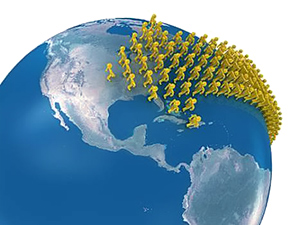
Malta gets a large EU grant to detect infectious diseases in Africans arriving there illegally

Why do we care?  Because for the last 5 years (at least) we have been taking some Somali illegal aliens who arrive in Malta on boats to the US as legitimate refugees.  So, now I suppose we should be glad infectious disease screening is going to improved.  Here is just one recent post on the Malta mess.

Africans arrive in Malta. Bound for the USA (eventually).

From the Times of Malta:

A new initiative by the Health Ministry, funded by the EU and intended to prevent the spread of infectious diseases in Malta, will kick off tomorrow at Lyster Barracks Detention Centre.

The Health Promotion and Disease Prevention Directorate within the Ministry, has managed to secure an investment of over €700,000 from the European Refugee Fund Emergency Measures Annual Programme 2012 to develop a project to enhance the screening process at Lyster Detention Centre in Ħal Far.

For ambitious readers, I bet we have over a hundred posts (at least dozens and dozens for sure) on Malta here at RRW.

Update: Be sure to see World Refugee Day celebrated on Malta, here.  They celebrated a dinghy.

Increase in flesh-eating parasite observed in refugees in Syria, Middle East generally

Sand flies carry the disease.  Here is the story in the Gulf News (which credits the Washington Post for the story, but I don’t see it there in a quick look):

Cutaneous leishmaniasis in refugee populations in Middle East

Al Salama, Syria: A crowd gathers at the centre of Bab Al Salam, a refugee camp on the Turkey-Syria border that is home to some 13,500 internally displaced Syrians. Children sit at their mothers’ feet, playing with plastic toys in the melting mud. One boy’s cheeks are pocked with small red dots; a boy next to him, wearing nothing but a diaper, has a large crusted lesion on his leg – signs of an infectious skin disease that is spreading throughout Syria and the neighboring region.

Since war came to Syria a little more than two years ago, the country has been transformed into a public health nightmare. Gastroenteritis, which causes severe diarrhea, vomiting and abdominal pain, is ubiquitous among displaced populations – both inside and outside Syria – and a measles epidemic is currently sweeping the northern portion of the country. (At least 7,000 cases of the disease have been detected since 2011, according to Doctors Without Borders.) An outbreak of water-borne diseases such as hepatitis, typhoid, cholera and dysentery, meanwhile, is all but “inevitable,” according to the World Health Organization (WHO).

But in camps like Bab al-Salam, it is a silent, flesh-eating parasite that is literally leaving its mark on the population. Cutaneous leishmaniasis, also known as the “Aleppo evil” or the “Aleppo boil,” is carried by sand flies and causes painful lesions that can become secondarily infected, often resulting in disfigurement. Another form of leishmaniasis – visceral – affects the spleen and liver, and it is the second-largest parasitic killer in the world after malaria. Mercifully, it is only the nonlethal parasite that is coursing through the Syrian countryside, where years of fighting has made seeking medical treatment extraordinarily difficult. Still, the parasite leaves its victims scarred for life.

There is more, here.

For more on health issues and refugees, see our category on the topic by clicking here.

MERS: One more reason to stop the flow of humanity from the Middle East

The single biggest worldwide public health threat!

A mystery disease centered in Saudi Arabia (at this time) is giving world health officials something to be frightened about.  With a 60% mortality rate and no clues yet about what causes it, doctors, researchers and other health experts from many countries convened in Cairo to make plans for the largest movement of people each year in that part of the world (besides refugees flowing from country to country), the Hajj.

From the UK Telegraph (Hat tip:  Always on Watch):

Health experts have started an emergency international meeting to devise ways of combating a mysterious virus that has been described as the single biggest worldwide public health threat after claiming 38 lives, mostly in Saudi Arabia.

Amid fears of a new pandemic more deadly than Sars, 80 officials and doctors, including two from Britain, gathered in Cairo yesterday to examine ways of tackling Middle East Respiratory Syndrome, dubbed MERS.

The coronavirus is casting a shadow over the annual Muslim pilgrimages to Saudi Arabia, where four new deaths were announced on Monday.

The three-day meeting called by the World Health Organisation will look at developing guidelines for Ramadan. In October, more than two million people are expected to attend the Hajj pilgrimage to Mecca.

[…..]

Cases have also been found in Britain, France, Germany, Italy, Tunisia and Jordan. Most were patients transferred home from the Middle East for treatment or people who had travelled to the region and became ill after they returned.

Dr Jon Bible, a clinical scientist, who treated one of the three British cases last year, said: “You don’t want to have this.”

I’ve said this before, but if the general public in the West doesn’t scare easily about terrorism entering the US with the immigrant population, diseases will eventually get their attention (scare them to death).  We have 157 previous posts in our ‘health issues’ category.

See also our earlier post on MERS.

Leprosy arrives in Ireland with immigrant from South America

Note to readers:  I should have thought of this sooner.  I didn’t know this post would attract as much attention as it has.  If you are a reader from Ireland—type ‘Ireland’ into our search function and weep.

One more of the joys of multi-culturalism and mass migration!

The feet of a man with leprosy in East Timor.

From Irish Central:

The Irish health authority has confirmed the first case of leprosy in Ireland in living memory but has reassured the public that there is no cause for concern.

The victim, who is understood to be a native of South America in his 30s is believed to have contracted the disease outside of Ireland and was thought to have suffered from the condition in the past. The disease was discovered at a County Meath clinic. The doctor who treated him stated he presented for a disease seen  “more in the Middle Ages than on a busy morning clinic in Co Meath”.

Learn more about Leprosy here.

And, go here to our ‘health issues’ category for more on diseases and other health problems you need to know about especially if you are working closely with refugees and other immigrants.

Sacramento Iraqis have mental problems; no psychiatric treatment readily available

This is not the first time that we have written about Iraqi refugee mental health problems (and I suspect it won’t be the last).

So far, this fiscal year (2013) we have “welcomed” 11,066 Iraqis.  If the Sacramento percentages of suffering delicate Iraqis is representative then we have just admitted:

6,528 cases of insomnia

4,869 depressed people

4,537 people with headaches

4,205 fearful people

…all in need of mental health professionals to help them cope, so that they can find jobs.

LOL!  I bet the percentages of Americans reading this post who are experiencing sleeplessness, depression, headaches and fear are at about the same percentage as the Iraqis as we contemplate what the US State Department and the resettlement contractors are doing to America and how the heck we are going to pay for all of this!

Here is the story from California Health Line:

Many of the 2,700 Iraqi refugees living in the Sacramento area have experienced symptoms of post-traumatic stress disorder but struggle to obtain mental health care services, according to a report by the UC-Davis Health System Clinical and Translational Science Center, the Sacramento Bee reports.

The report was conducted with the help of Opening Doors,* a refugee resettlement agency, and the Mesopotamia Organization, an Iraqi self-help agency.

Report Findings

The report analyzed the number of Iraqi refugees experiencing PTSD symptoms and found that:

59% of refugees reported experiencing insomnia;
44% of refugees reported experiencing depression;
41% of refugees reported experiencing headaches; and
38% of refugees reported experiencing fear (Magagnini, Sacramento Bee, 6/3).

Obamacare to the rescue?  Don’t count on it!

According to the report:

65% of refugees reported experiencing long waits for treatment of symptoms;
74% of refugees said needed services were not covered by their health insurance; and
82% of refugees said that the U.S. health care system moved too slowly (UC-Davis report, May 2013).

The Iraqi unemployment rate in the US is at about 67%.   Who knew it was because they have so many mental health problems.

He ( Sarmed Ibrahim) added that the lack of medical treatment is affecting Iraqi refugees’ ability to obtain jobs.

Just a reminder, California takes the most refugees of any state, so its only going to get worse for Medi-Cal.

* Opening Doors is a Sacramento refugee resettlement agency.  Its most recent Form 990 is here.  Out of a revenue stream of $636,186, government grants (taxpayer dollars) supplied $595,700 of their income.