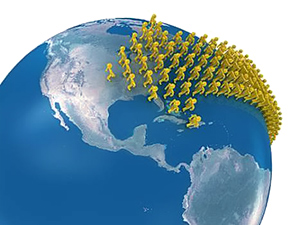
Greenfield: No one can save Africa but Africans

Or the Middle East, or Southeast Asia, or Detroit etc. except those who live there.

Daniel Greenfield at his blog Sultan Knish  wades into a thorny minefield to question western aid to Africa (and elsewhere) and how it might make a few do-gooders feel good about themselves, but in fact is just a bottomless money-pit where your money ends up feeding ‘government’ corruption and providing fat salaries for NGO employees in a never-ending cycle.

Remember in 2008 when Irish writer Kevin Myers penned a column on the topic, and you-know-what hit the fan and his job was threatened at the Irish Independent for daring to say this:

The wide-eyed boy-child we saved, 20 years or so ago, is now a priapic, Kalashnikov-bearing hearty, siring children whenever the whim takes him.

And, once you’ve read it, a never-to-be-forgotten dark novel about the African aid racket is Paul Theroux’s ‘The Lower River’, based on the author’s own experience with aid agencies in Africa.

Greenfield continues the theme today at Sultan Knish (hat tip: Ed).  Emphasis is mine:

Every lofty aid goal begins with a big number and bleeds down to the prosaic reality that the goal will never be met, but that everyone involved will be told to feel good about themselves for trying. The bigger the goal, the bigger the administrative overhead, the corruption and the inefficiency. Instead of scaling up results by scaling up funds, more money and more people lead to fewer individual results.

The aid economy of the underprivileged is the smaller half of the overall aid economy. The biggest piece of the aid economy is in the hands of the aid organizations that profit from an unsolvable problem that, all their fundraising brochures to the contrary, they have no interest in solving because it would remove their reason for existing. Africa’s misery is their wealth. The worse Africa becomes, the more incentive the easily empathetic and the guilty of the West will have to pour money into their latest cause to buy everyone in Africa a goat, a laptop or a sandwich.

It’s the old Soviet problem. The producers have no interest in producing anything. The aid recipients, distributors and providers have achieved a dysfunctional equilibrium. The system is broken, but everyone has learned their roles within the broken system. If the system changes, they will all have to get jobs. It was that inertia which kept the USSR going long after its leaders stopped caring about the ravings of Marx, Lenin and Stalin. It took the energy of a younger generation that had yet to become invested in the system to topple it and it is the older generation that is most likely to march with portraits of Communist leaders and kiss them for the cameras.

You can buy a homeless man a sandwich, but you can’t buy them all sandwiches because once you do that, you are no longer engaging in a personal interaction, but building an organization and the organization perpetuates itself. You don’t need a homeless man to exist so that you can buy him a sandwich, but once an agency exists that is tasked with buying homeless men sandwiches, it needs the homeless men to exist as ‘clients’ so that it can buy them sandwiches and buy itself steak dinners.  [Sound familiar!  This is what perpetuates the entire refugee contractor industry!—ed]

In aid economies, the scale of the problem grows slightly faster than the amount of aid and activists hold out the tempting promise that by increasing spending to stay ahead of the problem, it can be solved completely. All it would take is for everyone to become engaged and care. That isn’t a plan, it’s a pat on the back for the people who do care and an incentive to show their moral superiority by continuing to throw good money after bad into the aid economy.

There is much more!  Read it all!

You won’t save Africa either by removing Africans from Africa and placing them in small town (or large city) America!

UNHCR tells countries to take Somali asylum seekers while closing Kenyan camp

Dadaab: Going home to Somalia and to 44 industrialized countries around the world!

I don’t know what to make of this!  While we are getting news that the UN is working toward closing the massive Somali refugee camp in Kenya (the Kenyan government doesn’t want them after the horrific mall attack), and “refugees” are returning to Somalia (here), the UN is also admonishing governments around the globe to take more Somali asylum seekers.

Asylum seeking Somali numbers are high!   How many arrived in Malmo? Are they fearful, or just looking to be taken care of in the West?

From All Africa:

More than 42,000 Somalis sought asylum in neighbouring countries and elsewhere in 2013.

Feeding into their fear, the UNHCR says don’t send them back to Somalia (while the UN scales back rations and sends them out of Kenya?), continued UNHCR at All Africa:

We are appealing to all states to uphold their international obligations with regard to no forced returns, or non-refoulement. Somali nationals should not be forcibly returned to Somalia unless the returning state is convinced that the persons involved would not be at risk of persecution.

[…..]

Between January and November 2013, 21,517 Somalis sought asylum in neighbouring countries. In addition, Somalis filed 20,600 asylum claims in 44 industrialized countries in 2013, compared to 18,701 claims in 2012. While more than 33,000 spontaneous returns were recorded between January and November 2013, many may not have been permanent. As of end 2012, the number of Somali refugees worldwide was 1.136 million.

If they all went back to Somalia (with the help of the UN!), al-Shabaab would not have a prayer of surviving against a million people encouraged and determined to re-build their country.  The UN seems to be encouraging them to be fearful and expects “industrialized countries” to take care of them.

Maybe it’s time for Somalis to ‘man-up!’

Minneapolis: Special classrooms for influx of Somali newcomers

A school district in Minneapolis is trying to figure out how to bring new Somali kids up to speed educationally, how to “jump-start” them.

Somali students in the lunchroom.
http://daughternumberthree.blogspot.com/2010_04_01_archive.html

The story at the Star Tribune this past week mentions that there are many more kids arriving from Somalia than in recent years, but no mention of why that is.   Somali family reunification from Africa is now up and running again after about a four year hiatus that ended in 2013.  It had been closed for years due to the widespread fraud uncovered by the US State Department in 2008.

Going to the DHS’s Annual flow report, see that in 2010 we resettled 4,884 Somalis, 2011—3,161 and 2012—4,911.

In fiscal year 2013 we had a big jump to 7,608 Somalis and in the first three months of fiscal year 2014 we have resettled 1,744.***  It stands to reason many went to join their people in Minneapolis.

From the Star Tribune:

Shuttling between classrooms at Anne Sullivan school in Minneapolis, teacher James Kindle noticed that classroom teachers were stretched mightily to serve the wide range of abilities in a school with many immigrants.

A teacher might be showing one group of students how to measure the angles in a triangle, while other students in the same class were just learning that “triangle” is the word for a three-sided polygon.

Kindle did some research, talked to other teachers and together they went to school district officials. The result is a pair of “newcomer classrooms” and a concentrated effort to jump-start the adjustment of Somali students in American schools.

The timing is good for Sullivan and other schools receiving a surge of Somali refugees.

“This is a heroic effort on Sullivan’s part,” said Lynn Harper, a district K-8 multicultural specialist.

The newcomer program is aimed at Somalis, but the concept could be adapted to any immigrant group, she said.

Students new to the country are steered into a classroom with other newcomers, so they can learn things like “triangle” before heading into classes with other students.

The district is ramping up the effort even before knowing results. The school board last month approved an expansion from Sullivan’s two classrooms to eight newcomer classrooms, split between Sullivan and Andersen United school. Together the two schools account for one of every six K-8 students in the district from a Somali-speaking family. The expanded program starts next fall.

The Sullivan experiment comes as the school district sees an influx of students from Somalia. At the start of this year’s classes, 336 refugee students had registered recently enough that they could have been eligible for newcomer classes. That’s a marked increase over previous years.

The influx won’t be ending anytime soon for “welcoming” cities like Minneapolis.

For the numbers of Somalis arriving in the last three decades, visit one of our most-read posts here at RRW.  In three years of the Bush Administration the numbers topped ten thousand per year!

***While you are checking those stats for Somalia at WRAPSnet, note that Somalis make up the fourth largest number of refugees resettled in fiscal year 2014.  The top three in the first three months of this fiscal year are:

Iraqis:  4,111

Burmese:  2,316

Bhutanese:  2,257

Somalis: 1,744

Mental illness: new ticket to America?

Searching around the world wide web one can find much being done in Tanzania and Africa generally in the mental health field. http://www.gmhi.org/

An appeals court in Richmond, Virginia has granted asylum to a man who says his treatment for mental health problems in Tanzania amounted to persecution.   The general understanding of what constitutes a legitimate claim for asylum usually contains these elements:

The refugee/asylum seeker must demonstrate a “well founded fear of being persecuted for reasons of race, religion, nationality, membership of a particular social group or political opinion.”

No doubt the applicant in this case was fearful, but his complaint does not fit the definition.  There is, however, an ambitious movement afoot by immigration lawyers to expand the definition beyond its original intent.  One could conclude from this case that anyone treated badly for myriad reasons in their home country was eligible for asylum if they could get themselves into the US in order to apply.

One thing that struck me in this news is that the man was denied in lower courts and the Court of Appeals split, so one of the judges wasn’t buying the story and there must be much more to this case then we are being told.

From UPI.  (Hat tip: Pungentpeppers)

RICHMOND, Va., Jan. 22 (UPI) — A federal appellate court panel has ruled a bipolar man who said he was repeatedly tortured in Tanzania should qualify for asylum in the United States.

The Homeland Security Department tried to deport Tumaini Temu back to Tanzania in 2010, four years after his temporary visa expired.  [For what reason did we originally grant him a temporary visa to get into the US?—ed]

Temu applied for asylum and claimed he was persecuted in his home country due to his mental illness, which is considered demon possession in Tanzania, Courthouse News Service reported.

An immigration judge and the Board of Immigration Appeals denied his application, but a three-judge panel of the 4th U.S. Circuit Court of Appeals in Richmond, Va., reversed the decision on a split vote.

[….]

Temu came to the United States after his family rejected him, and he was diagnosed with bipolar disorder.

Get ready for a parade of crazy asylum-seeking Tanzanians in need of meds through Obamacare!  And, just a reminder, once granted asylum these new “refugees” are given access to all of the social services (welfare programs) available to refugees.

Endnote:  I just now searched around for more on the treatment of mental health problems in Tanzania and in Africa generally and note that there is much happening there, and throughout Africa, to help those with mental illnesses.  We don’t need to be moving them to America!

See our Health issues category (here) for more on refugee mental health problems.

Brazil “unprepared” for asylum-seeker crush

It’s not just Australia, Israel, Bulgaria, Italy and the rest of Europe trying desperately to hold back the tide of migrants from the Middle East/Africa and other third world nations, but even in South America there is no peace from largely economic migrants (all calling themselves ‘asylum seekers’) looking for new places to call home.

Homeless “asylum seekers”

From Deutsche Welle (The star of this story is Mohammed from Syria):

Brazil has seen the number of asylum seekers increase nearly tenfold over three years and official agencies are woefully unprepared to deal with the refugees. Few people receive asylum and help for immigrants is sparse.

[….]

In Brazil, political refugees from the Middle East or Africa have been a rare sight over the last few years. The South American country appears far removed from the horrors of war on foreign continents. But that is changing. Between 2010 and 2013, the number of people seeking asylum in Brazil increased nearly tenfold, from 566 to 5,200. Adding to those numbers are thousands of immigrants from Haiti, Senegal, Angola, Liberia, Bolivia, Pakistan and Bangladesh.

“Brazil has to prepare for an increasing crush of immigrants,” said Andres Ramirez, who represents the UN’s refugee agency in Brazil (Acnur). Since 2013, the organization has been operating a small office in Sao Paulo. One of the biggest problems, he told DW, is the lack of emergency shelters. “Many refugees sleep on the streets for days before they get any help,” he said.

Of the 5,200 people applying for asylum in Brazil, just 649 were recognized, according to figures from the country’s Ministry of Justice. The largest group among them, 283, came from Syria, followed by the Democratic Republic of the Congo, with 106, then Columbia and Angola.

The largest group seeking asylum, however, were the 1,814 Bangladeshis. Just one was recognized as a political refugee. Senegal followed with 868 asylum seekers, of whom four were recognized. In other conflict regions, such as Lebanon, Guinea-Bissau and Somalia, acceptance rates stood at below 3 percent.

Such statistics don’t include the 15,000 Haitians in northern Brazil. Roughly 70 per day arrive in Brasilia, a city of just 10,000 in the state of Acre, bordering Peru.

[….]

The unofficial influx has become a political problem. In an extraordinary cry for help, the state government of Acre requested on Wednesday (15.1.2014) that the federal Ministry of Justice allow it to close the border to Peru.

Read it all.

As always, I wonder how the poor and destitute from places like Bangladesh are getting the money to travel half way around the world to Brazil.  And, do they all pass through Cuba on the way???  I suppose it’s just a matter of time before they work their way north to the US border!