Dadaab: Going home to Somalia and to 44 industrialized countries around the world!
I don’t know what to make of this! While we are getting news that the UN is working toward closing the massive Somali refugee camp in Kenya (the Kenyan government doesn’t want them after the horrific mall attack), and “refugees” are returning to Somalia (here), the UN is also admonishing governments around the globe to take more Somali asylum seekers.
Asylum seeking Somali numbers are high! How many arrived in Malmo? Are they fearful, or just looking to be taken care of in the West?
More than 42,000 Somalis sought asylum in neighbouring countries and elsewhere in 2013.
Feeding into their fear, the UNHCR says don’t send them back to Somalia (while the UN scales back rations and sends them out of Kenya?), continued UNHCR at All Africa:
We are appealing to all states to uphold their international obligations with regard to no forced returns, or non-refoulement. Somali nationals should not be forcibly returned to Somalia unless the returning state is convinced that the persons involved would not be at risk of persecution.
[…..]
Between January and November 2013, 21,517 Somalis sought asylum in neighbouring countries. In addition, Somalis filed 20,600 asylum claims in 44 industrialized countries in 2013, compared to 18,701 claims in 2012.While more than 33,000 spontaneous returns were recorded between January and November 2013, many may not have been permanent. As of end 2012, the number of Somali refugees worldwide was 1.136 million.
If they all went back to Somalia (with the help of the UN!), al-Shabaab would not have a prayer of surviving against a million people encouraged and determined to re-build their country. The UN seems to be encouraging them to be fearful and expects “industrialized countries” to take care of them.
Nor are there jobs for your college graduate kids!
Just now as I turned off the TV, President Obama was being interviewed about how to create more jobs and yesterday the Republicans were announcing their plan to flood the job market with both uneducated and educated immigrants for their big business donor friends, yet here is a story from Maine boo-hooing about no jobs for educated refugees!
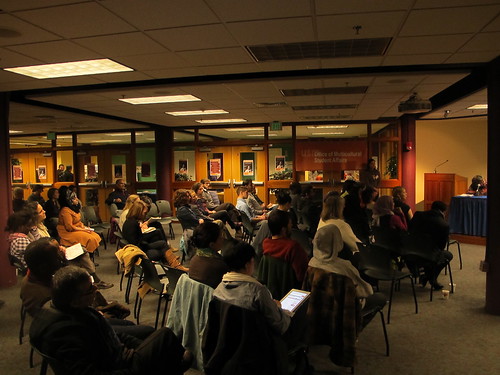
University of Southern Maine audience listens to plight of refugees who can’t find work!
From Maine Public Broadcasting Network. (Hat tip: ‘pungentpeppers’) An Iraqi with a college degree from Iraq took part in panel discussion on jobs hosted by Catholic Charities of Maine among others. I guess there are no more struggling job-seekers among the Americans in Maine!
Portland resident Sarah Mahdi came to the U.S. with a college degree, but, like many immigrants, has had trouble getting it recognized in the U.S. It’s not an unusual problem. Maine educators and other service providers are now looking for ways to make it easier for educated immigrants to find suitable jobs or further their educational opportunities.
[…..]
“When I first came to the States I just wanted to study,” said Mahdi, who was among a handful of immigrant students sharing their experiences Wednesday night at a panel discussion in Portland. The panel was organized by the University of Southern Maine’s Office of Multicultural Student Affairs, and Catholic Charities Maine.
New Mainers Resource Center uses tax dollars to help immigrants prove they actually have a legitimate college degree.
One place immigrants can turn to is the newly-established New Mainers Resource Center, one of the several service providers on hand at Wednesday night’s event to offer advice. The center’s program co-ordinator, Sally Sutton, is talking to George Dakonsa, who arrived here from the Democratic Republic of Congo seeking asylum four months ago.
“I have a bachelor’s degree in economics and finance,” he says. “I’d like it if they can help me to evaluate.”
The center was recently opened by Portland Adult Education with the aim of specifically helping college-educated immigrants in their search for suitable employment or further education. Co-ordinator Sutton says with immigrants like Dakonsa come an opportunity to breathe new economic life into the state. [Would someone please explain exactly how they are breathing new economic life into the state!—ed]
That bad ‘ol Maine governor is at it again—-how dare he try to balance the state budget!
The New Mainers Resource Center, however, may end up being a short-lived venture. It’s meant to be a two-year pilot project funded at $75,000 a year.
But the program could be eliminated after its first year – just one small part of the nearly $34 million in spending cuts being recommended in a report commissioned by the LePage administration, looking for ways to balance the two-year budget.
Governor LePage needs to continue working on something else! Maine has become a go-to state for asylum seekers.
Check out this articlefrom The Free Press from earlier this month:
Maine has become known to many central African asylum seekers as a place where they can find community support as well as temporary financial assistance while they have their visas and work permits approved. Often they arrive on tourist or business visas, sometimes with forged documents.While many asylum seekers are well educated and come from financial means, the money doesn’t last long and many end up in homeless shelters while their applications are being processed.
Maine happens to be one of a handful of states that does not require proof of citizenship. All asylum seekers must show is that they are applying for asylum. Unlike official refugees, such as many in the Somali and Sudanese populations who are resettled in Maine by the U.S. State Department [and Catholic Charities—ed], asylum seekers do not qualify for any other state or federal benefits while they are applying for asylum. The whole asylum approval process can take from one to two years and it typically takes at least 150 days for asylum seekers to be eligible to legally work once approved for asylum.
One more thing….so much for the importance of educated refugees!
Reader ‘tomasrose’ sent us this comment to our earlier post about Bhutanese low-skilled laborers and the US State Department (as headhunters) bringing them in for businesses:
I spoke with a refugee from the middle east just last week and he confirmed, of course, refugees are coached in what to say to improve their chances at coming to the U.S.. One of the things he said is they hide any education they might have. If the U.S. thinks you are educated your chances of moving to the U.S. are lower. He cited an M.D. from Baghdad who told refugee officials he was a menial laborer and, presumably, would be happy to work the same jobs in the U.S.. Had he advertised his credentials as a doctor, he would have a better chance at going to one of the Scandinavian countries, but to get the U.S. he had to really dumb his resume down.
The headline of the AP piece from CBS Las Vegas, calls her a “refugee” but it’s not clear if she was actually granted asylum. Hat tip: ‘pungentpeppers.’
LAS VEGAS (AP) — A Chinese woman who says she sought asylum in the U.S. after taking part in pro-democracy demonstrations in Beijing’s Tiananmen Square in 1989 was sentenced in Las Vegas to nearly four years in federal prison for her role in a multi-million dollar casino baccarat fraud scheme.
Irene Li’s lawyer, Assistant Federal Public Defender William Carrico, said Thursday he’s virtually certain his 53-year-old client will be deported to China after her 47 months in prison.
Li pleaded guilty in October to one count of conspiracy to commit wire fraud in a plea deal that had other charges against her dismissed.
U.S. District Judge Andrew Gordon also ordered Li on Wednesday to repay $2.2 million in damages to five Las Vegas casinos.
Officials say Li’s husband remains a fugitive in the case.
Chinese make up the largest percentage of asylum seekers granted permission to stay in the US
Go to Table 6, page 6 of the Department of Homeland Securities 2012 Annual Flow Report. Here are the stats for Chinese given refugee status (after arriving in the US on their own either illegally or as visa overstays).
2010: 6,693 Chinese granted asylum (31% of the total)
2011: 8,585 (34%)
2012: 10,151 (34%)
Astounding!
By the way, a large number of Chinese men are being granted asylum because they tell immigration judges they want to have more than one child and that is grounds for admission! Once asylum is granted, the asylee can access all of the welfare programs open to refugees. See ourfact sheet.
Syrian asylum seekers block the port of Calais, demand entry into the UK. http://www.telegraph.co.uk/news/worldnews/europe/france/10357103/UK-border-police-to-consider-entry-for-Syrian-refugees-waiting-in-Calais.html
A new poll shows that most Brits want to either “keep the door firmly shut” against Syrian “asylum seekers,” or don’t know, as British politicians are warming to the idea under withering pressure from the humanitarian industrial complex.
“Some European countries are agreeing to each admit a few hundred of the people in the Syrian refugee camps. Do you think the United Kingdom should or should not also agree to admit a few hundred refugees from Syria to settle here?”
The answer? The British public are a lot less keen than some of our political leaders.
Just 39% of us think we’ve got room for a few hundred displaced Syrians. 47% think we should refuse to admit them, and 14% don’t know. Supporters of Ukip were more inclined to say no – 71% did – and over half of the Tory voters polled also said we should keep the door firmly shut.
Those demonstrators at Calais, France last fall sure didn’t help the cause of Syrian “refugees.”
Someone should do a poll in America! Should the US take thousands of Syrians this year? I think the results would be very similar to those found in the UK.
Searching around the world wide web one can find much being done in Tanzania and Africa generally in the mental health field. http://www.gmhi.org/
An appeals court in Richmond, Virginia has granted asylum to a man who says his treatment for mental health problems in Tanzania amounted to persecution. The general understanding of what constitutes a legitimate claim for asylum usually contains these elements:
The refugee/asylum seeker must demonstrate a “well founded fear of being persecuted for reasons of race, religion, nationality, membership of a particular social group or political opinion.”
No doubt the applicant in this case was fearful, but his complaint does not fit the definition. There is, however, an ambitious movement afoot by immigration lawyers to expand the definition beyond its original intent. One could conclude from this case that anyone treated badly for myriad reasons in their home country was eligible for asylum if they could get themselves into the US in order to apply.
One thing that struck me in this news is that the man was denied in lower courts and the Court of Appeals split, so one of the judges wasn’t buying the story and there must be much more to this case then we are being told.
RICHMOND, Va., Jan. 22 (UPI) — A federal appellate court panel has ruled a bipolar man who said he was repeatedly tortured in Tanzania should qualify for asylum in the United States.
The Homeland Security Department tried to deport Tumaini Temu back to Tanzania in 2010, four years after his temporary visa expired. [For what reason did we originally grant him a temporary visa to get into the US?—ed]
Temu applied for asylum and claimed he was persecuted in his home country due to his mental illness, which is considered demon possession in Tanzania, Courthouse News Service reported.
An immigration judge and the Board of Immigration Appeals denied his application, but a three-judge panel of the 4th U.S. Circuit Court of Appeals in Richmond, Va., reversed the decision on a split vote.
[….]
Temu came to the United States after his family rejected him, and he was diagnosed with bipolar disorder.
Get ready for a parade of crazy asylum-seeking Tanzanians in need of meds through Obamacare! And, just a reminder, once granted asylum these new “refugees” are given access to all of the social services (welfare programs) available to refugees.
Endnote: I just now searched around for more on the treatment of mental health problems in Tanzania and in Africa generally and note that there is much happening there, and throughout Africa, to help those with mental illnesses. We don’t need to be moving them to America!
See our Health issues category (here) for more on refugee mental health problems.