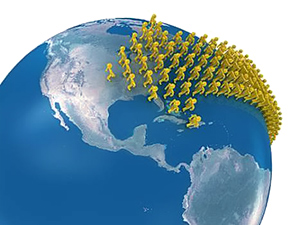
Update March 31st: Leftwing community organizer and race baiter at work in St. Cloud, here. His goal is to shut down any criticism of the Somali ‘community.’
Update March 30th: I think the St. Cloud Times is helping with the propaganda campaign with this reporton why Somalis make wonderful employees (not!).
Update March 26th: More on who is to blame—Lutheran Social Service of Minnesota—go hereto see what you can do!
Update March 24th: Now the agitation begins in earnest as CAIR arrives on the scene, here.
A few years ago Saint Cloud, MN was targeted as a new Somali resettlement site by the US State Department and its contractor there— Lutheran Social Service of Minnesota.
Originally the Somalis there were what the refugee industry calls “secondary migrants” who move in from other areas of the state or from another state—usually because they hear that an enclave of their kind of people is growing, sometimes for jobs, and sometimes for better welfare.
A group of students in protest walked out of classes Wednesday at Technical High School. (Photo: Jason Wachter, jwachter@stcloudtimes.com)
St. Cloud’s Somali population is now growing as Somalis are arriving directly from hot spots around the world. (The direct resettlement by the Lutherans to St. Cloud began in around 2010.)
So is it any surprise that diversity is not beautifuland tensions are building between Somali students and African American and white students in places like Tech High here this past Wedesday?
Ethinic tension inside Technical High School became public spectacle Wednesday on its south lawn as more than 100 students and parents, most of them Somali, protested what they described as a pattern of bullying and discrimination to which school officials have not adequately responded.
The protest started shortly before noon. Protesters, including students and parents, chanted slogans and waved posters.
With migration across the Mediterranean surging, the European Union’s largest border operation is bracing for a record year of arrivals by sea, especially as summer brings calm waters between Italy and Libya.
Off the eastern coast of Sicily, the 18-member crew of the Icelandic coast guard vessel Tyr – named after a Nordic god of war – are conducting rescue drills in seas more familiar in Greek mythology, preparing for the worst.
Though the United Nations refugee agency has criticised the mission, known as Triton, because its mandate is not search and rescue but border control with patrols near the Italian coast, the EU border agency Frontex says it is saving lives.
“We participate in a lot of search and rescue operations that take place far from the Italian shore, usually about 40 nautical miles north of Libya,” Frontex spokeswoman Ewa Moncure told Reuters on the bridge of the Tyr yesterday.
[….]
About 170,000 entered the EU through Italy last year by way of the dangerous sea crossing organised by human traffickers, mostly in Libya, while more than 3,000 perished.
During the first two months of this year, arrivals were up 43 per cent versus the same period of 2014.
[….]
The governments of southern EU countries – including Italy, Malta, Greece and Spain– have repeatedly criticised the failure of the 28-nation bloc to devote more attention and resources to the growing immigration crisis. To increase solidarity, the European Commission has said it will present a “migration agenda” in May, when good weather is expected to boost the flow of migrants and refugees, many of whom are fleeing civil war in Syria or forced military conscription in Eritrea.
This might be a good time to read The Camp of the Saints as the 4-decades-old novel is now coming true. Author Raspail was only wrong on his prediction of where the invaders would launch from.
See our ‘Invasion of Europe’ serieshere. Remember that the US State Departmenttakes some of Malta’s illegal aliens to the US as “refugees.”
This is a really informative news report from reporter Gretchen Frazee at Indiana Public Media. The story begins with a warm introduction to a Syrian family which has just arrived in Indianapolis with the help of federal resettlement contractor Exodus Refugee Immigrationwhich is a subcontractor of both Church World Serviceand Episcopal Migration Ministries (two of the big ninecontractors).
You can read the warm and fuzzy part yourselves, then this (emphasis is mine):
The U.S. began bringing in Syrian refugees in October and expects to allow in a total of 2,000 by the end of the fiscal year. [This fiscal year ends September 30th, 2015. Yesterday we learned that the contractors are pushing Obama to raise the ceiling for Syrians.—ed]
One of the pressing questions we have (and most readers concerned for their towns have) is how is a town or city chosen to be the next resettlement site for a group of new refugees.
Carleen Miller, Executive Director Exodus Refugee Immigration: “This year the number will be small…then their relatives will come and then their relatives will come.”
The State Department normally sends refugees to cities where they have friends or family. But Lababidi and Alhamoud didn’t know anyone in the U.S., so the government used a kind of formula to determine which location had the resources to best meet their needs. The department determined that place was Indiana. [I sure would like to see this formula!—ed]
“The main thing is that refugees go to a place that’s welcoming, that has a cost of living they can survive in, that has employment and opportunities,” says Carleen Miller, the executive director of Exodus Refugee Immigration, which is handling Syrian families’ resettlement in Indianapolis.
She points out that the Islamic Society of North Americais based just outside of Indianapolis in Plainfield. There is also a mosque which many Syrians attend in Fishers and a group of Christian Syrians at a nearby church.
“There are people who are interested in Syrians in our city, so it makes for a good environment for them to be successful,” Miller says.
Then there is a very long section on security concerns.
Regular readers know that the FBI testified in Congressa few weeks ago that it was virtually impossible to properly screen the Syrians.
Exodus Refugee Immigration has resettled three Syrian refugee families in Indianapolis so far.
Miller calls the process long and arduous.
“The U.S. has the most rigorous screening process where they do at least five security checks on refugees coming into the country,” she says.
Syrians are also receiving additional scrutiny, although State Department officials aren’t saying exactly what that is.
“It’s a hard balance to strike,” says former Rep. Lee Hamilton, D-Indiana, who served as chairman of the Committee on Foreign Affairs, the Permanent Select Committee on Intelligence and the Select Committee to Investigate Covert Arms Transactions with Iran.
“You want to welcome these people into this country and into the state, but at the same time you want to be careful about it. You want to trust, but you want to verify,” Hamilton says.
The cause for concern and an extra watchful eye is the threat of radicals who might try to enter the U.S. as refugees. Even while most people acknowledge the vast majority of people applying for refugee status are harmless and are in a real need of help, the small possibility of extremists trying to get into the U.S. via refugee status is raising questions.
[….]
“If it’s a very young person, a child, you probably don’t need to follow that person closely,” he says. “An elderly person, likewise. The people you really have to keep your eye on, to be blunt about it, are young men. They’re not exclusively the problem, but they’re the overwhelming part of the problem.”
Oh, yeh, I bet the Islamic Society of North America and CAIR aren’t going to like this!
Hamilton says that’s why police must keep tabs on refugees after they enter the country — often through random checks of the places they frequent, such as the churches or mosques they attend — but he is quick to reiterate that in the overwhelming majority of cases, refugees are hard working people who simply want to make a better life for themselves and their families. [Definitely keep an eye on those Christian terrorists!—ed]
Spartanburg, SC and every town in America faced with “welcoming” refugees pay attention to this. Never truer words were said: Obama seed community will grow!
The U.S. cannot say how many more Syrians might come to Indiana specifically, but service providers are doing their best to prepare because refugee populations tend to build on each other.
“This year the number will be small and it may grow as we get a few families, and then their relatives will come and then their relatives will come,” Miller says.
Read this whole article. I’ve only snipped some of the news that interested me. There is a discussion about refugee mental health and about how the Burmese have overwhelmed Fort Wayne, Indiana—from refugee resettlement and from secondary migration.
Several years ago former Indiana Senator Richard Lugar obtained a GAO Reporton the problem of refugee overload to towns and cities and it appears to have been just an exercise in futility as it appears to have been simply thrown down a rat hole.
Go herefor our archive on Indiana. We have published many posts on problems in the state. We first became aware of those problems when the Health Department in Fort Wayne was overwhelmed with refugee TB cases in 2007.
An afterthought: Check out the contractors most recent Form 990 here. They took in $2,120,954 and only $237,255 might have come from non-taxpayer funds (p. 9). Remember this is a business, it is not funded by passing the plate at church on Sunday!
This starts out as the usual feel-good fluffy-puffy story about a happy Iraqi refugee landing in Detroit, Michigan, but there are some very interesting nuggets of information that appear mid-story.
Detroit’s suburbs have absorbed tens of thousands of Iraqi refugees in recent years after violence erupted in the wake of the war. The established Arab community in Detroit has made it the top destination for Iraqi refugees—and that, in turn, has made Michigan one of the states receiving the largest influx of refugees.
Protestors in Dearborn: A large number of Dearborn’s Muslims are on US Terror Watch List. From Jihad Watch http://www.jihadwatch.org/2014/08/dearborn-residents-on-terrorist-watch-list-second-only-to-new-york
From 2010 to 2014, Michigan saw a 38 percent increase in the number of refugees moving to the state, according to data from the Health and Human Services Department. The vast majority are fleeing Iraq, where they faced violence and retaliation for working with U.S. troops during the war, like Al Saady, or because they belong to a religious minority. The number of Iraqi refugees arriving in Michigan nearly doubled in the last four years, with 2,751 arriving in 2014.
The growing number of refugees exacerbated the economic strain on Detroit communities as it struggled during the Great Recession. Refugees had trouble finding work, and staff was stretched thin at the social service agencies that help families resettle in the area. In 2008, the State Department started limiting Iraqi resettlement to Detroit to those who had immediate family members there. But many of those Iraqi refugees who have been resettled elsewhere in the years since still end up moving to Detroit anyway, says Mihaela Mitrofan, refugee-resettlement program manager for Lutheran Social Services of Michigan. [Readers, it is called “secondary migration” in resettlement industry lingo. The Iraqis want to live with their own kind, as do the Somalis that flock to Minnesota, but God forbid you want to live with people you are culturally comfortable with!—ed]
“With everything that’s happening with ISIS, we anticipate another wave of refugees from Iraq and also Syria,” says Mitrofan.
Since the middle of 2007, Lutheran Social Services has resettled more than 8,000 Iraqi refugees in the Detroit area. Christian Iraqis are usually integrated into the large Chaldean community in the northern Detroit suburb of Sterling Heights. Chaldeans are a Catholic minority group in Iraq. [Christians are only about 22-25% of the Iraqis we resettle.—ed]
Muslim Iraqis, like Al Saady, are usually sent to Dearborn, a suburb just southwest of Detroit that has provided a home for Arab-Americans of Lebanese, Palestinian, Yemeni, and other backgrounds for nearly 100 years. Lutheran Social Services runs a small office on the city’s main drag, above a hookah bar and across the street from a halal grocery store.
One LSS staff member, Arjwan Khadoori, helped 13 Iraqis resettle in Dearborn this past January. Khadoori tracked down housing, took them to buy groceries, and guided them through the process of registering for Social Security cards, Medicaid, driver’s licenses, and food stamps. Each person also receives $925 in federal cash assistance to help tide them over until they find work.
Another staff member, Jawhar Altahesh, persuades employers to hire the refugees. This can be tough, he says, especially in an area with such high unemployment. Sometimes employers will accuse him of taking away jobs from Americans. Even Arab-American Muslims might not want to hire women or Shiite Muslims. [By the way, we are bringing an almost equal number of Sunnis and Shiites out of Iraq.—ed]
“I tell them that’s against the law,” says Altahesh, “but it doesn’t matter.”
From November through January, the Dearborn office helped find full-time jobs for 30 of 50 refugees seeking employment in Wayne County.
Michigan received the 4th highest number of refugees in FY2014, here.
….implying that they don’t have a point—no legitimate reason to be scared to death about how Europe is being overrun by invaders (no speaking in code here)?
Hey! Adrian! Those “indigenous workers” you refer to “perceive” more clearly than you ever will! The migrants aren’t after your job yet! Dr. Adrian Pabst at the University of Kent. https://www.kent.ac.uk/politics/about-us/staff/members/pabst.html
(Bloomberg) — Not so long ago, the U.K. Independence Party was dismissed by a future prime minister as a bunch of “closet racists,” Danes were embarrassed to admit that they voted for the anti-immigration Danish People’s Party and France’s National Front finished third in 2011 local elections.
How quickly the tide rises.
This year, UKIP could win about 15 percent of the vote in the U.K.’s May polls, while forcing a national reckoning on immigration. The Danish People’s Party will probably be the largest political party in soon-to-be-announced elections. And polls show the National Front running neck-and-neck for first in the popular vote in local elections that begin March 22.
How in Europe, a bastion of western liberalism, have a handful of stridently anti-immigration and anti-European Union leaders managed to burst from the margins of civil discourse to the gates of political power?
The common threads are a sense of voter insecurity in the aftermath of the European debt crisis, the failure of established leaders to create an alternative vision and, most important, the decision by the extremist parties to begin speaking in more muted language. They rely on code words to evoke surrogate issues such as welfare or national identity.
They criticize immigration, not immigrants.They speak of national values, not of religion. In Denmark, the People’s Party used halal food to raise questions about Danish values. In the U.K., stopping immigrants from perceived abuse of the National Health Service has become an electoral linchpin.
“The change in rhetoric is about getting a mainstream audience and getting a hearing in the media. Otherwise these parties get demonized or shut out,” said Adrian Pabst, who teaches politics at the University of Kent. “There is an active scaremongering, but it’s also a reflection of popular fears and real concerns with how indigenous workers perceive their future.”
Our complete ‘Invasion of Europe’ series is here. For new readers, we write often about Europe because many countries there are ahead of us in western civilization’s downward spiral, and we need to learn from them! So, where is our American UKIP?