TIRANA, Aug. 13 (Xinhua) — Albanian police Tuesday detained some 40 illegal immigrants from Eritrea, five of whom have symptoms of the deadly Ebola haemorrhagic fever.
Local media said the illegal immigrants were arrested near the city of Vlore, in south Albania. The five who have suspected symptoms were taken to a local hospital for further tests.
There’s no exact statistics of refugees coming from poor and war-torn African countries to Albania. Official data shows that in the first half of 2014, about 500 Eritrean and Somali immigrants were detained in Albania. Their destination is some of the Western European countries.
Albania is a country from which migrants flee, but now Africans and Middle Easterners are fleeing to the country (at least as a jumping-off place to the West).
See our most recent post on the ‘invasion of Europe’ here.
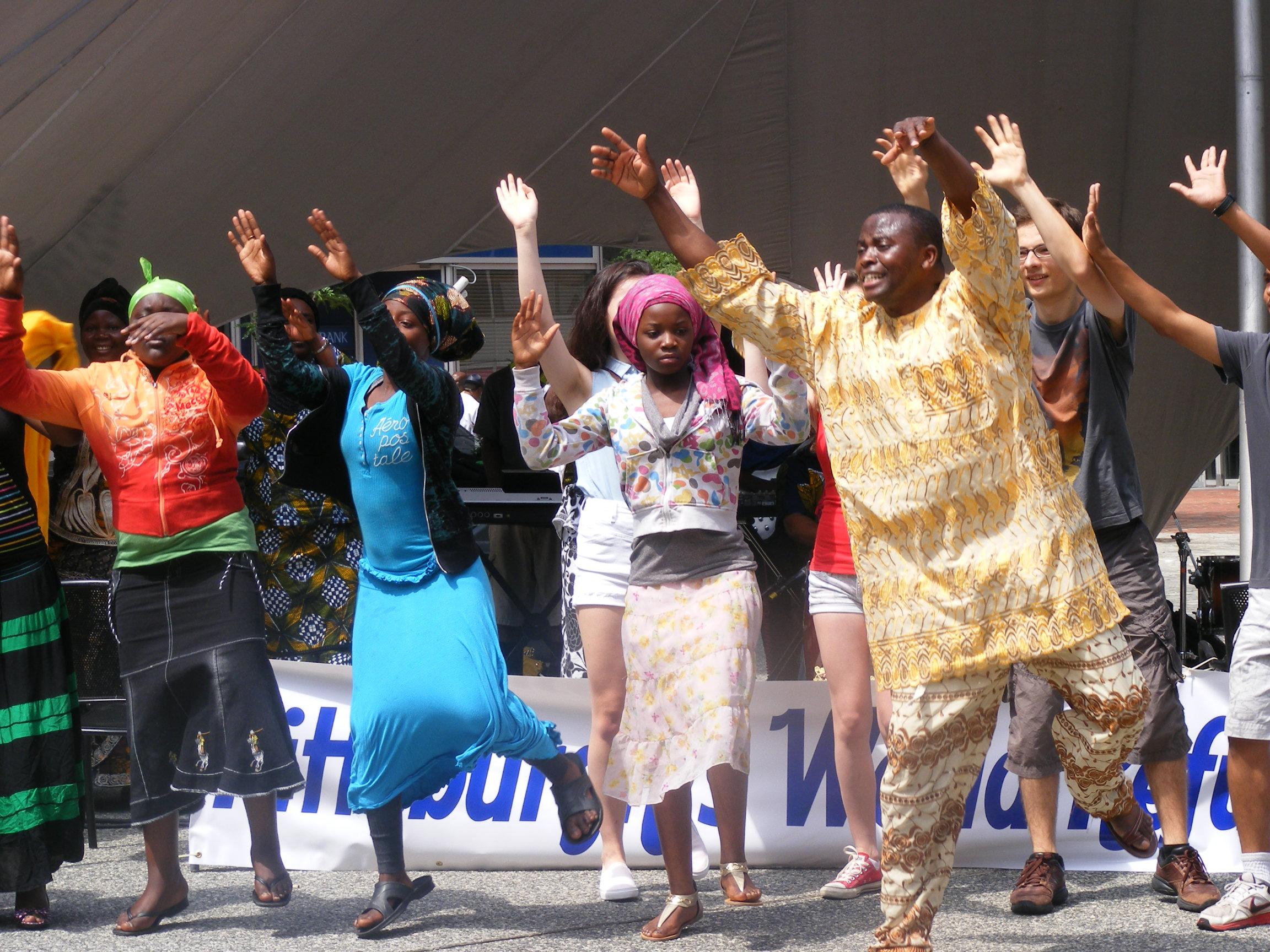
World Refugee Day celebrated in Pittsburgh. https://refugeeresettlementwatch.org/2013/06/25/pittsburgh-world-refugee-day-brought-out-the-diversity-but-few-americans/
Pittsburgh and surrounding communities have reached a “tipping point” and need to plan for a rapidly rising and diverse foreign population, immigration experts tell the Tribune-Review.
“The changes we’re seeing today, which we’ve been seeing for years now and are building, are not merely anecdotal. We’ve reached the tipping point,” said Barbara Murock, manager of the Allegheny County Department of Human Services’ Immigrants and Internationals Initiative.
Murock said that means social welfare agencies, public service nonprofits and religious groups should expand literacy training, career counseling and health care programs for foreign families.
I guess they couldn’t find any local critics willing to speak on the record to a reporter, but they did get Mark Krikorian of the Center for Immigration Studies in Washington to say a few words near the end of the article:
Critics voice concern about how the U.S. refugee resettlement program has morphed over the past decade, arguing that for every success story such as Pittsburgh’s Bhutanese there are others, such as Somali farmers, who struggle in 21st-century urban America.
They want the government to slash refugee quotas.
“The State Department should look at refugee resettlement in the United States as an absolute last resort, not the first. That’s been my problem with the policies. They took the easy way out and sent them here,” said Mark Krikorian, who directs the Washington-based Center for Immigration Studies.
Read it all here. Don’t miss the LIVELY comments (do I detect resistance?).
This is how the State Department rolls. They find a community that by its silence is deemed “welcoming” and then they don’t know when to stop delivering more refugees. I’ll be keeping an eye on Pittsburgh and report back when we see the first real local push-back make the news.
By the way, the reporter never quite explains what happens when the “tipping point”is reached.
We did earlier this year report on refugee mental health problems in Pittsburgh, in addition to the World Refugee Day no-show article last year.
VDARE has an amusing analysis of this news items and Pittsburgh’s plight, here (refugees “enriching” Pittsburgh) yesterday.
The family, which includes 12 children, was living at 515 Union St. when one of the older children called police in May because their electricity had been shut off for days. City housing officials were notified and found “heavy infestations” of roaches and bedbugs, plus noting the house was far too small to accommodate the family, which had grown exponentially since they moved in.
The issue also revived the controversy in the city over managing the influx of Somali refugees since 2003. Mayor Domenic J. Sarno has repeatedly called for a moratorium on new placements, arguing the families tax the city’s housing and school systems and don’t receive the proper long-term supports.
The city condemned the apartment; property manager David Sims was hauled into Springfield Housing Court and the family was temporarily relocated to a hotel shelter in Greenfield. However, lawyers for Sims and the family reached an agreement on Tuesday to move the family to a duplex at 185-187 Northampton Ave., which has been cleared by city inspectors, according to Lisa DeSousa, a lawyer for the city.
Family members Haji Mamo, his wife, Habiba Said and sister-in-law Sitey Said were in court Tuesday, and sorted out the agreement with the help of a Somali interpreter in a closed-door meeting.
The family also filed a demand for nearly $133,000 in monetary claims with the housing court. The complaint contends they should get abatements for rent, nearly $10,000 in “homeless damages,” and treble damages near $83,000 because of the conditions of the Union Street apartment.
Daniel D. Kelly, a lawyer for Sims, denies the allegations in the complaint including that Sims willfully ignored code violations and deliberately impaired the health and well-being of family members.
“It was a combination of problems that came about very quickly.
[….]
Sims said the family was much smaller when he originally rented the apartment to them.
We will be watching what happens with their new house!
Also, for more reading pleasure, we have been following Springfield for several years, click here, for that archive.
Endnote: It’s interesting to watch the“pockets of resistance”grow in cities that were originally “welcoming” and now are becoming overloaded with needy migrants (legal and illegal). It is a matter of numbers—a few migrants needing services kind of go under the radar until a tipping point is reached for the taxpayers. Cases like this one break into the news causing citizens to finally say, ‘whoa!’ what is going on here? But, at that point it is usually too late for the community because the contractors are bringing in the relatives of the first seed population and anyone who complains is immediately labeled a xenophobic, racist, bigoted boob! and the complainers scurry for cover. I don’t know how this will all end.
A representative of his refugee resettlement agency says he was mentally ill and the police handled it wrong. Should have found a translator they say.
This is just one more example of the mental illness we are welcoming to America and the language problems being experienced by police and first responders. See Waterloo, Iowa just last week, here.
SAN DIEGO – Friends of a young man with mental illness, who was killed by police after he threatened his family and police with knives and a stick at his City Heights apartment over the weekend, wondered if police could have handled it differently.
Patrol personnel went to the residence in the 3800 block of Menlo Avenue at 10:20 p.m. Sunday on reports that a man was threatening the lives of his family, according to San Diego police.
Officers arrived to find the man holding a knife and a stick and behaving in an “agitated” manner, Lt. Mike Hastings said. As the officers tried to persuade him to disarm himself, he allegedly began threatening them and retrieved a machete.
Officers tried in vain to subdue the suspect with stun guns and police dogs, Hastings said. When one of the canines approached, the man struck the animal on the back with the machete, according to police.
The suspect then allegedly swung the weapon at an officer, prompting two others to open fire. He suffered multiple gunshot wounds and died at the scene.
The man was identified by friends on a social media website as 21-year-old Burmese refugee from Myanmar named Ja Ma Lo Day. He was oldest brother of four siblings, all Burmese refugees who escaped their country due to religious and ethnic persecution, according to a friend of the family.
He suffered from mental illness and had been involved in several prior encounters with the police, according to the online posting.
How many Burmese are in the US?
Here is one accounting of how many we have resettled over the last 12 years from Burma and camps in Thailand. They are still coming.
*Burmese refugees resettled in the US since 2001: 97,713
*Chin Refugees resettled in the US since 2001: 30,453
*Karen Refugees resettled in the US since 2001: 57,962
*The rest ethnic groups from Burma in the US since 2001: 9297
This last number above would include Burmese Muslims/Rohingya
News of the surge of illegal aliens swamping Texas and being driven and flown to other states, has pushed most of our other “refugee” news to the side, but here is one bit of news from a week ago that must be mentioned.
This is a problem we have written about off and on for seven years—by federal executive order (Clinton) local governments/courts are required to have interpreters available for the myriad languages being spoken by immigrants in their communities, but most can’t afford it.
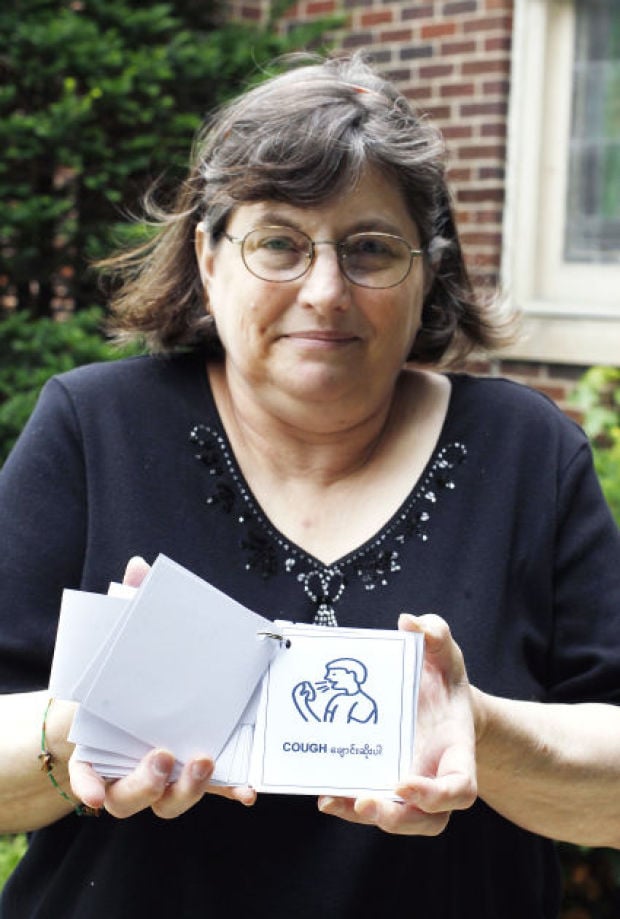
Cough? (Got TB?) COURTNEY COLLINS / Courier Staff Photographer
From WCF Courier (hat tip: ‘pungentpeppers’). By the way, note that here we go again with Catholic Charities and meatpackers needing cheap labor!
WATERLOO | Emergency dispatchers and response teams are struggling with a widening language divide as they attempt to service Waterloo’s growing population of non-English speakers.
The communication barrier creates problems for all parties involved, from the dispatcher deciphering a 911 call to the officer trying to put together an accurate police report to the concerned resident trying to communicate a problem with little to no knowledge of the English language.
Over recent years, Waterloo Police have dealt with a slew of languages including Bosnian, Spanish, Serbian, Croatian, Burmese, French and Vietnamese.
In 2006, Burmese refugees began settling in Waterloo for the employment opportunities at Tyson’s meat plant, and the community has been growing ever since.
Dispatchers at the Black Hawk Consolidated Communications Center receive about a half-dozen calls a day in foreign languages.
But resources for interpretation are slim, a Courier investigation shows.
And as refugees from Burma continue to move to the area at a steady pace, bringing with them five vastly different languages, it has quickly become a complex problem to solve.
Nearly 1,500 Burmese refugees have planted roots in the Waterloo area, according to local estimates. That population is expected to reach 2,000 in the next year. In summer months, about two to four households migrate to the area each week.
Stephen Schmitz, who resettles new refugees through Catholic Charities in Cedar Rapids, estimates that more than half of these incoming refugees are illiterate.
There is more, read it all. Be sure to check out the comments!
I don’t have time to do all the linking but know that BIG MEAT (and its head hunters at the State Department and contractors like Catholic Charities) is responsible for changing the demographics of many small cities in the Mid West and South. It is a win-win for them—cheap captive “illiterate” labor (refugees cannot go home) that you subsidize them (housing, food stamps, education). They get to wear the do-gooder white hat and you pay the price!
How about if the meatpackers, like Tysons, pay for the extra costs to the community—like interpreters!
About the photo: We are not suggesting that the woman in the photo was asking refugees if they have TB, but readers should know that Burmese especially have higher rates of TB than some other refugee groups. See our health issues category for more on TB in the refugee population, but here is one postgenerally making the point.