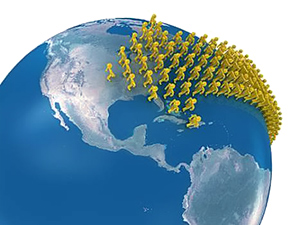
170 Bhutanese resettled in New York City

The New York Times reported this week about the new lives of Bhutanese/Nepalese refugees resettling in the Bronx.   These 170 resettled by the International Rescue Committee are a tiny fraction of the 60,000 the US will be taking over 5 years.

All of the newcomers are Bhutanese of Nepalese ethnicity who had migrated to Bhutan or were descended from immigrants. In the early 1990s, Bhutan expelled tens of thousands of Nepali Bhutanese, most of them from poor farming families, accusing them of immigrating illegally. The majority ended up in seven refugee camps in Nepal, where they lived in bamboo-and-thatch huts and were cared for by international aid agencies.

Bhutan refused to take them back and Nepal refused to give them citizenship. In 2007, the United States agreed to resettle at least 60,000 of them. The first arrived in early 2008.

There isn’t much in this article that we haven’t reported before about how they came to be in the US, but I was interested in this report on their living conditions.  Early in the article the reporter describes a sparsely furnished apartment.

The place was furnished with a couple of bureaus, several beds that doubled as couches and little else.

The federally contracted resettlement agencies sign a contract with the US State Department and commit to supply certain furnishings.  It sounds like these folks may have not gotten everything they were supposed to get—a common complaint.

Then this really attracted my attention.  The landlord of this 60-unit building is somehow connected to the International Rescue Committee.  What is the connection?  Does anyone know?  One of those rumors we are always trying to nail down is that some landlords have ‘insider’ connections with resettlement agencies.

Through an elaborate process involving consultation between resettlement agencies, about 170 Bhutanese refugees have been placed in New York. The families at 2515 University Avenue were brought by the International Rescue Committee, an agency that has a longstanding relationship with the landlord.

Whatever the connection, the building is not without its dangers.

Mr. Tamang said that one day his elderly parents, who speak no English, were alone in their apartment when they heard loud knocking. Opening the door, the father was confronted by several young men. Although he understood none of the words the men were using, he gathered from their angry gestures that they were looking for a missing bicycle and were demanding to search the apartment.

Mr. Tamang said his father, small and mild-mannered, stepped aside to allow the group to enter, but the men eventually went away, leaving the father shaken.

“They were trying to get in,” Mr. Tamang recalled, surprise and pain in his voice. “We are very honest people.” Mr. Tamang said he would no longer leave his parents without one of their English-speaking children.

We recently told you about a Bhutanese young man killed by an African American thug in a dangerous Jacksonville neighborhood where he had been resettled, here.    It appears that another refugee in this Bronx building writes a blog and that Florida murder is one of the stories he has posted for his community here and back home.   Check out ‘Journalism in Exile’ here.

Note to new readers:  To understand why there are problems in the camps in Nepal and why a journalist might be missing there, you can go to this previous post of mine and learn about the politics of those (Maoists!) who do not want the Bhutanese to be scattered across the world.

UN releases budget: plenty for all, especially Palestinian “refugees”

A column by George Russell, executive editor of Fox News, gives a detailed account of the UN budget and explains all the accounting tricks that make it so difficult to know what the UN actually spends. The headline says the budget is $13.9 billion, but the first paragraph says it is $4.9 billion. It takes most of the article to explain all the additions and tricks that get the total from the lower figure to the higher. Let’s just say that UN bureaucrats are experienced and skilled at presenting one thing to the public and another to each other.

Even the $13.9 figure is low:

“It’s easier to work your way through the U.S. budget — which is immensely bigger — than through the U.N. budget,” observes Brett Shaefer, a U.N. expert at the conservative Heritage Foundation, who has just edited a new book on U.N. reform entitled ConUNdrum: The Limits of the United Nations and the Search for Alternatives. “What you see is the U.N. doing a bit of sleight of hand.”

Nor does the sleight of hand end there. Even the $13.9 billion number does not include the cost of some of the U.N.’s biggest and most sprawling organizations, which submit their own budgets to separate panels of U.N. member states, even as their programs increasingly intertwine and overlap.

Here’s the relevant section on refugees:

Among other things, a substantial portion of the extra-budgetary increase, Ban’s report notes, has gone to the Office of the United Nations High Commissioner for Refugees — $282.2 million — and the United Nations Relief and Works Agency for Palestinian Refugees in the Near East (UNWRA) — $186.9 million.

(As it happens, Ban’s initial budget report for 2008-2009 said very similar things, noting that big increases from hikes in extra-budgetary resources went to UNHCR — $423.3 million — and UNWRA — 122.9 million.)

That is simply obscene. There are more than 12 million refugees worldwide. The number of so-called refugees in Gaza and the West Bank number well under 2 million. And the vast majority of these have nothing in common with real refugees. They live in houses in cities and towns in defined territories governed by their own elected governments. Yet the Palestinian’s refugee agency gets two-thirds of what the real refugee agency gets. And the Palestinians get lots and lots of aid from governments as well.

The United States gave $900 million for Palestinian aid in 2009. As far as I can tell (Ann will correct me if I’m wrong), our government spent about  “$809 million for basic life-sustaining support and protection of refugees, conflict victims, and internally displaced persons overseas,” and about the same for refugee resettlement in the U.S.  These numbers are almost as slippery as the UN ones — you can’t really find all the spending, either abroad or at home, because it’s often split among different agencies and budget line items. The point is that the Palestinians receive enormous amounts of aid. And as we’ve reported, much of the aid goes right to Hamas, a terrorist group and America’s declared enemy. 

If the UN and the U.S. shifted their money from the Palestinians to real refugees, many more people would have better lives. See more about UNRWA here, and in other articles in our “Israel and refugees” category.

Addendum, September 19: I want to add a link to a great post by David Horowitz on his great new blog, Newsreal.  It’s called The UN Is a Morally Disgusting Institution and a Global Menace.

EU trying to improve its image on refugee resettlement

Seems the European Union is trying to come up with some refugee scheme that won’t serve as a pull-factor that would only encourage more illegal aliens to try to reach Europe.  Good luck with that!

From the Ottawa Citizen:

BRUSSELS – The EU this week unveils plans to boost and coordinate Europe’s response to the waves of immigrants from Africa and the Middle East, seeking to polish its own international image at the same time.

On Wednesday, the European Commission will get the ball rolling with a recommendation for a “joint EU resettlement programme” under which nations would take in more refugees from poor and war-hit third countries.

This scheme, though voluntary, is aimed at cutting the numbers seeking to reach Europe’s shores aboard rickety boats or via unscrupulous people traffickers.

The EU’s executive arm is also trying to ease the pressure on countries such as Malta, Italy and Spain which are in the frontline of the influx and feel that other member states are not sharing enough of the burden.

Then in October, the commission will publish proposals for harmonizing asylum and family reunion criteria through Europe.

I’ll be watching for that “harmonizing” this fall, won’t you?

Also, according to the story the UNHCR is telling the EU what bad boys and girls they are for only taking 6.7% of the world’s refugees last year.  Funny, I thought we were hearing that wonderful “welcoming” European countries like Sweden were taking the lions share.

The EU wants to improve its humanitarian image.

While the European Union is keen to do its best to help refugee-laden countries plus the immigrants themselves, there is also a feeling that at the moment the bloc has an image problem.

“The current relatively low level of involvement of the EU in the resettlement of refugees impacts negatively on the ambition of the EU to play a prominent role in global humanitarian affairs and hence on the influence of the EU in international fora,” the commission said in the resettlement proposals.

Be sure to use our search function for ‘Malta’ and learn how the US has been adding to the “pull factor” by taking some of Malta’s illegal aliens to the US.

UN and its leftwing media friends continue to badger Japan to diversify

We have written previously about the pressure Japan is under to take more refugees and asylees.  So far, apparently wanting to preserve its unique culture, Japan has resisted.  But, last year under stepped up pressure from the UNHCR (UN High Commissioner for Refugees) and its leftwing media lobbyists, Japan did begin a pilot program of refugee resettlement.   I feel sorry for Japan which apperently hasn’t completely bought into the diversity-is-strength-multiculturalism-uber-alles-no-borders-goal of the Left.

So far, it looks like Japan is only taking Asians. 

However, we had a good laugh back in September 2008 about a Japanese blogger hankering to bring Somalis to Japan, here.

This is the article that prompted me to post again on Japan.  From Japan Today:

It’s easy not to notice them: they blend in anonymously with the rest of the foreign faces here. You could be forgiven for not even realizing they exist at all. But refugees and asylum seekers are very much a reality in Japan — and as their numbers increase, the government is coming under fire for its handling of the issue.

Despite being the third largest donor in the world to the United Nations High Commissioner for Refugees (UNHCR), Japan admits only a tiny number of asylum seekers compared to other industrialized nations, and often appears reluctant to grant refugee status to those who do come. Damning statistics are bandied about, such as the fact that the country has accepted just 508 refugees from the 7,297 applications made since 1982.

The media doesn’t paint a very flattering picture, either. Many will remember the Dogan and Kazankiran families, Kurdish Turks whose unsuccessful battle to be recognized as refugees in Japan was reported extensively in local English-language press and overseas. When two members of the Kazankiran family were summarily deported in January 2005, the UNHCR denounced the move as “against international law,” and the Japanese government received widespread condemnation.

Both families have since been resettled in other countries, but the memory of their struggle has lingered on. So too have criticisms from organizations such as Amnesty International, which reported in May that Japan “continued to deport failed asylum applicants to countries where they faced a risk of torture or other ill-treatment.” Not exactly the most glowing of report cards. But is the reality as bad as the detractors would have us believe?

Japan has only recently begun to feel the impact of the refugee crisis. It didn’t ratify the 1951 U.N. Convention relating to the Status of Refugees until 1981, bowing to international pressure in the wake of the Vietnam War and the flow of refugees — the so-called “boat people” — that resulted from it. It took three years after the fall of Saigon for Japan to accept just 500 people, and ten years before the quota was raised to 11,500.

Although these were significant numbers for a country that had never previously taken in refugees, the government wasn’t ready to open the floodgates yet. Instead of granting individual refugee status to those it accepted, Japan admitted the refugees as a group based on humanitarian grounds. The number of refugees accepted thereafter slowed to a trickle — during the whole of the 1990s, fewer than 50 asylum seekers were granted refugee status.

Read on.

Bhutanese to Canada: clever photo—from mud hut to metropolis

For regular readers of RRW, there isn’t a lot new in the article about large numbers of Bhutanese (ethnic Nepalese) going to Canada and the US (other western countries too), but I specifically wanted you to see the clever photograph at the top of the story published here in the Gorkhatimes (original story from the Globe and Mail).   I don’t know if someone was thinking ahead and set this pair of photos up this way, or are they cleverly photo-shopped?

The family depicted here is going to British Columbia.

Seven Western countries agreed to accept the Bhutanese after years of talks between Bhutan and Nepal ended in stalemate. Most – about 60,000 – will go to the United States. Many of the Kattels’ friends and relatives have plane tickets to places like Dallas, Salt Lake City and Phoenix. Mr. Kattel wishes more of his friends were going to B.C.

In Canada, the Bhutanese are to be settled in nearly 30 communities from Newfoundland to B.C. Eventually, about 900 refugees – including the Kattels – will move to Coquitlam, just outside Vancouver.

It’s a daunting prospect for the suburban community, and for the country as a whole.

Nine hundred Bhutanese are scheduled to go to a suburb of Vancouver—Coquitlam.   I found this paragraph interesting because apparently Canada does what I have recommended we do—hold community meetings well in advance of refugees arrival and line up host families.

In fact, city officials, community groups and residents in Coquitlam have laid out the welcome mat for the refugees from a little-known land. The local school board and the Immigrant Services Society of B.C. have set up a summer camp for the kids to polish their English and learn basic computer skills. Host families have come forward to help the refugees with basic tasks such as shopping and learning transit routes. Community meetings held in the spring to discuss the refugees’ arrival were overflowing.

Here is a webpage from the Canadian government’s Immigration department (Citizenship and Immigration Canada) spelling out very thoroughly what the plans are for Bhutanese going to Canada and a status report on how many have arrived, etc.    I don’t think the US government has any website that is as clear as this one in Canada.

For all of our government readers, please let us know if there is a US government website comparable to this one!  It is your chance to disprove my contention that refugee resettlement is done as secretly as possible here.

For more information on the Bhutanese, please use our search function.