
Come and get it! Free government money for “culturally appropriate” child care

Your tax dollars!

We have a sequester.  The federal government is shortly going to lay off large swaths of its workforce, including the military, yet the Office of Refugee Resettlement (ORR) is still sending out announcements for applications for micro-enterprise grants to non-profits so they can further distribute your tax dollars to refugee ‘entrepreneurs’ who truth-be-told want to get paid to care for their own kids and a few others (of their own kind) in their own homes.  What! they can’t use existing American child care facilities?

Here is the announcement I received last week from ORR (applications are due in May):

Funding Opportunity
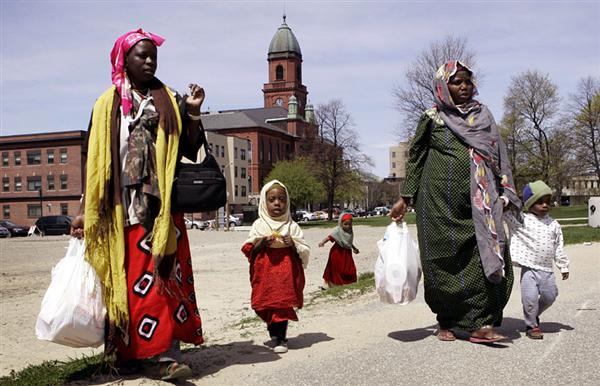
(Lewiston, ME) Candidates for micro-enterprise loans from the federal government—“culturally appropriate” home-based daycare for special groups of people. Photo: AP

Title: Refugee Home-Based Childcare Microenterprise Development Project

Description

The Office of Refugee Resettlement (ORR) within the Administration for Children and Families (ACF) is pleased to announce the availability of funds for Refugee Home-Based Child Care Microenterprise Development Projects. These projects are aimed at assisting primarily refugee women in becoming economically self sufficient by providing home-based child care services. Thus, recipients of grant awards through this announcement will teach refugee women about local, state, and federal child care laws, regulations and licensing requirements and about cultural norms [wouldn’t their kids learn cultural norms more quickly in American-run day care centers?—ed] concerning child care and child care development. Also, they will assist refugee women in English language acquisition, advance educational attainment (GED) and improve economic opportunities through application of acquired job skills in a market where there is a shortage of childcare providers. Through this grant, mentors [non-profit groups–ed] will help primarily refugee women establish agreements or contracts with State or county child care offices so they may qualify for State/county childcare reimbursement as childcare service providers.

Not to be exclusionary, men can get this money too!

Although the focus will be on refugee women, all services provided to refugee women under this project are available to refugee men who are able to benefit from these services.

I told you about this “culturally appropriate” daycare in January, here, when the Office of Refugee Resettlement reported on their ‘success’ with the program, and I said this:

We trained hundreds, paid out millions of dollars and got 79 refugees off public assistance all the while assuring the kids were cared for by appropriate culturally competent caregivers.

It’s not just day care centers we are encouraging.  Micro-enterprise loans flow out of the US treasury and then through a bunch of non-profit groups and fund all sorts of businesses that then compete with existing businesses in an already stressed economy.  Go to the Annual Report to Congress for 2009 (beginning on p. 43) to just get an idea of who is getting these grants from the Office of Refugee Resettlement.  And, could someone direct me to a site where we can learn how many of these “loans” to start a businesses are repaid!

For new readers:  See my previous posts on where we can save millions of dollars by cutting out grants to non-profits involved in setting up refugees as a special class of people, here (refugee unhealthy marriage grants), here (ethnic community based groups that create division), and here (federally funded savings accounts for special people—refugees—but not for you low-income Americans!).

More on those Annual Reports to Congress and ORR breaking the law

Before I get started on my latest foray into the Office of Refugee Resettlement’s flagrant law breaking regarding the Annual Report to Congress, yesterday I told you what people are searching that brings them to RRW, here.

This morning I just want to mention that searches yesterday were dominated by the phrase “Little Baghdad”—that would be El Cajon, California which we have discussed on many previous occasions.  Here is our archive on the refugee-overloaded city of El Cajon.  The most-read post yesterday with over 100 hits is this old post from 2009.

Back to the Annual Reports I spend a lot of time harping about!

Federal law says that the Office of Refugee Resettlement (ORR) must file a report to Congress within three months of the close of the fiscal year.  A fiscal year ends on September 30th of a given year and so the report is due in Congress by January 31st of the following year.  Presently the ORR is THREE YEARS LATE!  They owe Congress 2010, 2011 and 2012.

Earlier this week I told you about the Legislative summary I found at the Library of Congress on the Refugee Resettlement Act of 1980, here.   This is what I found on the Annual Reporting requirement:

Requires the Secretary, not later than the January 31 following the end of each fiscal year beginning with fiscal year 1980, to submit reports to the Senate and House Judiciary Committees containing: (1) a labor profile for refugees who have entered the U.S. since May 1975; (2) a geographic description of refugee location; (3) a summary of the location and status of unaccompanied refugee children; (4) a description of the activities and expenditures of the Office of Refugee Resettlement, States, voluntary agencies, and sponsors; and (5) an evaluation of services provided under this Act. Requires the Secretary, in consultation with the Coordinator, to report to the Congress within one year of enactment of this Act an analysis of: (1) resettlement systems used by other countries; (2) the desirability of using a system other than the welfare system to provide refugee assistance; and (3) alternative resettlement strategies.

Hah!  I wonder if they ever did that last part!

So when did they start breaking the law, thumbing their noses at Congress and not getting these reports done?  That is what I wanted to know.

First, the ORR makes it very hard to find all the annual reports.  Some are available at their website, here.  But the missing ones are housed at the Georgetown Law Library—WHY?

My original plan was to start researching at 1990 and move toward the present time to see when they went off track and began breaking the law.  It didn’t take long—1993!

So, I went back to 1980 and sure enough through the entire Reagan Presidency and the George HW Bush Presidency from 1980 to 1992 those Annual Reports were right on time—submitted to Congress on January 31st of the following year.

But, you know what the little cheaters did beginning with the 1993 report (and continued to do for the next 20 years)—they stopped putting publication dates on them.  Oh, they had FY 1993 on the cover, but no information about when that actually went to Congress—heck it could have been three years late then!

Lavinia Limon headed the ORR in the Clinton Administration and is now a federal contractor who gets grants from ORR. Fox News Latino

So, who was the Director of the ORR during Bill Clinton’s time in office? 

Lavinia Limon who now heads up one of the nine major federal contractors—the US Committee for Refugees and Immigrants—was in charge of getting those reports to Congress.   And, isn’t it funny that her former VP at USCRI is presently the Director of ORR.  There are a lot of revolving doors with this program between those who are handing out federal grants and those receiving them, but that’s a story for another day!

By the way, we have written a bunch of posts on Lavinia Limon over the years.  Here her subcontractor in Waterbury, CT was found to be treating refugees poorly and had come under review by the US State Department and Ms. Limon famously said “whoop-de-do”—we don’t get paid enough to do the job any better.

Incidentally, according to the most recent Form 990 (p.9) available for Ms. Limon’s organization they received 94% of their $35 million plus income from you—the taxpayer.

Only because I was keeping track do I know that the FY2008 report was released two years and 3 months late and the FY2009 report was three years and one month late.  And, as far as I know there hasn’t been a peep from the do-nothing House and Senate Committees responsible for over-seeing the Refugee program over all these 20 years since Clinton’s ORR flagrantly began breaking the law.   I’m guessing the attitude all around is that these are good people doing good work so they don’t have to follow the law!

About the photo and Ms. Limon:  Read all about her here at Fox News Latino.  Also, when you type ‘Lavinia Limon’ into our search function, you get this archive on the dozens of posts in which we have mentioned her.

The Refugee Resettlement Act of 1980, a refresher on its 33rd aniversary!

Every day I get up eager to find more interesting stories about our out-of-control Refugee Resettlement program, and I definitely avoid the nitty-gritty tedious work of digging through documents so that the average American wondering where all these third-worlders are coming from and who is paying for it (mostly you) might be better informed.

Today, I made myself do some digging.

An aside:  Readers you’ve probably noticed that government at all levels thrives on secrecy.  If you’ve ever questioned a local boondoggle project or any sort of government program you know what I mean.  They, government officials at any level, fear that the taxpayer will raise questions and they frankly hide stuff as best they can.   In fact, it is easy to do because the government is a leviathan and they don’t even need to purposely hide stuff, we private citizens just don’t have the time to dig for it.

And, by the way, their ability to hide stuff has been made easier since real investigative reporting is rare.  The mainstream media now appears to be on the side of government rather on the side of the citizens.  So, I’ve learned over the years that the first step in any battle with government is to find their documents—any documents!  It’s actually funny, you may never find a smoking gun, but just having their documents  makes them nervous and is your first step to bring about change.

Today I found something I’ve been wondering about for years—some of the Legislative history of the Refugee Resettlement Act of 1980 (really 1979).   It is here, at the Library of Congress and I can tell this bill summary is filled with all sorts of juicy things you will be hearing more about as time goes on.

Who do we thank for the Refugee Resettlement Act? 

Top honors go to Senator Ted Kennedy and President Jimmy Carter!

The reason we have a Refugee Program—Democrat Party voter recruitment!

I’ve written about this before, but along with Chief Sponsor Ted (don’t bring them to Hyannis) Kennedy we have the following co-sponsors (remember these guys—mostly Dems!):

Sen Biden, Joseph R., Jr. [DE] –
Sen Boschwitz, Rudy [MN] –
Sen Hatfield, Mark O. [OR] –
Sen Javits, Jacob K. [NY] –
Sen Levin, Carl [MI] –
Sen McGovern, George [SD] –
Sen Moynihan, Daniel Patrick [NY] –
Sen Pell, Claiborne [RI] –
Sen Randolph, Jennings [WV] –
Sen Ribicoff, Abraham A. [CT] –
Sen Riegle, Donald W., Jr. [MI] –
Sen Sarbanes, Paul S. [MD] –
Sen Tsongas, Paul E. [MA] –
Sen Williams, Harrison A., Jr. [NJ]

And, I always thought it was funny that Jennings Randolph’s and Bobby Byrd’s West Virginia and Joe Biden’s Delaware resettled only a tiny fraction of the 3 million refugees resettled since 1975!   The top year for resettlement was 1980! with 207,000!  1980 was also the first year we admitted refugees from Africa.

In 1981 we resettled 159,000 and in 1982 it was 97,000.  Reagan must have caught on and we saw a big drop to 62,000 in 1983.

Refugee Council USA (a lobbying group for the contractors):

Since 1975, the U.S. has resettled over 3 million refugees, with annual admissions figures ranging from a high of 207,000 in 1980 to a low of 27,110 in 2002. The average number admitted annually since 1980 is 98,000. [That low year (2002) was because 9/11 happened and they were all scared that a refugee might be a terrorist—that did happen eventually, but not right after 9/11.—ed]

But then get this!

The law specified that the refugee cap for 1980, ’81 and ’82 was set at 50,000 a year unless the President determined there was a great crisis—-did Ronald Reagan actually agree with this?    Although fiscal year 1980’s 207,000 would have been Jimmy Carter’s gift to America (along with having signed the bill into law on March 17th, (St. Pat’s Day) 1980!).

Library of Congress summary, here:

Provides for up to 50,000 annual refugee admissions for fiscal years 1980 through 1982. Authorizes the President to exceed such 50,000 admissions level if, at the beginning of a fiscal year and after appropriate consultation, he determines it to be for humanitarian purposes. Provides that these admissions shall be allocated to groups of special concern to the United States.

Funds were only authorized for those three years as well.  Wonder if they have been just operating ever since without formally reauthorizing the funding?

Endnote:  Ann Coulter reminded the audience at CPAC of Ted Kennedy’s role in changing America with immigration, here, on Saturday.  Readers!  They are changing the people!

We have a “where to find information” category that is chock full and this post will be archived there.

Another suggestion for the sequestration budget cutting ax: IDAs

Your tax dollars!

IDAs—Individual Development Accounts!

What is that?  It’s a fancy name for your tax dollars matching a refugee’s savings.  For every dollar a refugee saves in this program (administered not by a government agency, but laundered through a non-profit), he or she is matched a dollar from the federal treasury.  I am not kidding!

How many times over the years have I heard someone complain—how are these refugees getting cars and such—this is how.  The monies can be used toward purchasing a car, a house, a business or education.

Here is a profile of a refugee eligible for this special deal.  He/she is usually employed (and may earn up to $3000 a month!) and own a house, have one car, and no more than $10,000 in assets, and can sign up for the program.   Nothing like this is available to a low income American citizen that I know of!  Ever heard of it?

$4-5 million could be saved annually if we dumped this discriminatory program!

Like St. Patrick’s never-ending pot of gold, the federal treasury is available for certain special groups of people.

In 2009 (from that finally-released three years late 2009 Annual Report to Congress, p.38) we spent $4.6 million on the program, again by passing your money through an unaccountable non-profit agency.   If we insist on redistributing taxpayers money this way, couldn’t the program go through the state refugee agencies which are at least nominally open to public scrutiny?

By the way, ORR tells us that 8% of participants quit the program—I wonder do they give your money back?

Here then are the resettlement contractors and ethnic community group grants for 2009.  I bet they each get to keep a cut of the pie for their own “administration” of the program.

Continuation grants awarded in FY 2009 to the following programs with cycles that will end on September 29, 2010 are:
•
Lao Family Community Development, Inc., Oakland, CA, $200,000
•
World Relief DuPage, Wheaton, IL, $235,000
•
ISED Ventures, Des Moines, IA, $235,000
•
Jewish Family & Vocational Services, Inc., Louisville, KY, $230,000
•
International Institute of Metropolitan St. Louis, St. Louis, MO, $180,000
•
New York Association for New Americans, New York, NY, $300,000
•
Women’s Opportunities Resource Center, Philadelphia, PA, $235,000
•
Catholic Charities of Tennessee, Nashville, TN, $194,392.

Continuation grants awarded in FY 2009 to the following programs with cycles that will end on September 29, 2012 are:
•
Catholic Charities of Santa Clara County, San Jose, CA, $204,000
•
Western Kentucky Refugee Mutual Assistance Society, Inc., Bowling Green, KY, $150,000
•
Economic and Community Development Institute, Columbus, OH, $230,000
•
Maine Department of Health and Human Services, Augusta, ME, $207,901
•
Catholic Charities, Diocese of Camden, Inc., Camden, NJ, $225,000
•
Diocese of Olympia, Seattle, WA, $205,000
•
ECDC Enterprise Development Group, Arlington, VA, $280,000
•
Mountain States Group, Boise, ID, $201,018
•
United Way, Inc., Los Angeles, CA, $240,000
•
Neighborhood Assets, Spokane, WA, $50,000
•
International Rescue Committee Phoenix, New York, NY, $230,000
•
Alliance for Multicultural Community Service Inc., Houston, TX, $203,500
•
Catholic Charities, Diocese of St. Petersburg, Inc., St. Petersburg, FL, $200,000
•
Cambodian Mutual Assistance Association of Greater Lowell, Inc., Lowell, MA,$192,380

I wonder if the Health and Human Services Inspector General has ever looked into this program?  Does anyone audit these outfits?

Editors note:  This is the third in my series of suggested budget cuts.  Here I suggested we could cut the grants for refugee “healthy marriages,” and here for the little ACORN-like ethnic community based organizations.  Including the IDAs, I’ve now saved the US taxpayers over $13 million!  I wonder what the sequester is going to require ORR to cut overall?

Illinois: Too many refugees, too little money! (Cue the weeping)

They are wailing and rending garments in the land of too many refugees according to this lengthy and very informative article in Medill Reports:

[LOL! After the standard practice of featuring a successful refugee—ed] The Ethiopian association is one of the refugee resettlement agencies in Illinois, which are struggling under a triple burden as the number of refugees steadily climbs: large cuts in federal funding, a greater range of native languages among refugees and the recession.

Illinois has the largest immigrant population in the Midwest as shown here in data collected at the Univ. of Minnesota.  Medill continued:

Tens years of resettlement represented here (23,220). However, according to Silverman’s office in the Illinois Dept. of Human Services, Illinois has resettled 145,000 since 1975.

Illinois has received about 23,220 refugees from 66 countries since 2000, and the flow has steadily increased since 2006, according to data of refugee arrivals in Illinois from the U.S. Office of Refugee Resettlement.

Feds cut our money,while refugee numbers rise!  (They haven’t seen anything yet, wait till the sequester hits Refugee Resettlement!)

Cook, Kane and DuPage counties have unusually large refugee populations, making the state eligible for targeted assistance from the federal resettlement agency, according to Edwin Silverman, chief of the Bureau of Refugee and Immigrant Services at the Illinois Department of Human Services.  [Here is our Ed Silverman archive for the curious reader—ed]

However, in recent years the federal allocation to Illinois has been cut by more than 50 percent, according to official funding data.

“In the year 2000, we received $7.3 million in combined refugee social services and targeted assistance, and in 2012, we received $3.5 million,” Silverman said.

Federal funding to the state has fallen while refugee numbers have increased in Illinois, because they have also increased in other states.

More diversity=more difficulty

In the face of these cuts, resettlement agencies are striving to meet the needs of a greater diversity of refugees.

Over the past decade, the refugee population has become increasingly diverse linguistically, with wide-ranging educational and employment histories, according to a recent report issued by the U.S. Department of State, the U.S. Department of Homeland Security and the U.S. Department of Health and Human Services.

This makes it more challenging for resettlement agencies accustomed to receiving refugees from a limited number of countries.

More refugees=more unemployment  (by the way, readers, they could say “NO!” to the State Department and ask that the numbers be reduced.)

Achievement of self-sufficiency for refugees has also become more difficult in recent years, according to a 2011 research report for Congress by Andorra Bruno, a specialist in immigration policy.

The recession has played a major part, making it difficult for refugees to find employment and become economically self-sufficient.

Oh NO!  The real horror, Silverman says they have to do private fundraising!

“Finding employment is the biggest problem,” said Erku Yimer, the executive director of the Ethiopian association. “Because many of the companies that hire refugees are not hiring anymore.”

The subsidies resettlement agencies provide refugees is the only financial resource for those who can’t find work. The recession means those who are looking for a job rely on these subsidies for a longer period of time than in the past, Silverman said.  [Not exactly true, refugees are accessing welfare at accelerating rates, most of the contractors are putting their charges on the public dole as soon as they can!—ed]

“So in addition to providing resettlement service, the resettlement agencies have had to be in a constant process of fundraising from the private sector, in order to assure that refugees can pay their rent and don’t go homeless,” Silverman said.

Readers when this program first became law in 1980 (thanks to Ted Kennedy, Joe Biden and Jimmy Carter among others) the understanding was that refugees would quickly become self-sufficient and not be part of a permanent underclass.  Also, the program was to be funded through a PUBLIC-PRIVATE partnership.  Over the years the contractors got lazy and became increasingly dependent on the taxpayer to support THEIR charitable desires and the public is now largely on the hook.

If they have to exert themselves and do private fundraising now, too bad!  They should have been doing that all along.  [sounds of wailing!]