Why such a stiff sentence for ‘attempted’ murder of one gang member by another?
From the Minneapolis Star Tribune last week (hat tip: ‘pungentpeppers’):
A St. Paul man was sentenced to 18 years in prison for what a Hennepin County prosecutor called a brazen and unprovoked shooting at a Minneapolis food store last year.
Zakaria Yusuf, 25, was convicted of attempted second-degree murder in June. His sentence was the maximum allowed under the state’s sentencing guidelines. Judge Daniel Moreno said Yusuf continues to be arrogant and to have a complete disregard for other people’s lives.
Judge Daniel Moreno: Yusuf is arrogant and has a complete disregard for human life.
According to the criminal complaint and testimony at the trial, the victim, who is a member of the Somali Outlawz Gang, was standing outside the store at 201 W. Lake St. on Sept. 22, talking with two of his friends. Yusuf, who was known to associate with the St. Pistol Boys gang in St. Paul and Somali gangs in the Cedar-Riverside area, walked up to the group, pulled a gun from his waistband and fired it at the victim, hitting him in the arm.
The victim ran into the store and Yusuf kept firing, hitting him several more times. The victim collapsed and Yusuf fired one more time from the doorway, with the bullet hitting the victim’s arm when he threw it across his head for protection. He was hospitalized at Hennepin County Medical Center and eventually was discharged.
However, the victim refused to cooperate with the prosecution and was placed under court-ordered electronic home monitoring to be sure he would show up at the trial.
Meanwhile in Canada, a research project sought to find out why so many Somali youths in Edmonton were turning up dead, but it looks like the same old excuses—not enough opportunity, struggling with the cultural differences, blah, blah, blah.
Click here for our archive on Somali gang violence in Edmonton. There need to be serious consequences for immigrant criminal gangs, maybe this judge is doing exactly the right thing with this stiff sentence for the arrogant punk.
By the way, as usual I couldn’t find a readily identifiable photo of the convicted Minnesota man, but found this one of someone (a mean looking dude) with the same name from the same city who in 2010 was arrested for beating a “good Samaritan.” Surely they didn’t let that Zakaria Yusuf out that quickly! Or, did they?
And, just think! You raised these ‘youths’ on your dime!
Remember the brouhaha a few weeks ago when it was announced that an upstart refugee resettlement contractor from Manchester, NH was eyeing Dover and surrounding towns as a new resettlement site. We reported on it here. A plan for a public meeting at which the contractor would answer questions was abruptly cancelled when publicity began to swirl.
After ‘pungentpeppers’ spotted this letter (below) we learned that the Dover mayor and council did entertain comments this past week (absent the contractor ORIS) and here is a story on the meeting at Foster’s Daily Democrat. The tone of the meeting sure makes it sound like Dover is not ready to take the migrant spillover from an overloaded Manchester.
Here is a letter to the editor (Here’s what ORIS is not telling Dover) published yesterday at Foster’s. The writer has a unique perspective having been born in Dover and then having lived in the Somali capital of New England—Lewiston, ME. Emphasis below is mine:
This is the photo Newsweek published in 2009 with their Somalis- bring-economic-prosperity-to-Lewiston propaganda. The article was debunked by statistics (published by AP) and by city leaders, but as far as I know Newsweek never corrected its story. https://refugeeresettlementwatch.org/2009/01/21/i-knew-it-newsweek-did-not-tell-the-whole-truth-about-lewiston-somalis/
I have been following with concern the possibility of Congolese “refugees” relocating to the Tri-Cities. I was born and raised in Dover but spent most of my later years in Lewiston, Maine. Having lived through this situation in Lewiston, I believe I am qualified to provide you an honest assessment of what will become of the Tri-Cities if ORIS is successful. Although ORIS canceled the Aug. 13 meeting, do not believe for a moment they have gone away for good. Due to national immigration issues public sentiment is not on their side. When they do return expect them to be tactical in their approach, better prepared, and wield a heavier hand.
Lewiston’s first group of Somali’s arrived in 2000 during the dark of night, thus city officials were not prepared for the onslaught of people who arrived with nothing but the shirts on their backs. The exact number is still unknown, but most estimates are between 1,000 and 2,000. Twelve years later, the number is still unknown but is believed to be around 6,000. The numbers are not known because given their nomadic culture some leave, some come back, some don’t come back, and more tribes continue to arrive.
To believe the number of Congolese ORIS claims would be relocated to your area would be dangerously naïve. What ORIS is not telling you is that number simply represents the first wave. Adding to that is the multiple effect as many will have additional children and grandchildren and your welfare budget will spiral out of control.
The financial burden on a city with about 36,000 residents has been tremendous. State and Federal governments have not and will not pick up refugee related expenses leaving the residents of Lewiston to bear the entire cost and in very many cases at the expense of the working poor, veterans, disabled, and elderly, most who have worked their entire lives in Lewiston. When it comes to social services, expect the refugees to go directly to the head of the line.
If ORIS is successful expect your costs for education to increase much more than proportionately. Many of the positions that will need to be added are positions you do not have. You should plan for additional personnel to teach English as a second language. Lewiston had 50 students enrolled in ESL the year prior to the Somali’s arrival. The year after their arrival the number skyrocketed to 300.
Shortly after the first wave of Somalis arrived the city provided a school in their neighborhood for them to attend. You should be prepared for outrage from parents and children when the Congolese demand their children be allowed to attend other neighborhood schools thus displacing many children who have long attended their “neighborhood” school.
You should plan to increase your police budgets as well as adding additional police in your schools. The Somali and Bantu tribes are a latter day version of the Hatfields and McCoys.There have been numerous physical altercations between the two tribes as well as gang activity. Lewiston Deputy Police Chief James Minkowsky stated “we haven’t seen that it’s been fueled by drugs or alcohol but in some cases they seem to do it for the thrill of it. We’re not seeing the colors or the monikers but it’s still a gang mentality”. Prior to these attacks group robberies were almost unheard of according to police.
Those against refugee relocation should be prepared for broad accusations of being racist.In October of 2002 then Mayor Laurier Raymond wrote a letter to the Somali leaders asking them to hold off bringing more to Lewiston as the city could no longer afford the crippling financial burden. National media quickly picked up on the story labeling him a racist for simply doing what he was elected to do, govern the city.
In closing, reading publications such as The New Yorker and Newsweek would have you believe the influx of refugees has “revived” downtown Lewiston while many locals refer to the downtown area as “Little Mogadishu”. I would highly recommend you take the hour and a half ride up to Lewiston to see for yourselves what will become of your towns if ORIS is successful. A picture is worth a thousand words.
Paul Spellman
Lakewood Ranch, Fla.
We have an extensive archive on Lewiston, ME. Click here for dozens of posts on problems there. One of our top posts of all time at RRW is this 2009 post—Somali migration to Maine…. We also have written many posts on the problems nearby Manchester, NH is having especially as the mayor and other city leaders want to slow the flow to their city now—something that is virtually impossible to do once the refugee seed community has been established. In addition to the natural demographic growth and the secondary migration mentioned by Mr. Spellman above there is the role the contractor plays in resettling the extended family members of the first refugees dropped off—it is called family reunification or chain migration.
Recently the Center for Immigration Studies released a report on Tennessee (we reported on it here) about how immigrant employment was responsible for most of the job growth in that state, and then today I see they have another study out, this time on Florida. Here is how a piece by Ryan Lovelace atNational Review Onlinebegins:
A new report from the Center for Immigration Studies finds that the majority of the net increase in employment among Florida’s working age population since the first quarter of 2000 has gone to legal and illegal immigrants. Florida ranked second in the nation in employment growth among 16 to 65 year olds since the first quarter of 2000, CIS says, but still ranks 34th nationwide in labor-force participation of its native-born population in the same age range.
They need to do a study on North Carolina if they haven’t already!
One of the quasi-government/quasi-religious groups, Church World Service, is busy supplying refugee laborers for North Carolina companies and now they are whining again about cuts in taxpayer dollars that allow them, a non-profit ‘church’ group, to bring in workers to compete with native workers.
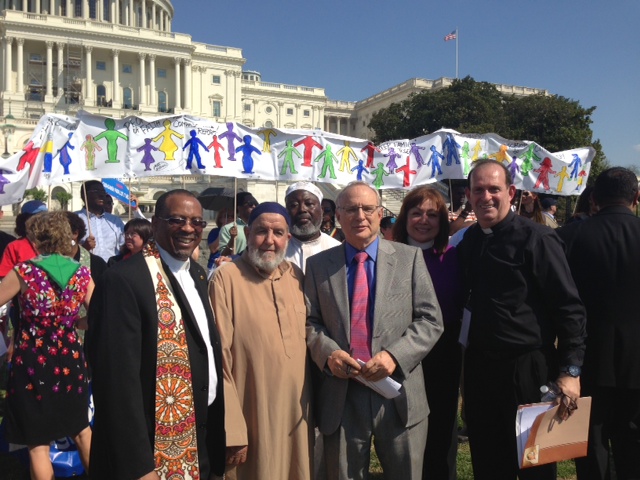
CWS CEO Rev. John McCullough (left with scarf) and other “faith” leaders pushing for amnesty in Washington. http://www.interfaithimmigration.org/2013/04/12/nationally-renowned-faith-leaders-speak-at-a10-time-is-now-immigrants-rights-rally/
Here is the Washington Post helping Church World Service get its cry heard for more money (from the US Treasury’s money tree), in the wake of the unaccompanied minors’ border invasion:
“We measure our success as a company by the number of rice cookers we have,” Lindsay Hancock, Creative Snacks’ director of business administration, says only half-jokingly. The company has four now.
All 30 full-time employees on the plant floor are refugees. Many came through the Church World Service resettlement agency and its Greensboro employment training program. But that program’s future remains uncertain because, in the world of immigration and refugee policy, it turns out that the Mexican border and all its politics can run right through a North Carolina snack plant full of refugees.
File this under unintended consequences: The U.S. Department of Health and Human Services’ Office of Refugee Resettlement allocates funds to programs for refugees and unaccompanied alien children. Earlier this year, when the number of children fleeing Central America and Mexico for the United States started skyrocketing, the office reallocated more money to help address a mounting crisis at the border. That money — $94 million — came directly out of refugee programs and services. Taking the hit were grants that help refugees with employment, preventative health services and adaption to America and its school system.
Don’t make us choose between refugees and illegal immigrants! WE want money for everybody (our salaries too)!
For state refugee coordinators and immigration advocates, the crisis at the border has meant walking a tightrope: Do not make refugees bear the cost of Congress’s refusal to provide more funding. Do not pit refugees against immigrant children. Do not make us choose one or the other.
State refugee coordinators have been scrambling to figure out how to avoid layoffs and keep their health-care, educational and employment services intact.
Then this (below) is what jumped out at me! “Creative Snacks” DEPENDS on Church World Service to supply it with workers and the owners have NO REAL ANSWER AS TO WHY THEY DON’T HIRE AMERICANS.
I have a few theories and one is that there are tax breaks of some sort for the employers when they hire refugees and what the refugees can’t afford through their salaries comes to them via various social services and training supplied by you! (There are even special savings plans for refugees for such things as cars, homes and education where the government matches their savings.) So, the company can keep salaries low—you take care of everything else. And, most importantly, refugees are basically trapped employees with nowhere else to go.
The WaPo continues (We want to know why is this the responsibility of the US taxpayer?):
“We depend upon Church World Service to help us find people,” Hancock says. “The loss of funding would have an immediate impact on our business.”
Yes, Hancock says, the company could hire the native-born, but Creative Snacks’ owners, Marius and Hilary Andersen, are committed to providing opportunities to refugees, who, by definition, have been wrenched from their homelands and who, in that loss, must place their faith in a new country. [So, they have been wrenched by the UN and Church World Service from their homeland, what does that have to do with answering the question about why the Andersens don’t hire native North Carolinians?—ed]
CWS isn’t as bad as some of their fellow contractors*** in terms of the percentage of federal dollars they gobble up in any given year (most contractors are up in the 90% range). Their 2013 Form 990 says they took in $74,101,599 and that $43,999,257 came from you as government grants. That’s about 59.3 %.
Doing well by doing good!
Their CEO, Rev. John McCullough makes a cool $285,830 in salary from CWS (and related activities). Five other employees are in the 6-figure salary range. Maybe if the shortfall continues they could cut those salaries down a bit and help the refugees more. (just saying!)
You should know that CWS lobbied for so-called Comprehensive Immigration Reform which we all know helped inspire the border surge.
Maybe you’ve seen this news, it all happened earlier this summer.
Just last Friday, we gave you an update from Syracuse where another Catholic Church became a mosque and it makes me wonder—in how many cities is this happening?
Former St. Johns Catholic Church with crosses now removed.
On Saturday, July 12, I sat down to talk with Feisal Elmi, a representative of the Darul Uloom Islamic Center, the new owner of the buildings on East 5th Street previously occupied by St. John’s Catholic Church and school.
As a former Catholic, I didn’t know much about Islam, so Feisal began with the basics.
After the basics of Islam are discussed:
The center’s goal is to be a catalyst for the growth of small business in the community, and its leaders see East 7th Street as a prime location for Somali stores and restaurants, akin to the Karmel Mall in South Minneapolis.
Somali refugees are still arriving from that war-torn country. Feisal told me that the first wave of Somali immigrants to Minnesota were refugees, but tended to be from the wealthier strata of Somali society, while the most recent ones are in more desperate circumstances. A couple of generations ago, many of them were Ethiopians who fled to Somalia; now, they are seeking to escape the strife in Somalia. The former rectory at St. John’s is housing some of these new arrivals, and the center will provide assistance in finding them permanent housing***. As with many mass inflows of refugees, they are sponsored by religious agencies (in this case, Lutheran Social Services), and must qualify for refugee status under federal law.
[….]
An Islamic center is something new in our neighborhood, but it wasn’t all that long ago that the St. John’s campus was the religious home of newly-arrived Irish immigrants, and Sacred Heart Catholic Church that of the German Catholics. If there’s one constant about the East Side, it’s that it’s always changing.
***It sounds like this Somali Center has become a refugee subcontractor, if the reporter has this right.
How did we get so many Somalis in Minnesota?—thank Catholic Charities, Lutheran Social Services and World Relief Minnesota (Evangelicals). Read all about itat one of our most read posts (from 2011).
We told you about Dawari, an Afghan “convenience store clerk” who is also supposed to be a doctor, arrested on immigration fraud charges here a couple of days ago. Now we learn that Dawari may have been passing coded messages glued in religious books from a terrorist group which he allegedly then sent on to others.
I’ve looked around at several reports on the case and can’t find a photo of Dawari (if someone does, please send it and I’ll insert it), and I have found no mention of how he got into the US in 2008—he very well could have been a refugee (or a successful asylum seeker) in order to now be ready for citizenship so quickly.
The feds really should check EBT records for his convenience store to see if there is any sign of trafficking in food stamps that might have yielded a windfall for a foreign terrorist group.
Asst. US Attorney Williams: the note appears to direct some urgent action.
From Philly.com yesterday (hat tip: ‘pungentpeppers’):
A 62-year-old Afghan doctor detained in Philadelphia this week on immigration fraud charges received and passed along coded messages from an anti-Western terror group with ties to al-Qaeda, federal prosecutors said.
At a court hearing Friday, Assistant U.S. Attorney Jennifer Arbittier Williams said FBI agents discovered the documents written in Pashto and hidden between glued pages of religious tracts mailed to Hayatullah Dawari’s Northeast Philadelphia home.
The package, intercepted during a January raid, came from Pakistan and included instructions to forward several books inside to various people across the United States.
A later search uncovered a coded message similar to that found in Dawari’s possession at the home of another associate in Philadelphia.
“The note, when translated from Pashto to English, appears to contain a message directing some urgent action,” Williams said.
[…..]
Dawari, his lawyer said Friday, worked as a doctor in his home country – cooperating with American Red Cross efforts as part of American military operations in Afghanistan – before moving to Philadelphia in 2008 [Could he have gotten into the US on a Special Immigrant Visa for those who helped the US in Afghanistan?—ed]. Since his arrival here, Dawari has become an active member of his mosque and a legal permanent resident, and was seeking citizenship to cement his life in America, Tinari said.
Though he recently became disabled, he worked for years as a convenience store clerk.