Milwaukee attracting more Somali refugees, Catholic Charities helps!

The Milwaukee Journal Sentinel has publish a feel-good story about how successfully Somali Bantus are settling in to Wisconsin.  You can read the opening yourself about one boy who becomes the first Somali in Wisconsin to go to college.  We are told that he changed his last name from Mursal to Mohamad.

The article follows with some nuggets of information on the program with a reference to Catholic Charities role in the resettlement.

According to the state’s Department of Children and Families, the first wave of Somali refugees began arriving in 1995. Since then the federal government has resettled approximately 700 Somali in Wisconsin, primarily in Brown, Barron, Dane and Milwaukee counties.

The largest population — about 400 people —lives in Milwaukee, said Joe Scialfa, communications director for DCF.

But Ussuf Mursal, Mohamad’s brother, who works at Catholic Social Services refugee program, thinks the actual number is considerably larger. He estimates as many as 1,300 Somalis are now living here.

There are about 250 families, he said, and most families have five or more children. For example, he said, he now has six children and his ex-wife has 11 children, including two of his. [I’m wondering if the ex-wife is an ex so that she can receive welfare benefits as a single mother?—ed]

With such large families, providing the necessary support is a strain, he said. And because so many Somali Bantu did not go to school, passing the U.S. citizenship test presents a problem. Still, many are getting established, buying homes and starting businesses.

Another Somali is quoted:

“We came here for security, education and a better life,” he said. He has 13 children, some grown, some who attend Riverside High School or Milwaukee Area Technical College.

And, he supports them all at his newly acquired halal grocery store.

Go here for more on Catholic Charities and refugees in Milwaukee.  Lutheran Social Services is their main competitor for contracts with the US State Department to bring refugees to this part of Wisconsin.

Graphic is from the Journal-Sentinel story.

Maine: Rule change could reduce welfare for some immigrants

Update December 29th:  Be sure to see Daniel Greenfield’s article on Somalis and welfare in Maine at Frontpage magazine.

In 2009 we wrote a post which has become one of our most-visited posts at RRW (Tenth most visited with 9,088 views).  It is entitled, ‘Somali Migration to Maine: it’s the welfare magnet, stupid.’   I’ve wondered since then what Maine was doing with its giveaways that made it so attractive.  This article in ‘The Portland Daily Sun’ gives us some hint.

The Maine Department of Health and Human Services is proposing a rule change to bring Maine’s welfare program in line with federal guidelines that require 5 years of residency before a legal immigrant (non-citizen) can access the program and of course a legal outfit is challenging the proposed rule. (Refugees get welfare right away, see our ‘fact sheet’ for more on how that works).

The Portland Daily Sun (emphasis mine):

A legal advocacy group has warned city and state officials that a proposed rule change at the Department of Health and Human Services could cut off benefits to members of Maine’s immigrant population.

Robin Merrill, a senior policy analyst with Maine Equal Justice Partners, met with members of the Portland City Council and the legislative delegation on Monday and talked about a proposed rule change that could cause some members of the immigrant community to lose general assistance.

“This would be devastating for Portland and for Lewiston,” Merrill said.

The rule being proposed by DHHS would block anyone from receiving general assistance if they do not qualify for federal assistance, like Temporary Assistance for Needy Families and the Maine Food Supplement program, because of citizenship status.

The rule change was proposed to align Maine’s public assistance programs with federal ones, according to DHHS, and the federal government does not provide coverage for legal non-citizens until five years after their arrival. The state will no longer fund general assistance for that population, DHHS said, though municipalities may still use their portion to assist them.  [Newly resettled refugees get all the available federal government programs right away—ed]

DHHS will hold a public hearing on the rule change on Jan. 10 at its Augusta office, and written public comment will be accepted until Jan. 24.

Here is the website for the Maine DHHS.  I did a quick search and didn’t find a reference to this meeting, but if you are a Mainer, and wish to comment, call them!

Related story:  Earlier this month Gov. Paul LePage charged that there is extensive welfare fraud going on in Maine, and here a women’s group criticizes the governor for saying such a dreadful thing about poor innocent people in Maine.   Just for fun I typed the words ‘Maine fraud’ into our search function and up popped pages of posts with Maine fraud stories—food stamp, medicaid, housing, etc.

Burmese refugee: All I want for Christmas is my HIV/AIDS drugs

My alerts are filled with news of charitable groups giving Christmas parties and other gift-giving events for the ‘holiday’ season.  I’m fully convinced that we have no more poor Americans remaining.  When I grew up it was all about Appalachia.  But, I guess those folks have moved on up.  Or, as fans of Nascar and Duck Dynasty, they aren’t so attractive to the do-gooder crowd.

This article from Tulsa, Oklahoma says the 5,000 Burmese who have arrived there since 2007 are living “on the fringe” which makes me wonder how we keep hearing that 80% (or more) of refugees have become self-sufficient within their first year in America.

Here is the news from Austin, Texas about the needy Aung Min family.  Hat tip: Joanne.

They want a another baby and they need to keep Dad free of HIV/AIDS long enough to conceive one!

Uka has to stay HIV-negative long enough to conceive a sibling for Okee. Nice shoes!
Photo:Ralph Barrera The Statesman

Uka Aung Min spent two days resting on the floorboards of a car, trying to be invisible. He would take little sips of water and eat only a little bit after dark. As a student protester, he was no longer safe in Burma.

The car took him from Burma, also known as Myanmar, to Thailand and then Malaysia, where he would spend 11 years in a refugee camp. There, he met his wife, Naw.

Now this makes no sense.  Because he was HIV-positive he was allowed to come to the US, but the pregnant wife was left behind?  And, if refugees are becoming self-sufficient, how on earth did he wander homeless from Alaska*** to Texas.   Was no one, no contractor, monitoring his care and his meds?  Wasn’t the whole reason he was given a ticket to America was to get his HIV drugs?  Does no curious reporter wonder how this is possible?

After Naw became pregnant with daughter Okee, Uka Aung Min, 32, learned he was HIV-positive. With no medicine available to him in the refugee camp, he was allowed to become a refugee to the United States.

First he settled in Alaska, and then he came to Austin. At times he was homeless, but eventually he was able to move his family here and meet Okee, who is now 2, for the first time.

Goodies are flowing in, but they need money for HIV/AIDS medicine! (For rent, utilities, internet etc. as well!)  Didn’t we learn that the whole reason Uka Aung Min got into the US was so he would be treated for AIDS?

Since being featured in the Statesman (Season for caring) program, the Aung Mins have received a couch and love seat, beds from Factory Mattress, dental care from Aloha Dental, an iPad and bookshelves.

They still have a lot of needs: rent and utilities assistance; a car; day care for Okee to enable Naw, 36, to attend English language classes in January; Internet service; dressers; dining room furniture; and a toy box. They also would love help paying for medicines to keep Naw HIV-negative while conceiving a brother or sister for Okee. Gift cards for clothing, groceries and gas would be appreciated. Okee loves to draw, and they would like to give her crayons and paper.  [Crayons and paper have got to be cheaper than those high-heeled shoes for a two-year-old!—ed]

So where was Catholic Social Services of Alaska when it came to monitoring Uka?

***I wondered who might be responsible for letting Uka Aung Min wander America and become homeless without AIDS drugs and it sure looks like it was Catholic Social Services of Alaska.  LOL!  They claim to have a self-sufficiency rate of 79%.  Was Uka’s AIDS so bad he couldn’t work? Is he working now?

The resettlement contractors will be quick to tell you that this is America and people are allowed to move without checking in with anyone, however, this story just reminds us that there are refugees with communicable diseases (like HIV/AIDS and TB) who are moving around with no one monitoring whether they are staying on their meds!

For more on refugee health issues, check out our category here with its 186 previous posts on the problems!

More diversity is beautiful in Lewiston, ME

Sudanese refugee Deng Mirac attempted to kill his wife with a kitchen knife, and remains behind bars until trial. Photo Russ Dillingham/Sun Journal

Here is another gift to Maine, most likely thanks to Catholic Charities which is still, I believe, the top resettlement contractor in that state (they say on their website that they are the only federal contractor in Maine).

From the Lewiston/Auburn Sun-Journal:

AUBURN — A judge sided with prosecutors Thursday in an attempted murder case, saying DNA evidence collected from the defendant shortly after his arrest was legal even though police hadn’t executed a search warrant.

Sudanese refugee Deng Mirac, 42, of 158 Blake St. in Lewiston was in Androscoggin County Superior Court for a hearing on his motion to suppress evidence. He was assisted by an interpreter.

He is accused of stabbing his estranged wife, Adut Adong, 34, in the face and abdomen with a kitchen knife in the driveway of her Blake Street apartment in Lewiston in April.

Mirac’s attorney, Nicholas Worden, argued that police should have secured a search warrant before collecting samples of a reddish-brown substance that appeared to be blood on Mirac’s hands and the black leather jacket he was wearing. He said there was no risk of his client destroying or hiding evidence because he was in police custody in an interview room at the police station in Lewiston with his hands cuffed behind his back.

Worden said those circumstances gave police enough time to seek a warrant before taking swabs of DNA from Mirac’s hands and jacket. His Fourth Amendment rights were violated, Worden said.

Justice MaryGay Kennedy disagreed with Worden and denied his motion.

For our many many posts on “welcoming” Lewiston, click here.  One of our most popular posts of all time is this 2009 post about Catholic Charities and Maine as the welfare magnet.

Arizona: So where is the wine bar/cafe to benefit poor Americans?

Catholic Charities Community Services of Arizona has launched a new enterprise to benefit refugees surely using mostly taxpayer dollars.  From their latest Form 990, here (page 9), we learned that of the $26 million they took in that recent year, $23 million is from taxpayer funds.

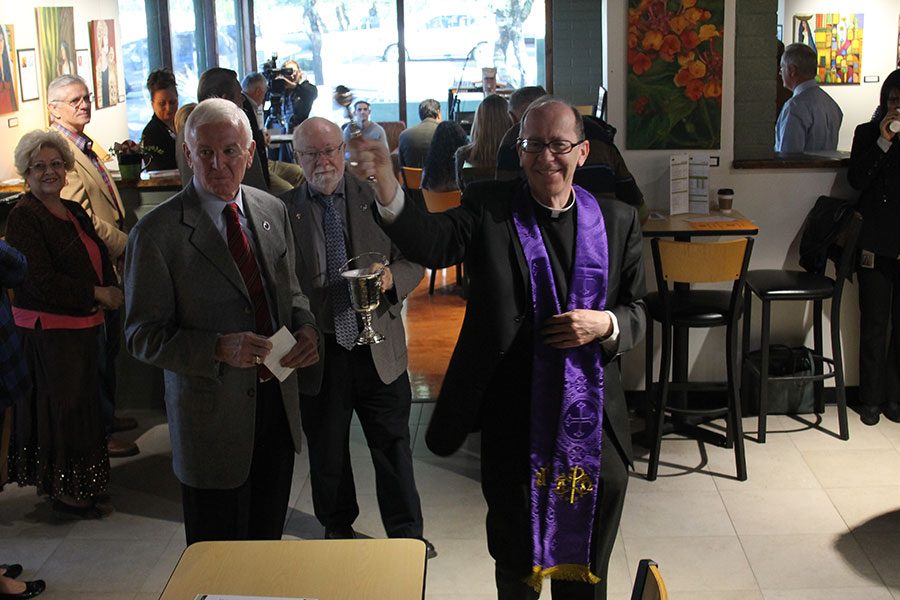
Bishop Thomas J. Olmsted blessing the Refugee Cafe.

Call me a cynic!  But, why are they in the “business” of setting up wine bars and cafes, and why do they find the world’s downtrodden of more interest than the local downtrodden?  That last is what I don’t get?   Why is the “other” more attractive (cool!) to them?  Or, perhaps this is just clever marketing for Catholic Inc.?

From the Catholic Sun (hat tip: Joanne):

A new coffee shop and wine bar has commuters and residents in the Camelback Corridor investing in more than a little “R and R.” They’re supporting the livelihood of local refugee families.

Bishop Thomas J. Olmsted blessed The Refuge AZ, a new coffee shop and wine bar Dec. 5 as part of a grand opening and “coffee cake cutting” event. It opened this fall as a social enterprise effort of Catholic Charities Community Services.

The café, 4727 N. 7th Ave., sits just south of Catholic Charities and has already provided supplemental support to 20 refugee families in its first seven weeks of business. Local refugee families that are also Catholic Charities clients benefit from food and beverage sales including Café Esperanza, a private label blend that customers can bring home.

I bet there are some “long periods of suffering” right there in Arizona!

Bishop Olmsted called The Refuge a great project and looks forward to coming back. He commented on the many refugees who come from far away, especially the Middle East after long periods of suffering.

“We have the privilege and the honor of receiving them and loving them in this place,” the bishop said. “Refugees need to be able to make a livelihood for themselves.”

They have a vice president of business development at Catholic Charities?  Are they using taxpayer dollars to out-compete a private business of this kind with refugees as the drawing card?

Steve Capobres, vice president of business development for Catholic Charities, said it was important to give refugees a venue to showcase their artistic and musical talents. As ambassadors welcoming nearly 1,000 refugees a year to the community, he said new outreach through the café is the least Catholic Charities can do.

I’ll bet a million bucks that if they weren’t being funded by you, and had to use private charitable gifts, there would be no cool refugee cafe.