It seems like an eternity ago that the Trump Administration, via an Executive Order, sought to give local governments and governors a say in whether their county/state would be open to refugee placement during a small portion of the present fiscal year.
In January a court in Maryland halted the President’s plan when refugee contractors filed a lawsuit challenging the reform effort and subsequently the Justice Department appealed the ruling.
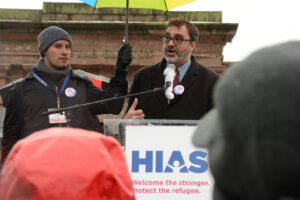
Mark Hetfield, President and CEO of HIAS, here at an anti-Trump rally in NYC in 2017. HIAS sued to stop the President’s Executive order that would have given local governments a voice in resettlement decisions.
Now comes news that 19 states are asserting via an amicus brief that they don’t want local governments (or governors) to have any say and indeed assert that refugee resettlement is the right and responsibility of the federal government.
In effect they are saying that the UN, the US State Department, the Office of Refugee Resettlement, and nine federal contractors know what is best for your county!
This is some of the press releasefrom California Attorney General Xavier Becerra a week ago. The title is a joke because in supporting the resettlement contractors’ lawsuit they are agreeing to have no states rights when it comes to refugee resettlement decisions.
Attorney General Becerra Blasts Federal Overreach, Continues Fight to Protect Refugee and State Rights
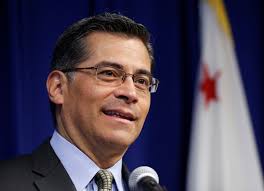
California Attorney General Xavier Becerra
SACRAMENTO – California Attorney General Xavier Becerra, Illinois Attorney General Kwame Raoul, and Maryland Attorney General Brian Frosh today co-led a coalition of 19 attorneys general in an amicus brief filed in the Fourth Circuit Court of Appeals in support of a lawsuit challenging President Trump’s unlawful executive order on refugee resettlement.
The executive order seeks to upend the existing process by requiring written consent from state and local authorities before being able to place refugees in their jurisdictions.
One of three primary opponents of the President’s efforts to reform the refugee program: Maryland Attorney General Brian Frosh
Following a multistate amicus brief at the district court level, the U.S. Department of State was blocked from implementing the executive order while litigation is ongoing.
In this latest amicus following the Trump Administration’s decision to appeal the preliminary injunction issued in HIAS, Inc. v. Trump, the coalition again asserts that the executive order violates the Refugee Act of 1980, undermines family reunification efforts, and disrupts the states’ ability to deliver essential resources that help refugees contribute to the communities that welcome them.
“Our nation is already reeling from an unprecedented economic and public health crisis,” said Attorney General Becerra.“ Now is not the time for the federal government to throw a wrench into a system that helps bring billions of dollars to communities across the country. Standing up for refugees who are lawfully admitted to this country isn’t just right, it’s the smart thing to do. Despite what President Trump might say, refugees are welcome here in California.”
What the heck! The refugee program costs federal and state taxpayers billions of dollars. They are such liars and no one ever calls them on it. The comment about family reunification is a lie too—the order specifically says families can be reunited.
So here are the 19 states that ‘welcome’ any and all refugees that the feds and their contractors want to send them!
In submitting the amicus brief, Attorney General Becerra is joined by the attorneys general of Illinois, Maryland, Colorado, Connecticut, Delaware, Maine, Massachusetts, Michigan, Minnesota, New Jersey, New Mexico, New York, Oregon, Pennsylvania, Rhode Island, Vermont, Virginia, and Washington.
We are only a few months away from the November Presidential election and if the Democrat candidate wins, it will be all over on the issue of refugees. Biden has already signaled that he will start with 125,000 a year if he wins the White House.
125,000 divided by 19 = 6,578 for each of the welcoming states and then leave the rest of America alone!
Now, we are told, the reason so few cases have been reported at the world’s supposedly largest refugee camp in Bangladesh is that the residents fear they will be isolated if found to be infected and are therefore refusing testing.
I know this is likely boring for most of you, but since I started following the warnings of “catastrophe” and “carnage” as the Chinese Virus spread “like wildfire” to camps where “vulnerable” migrants live in close proximity to each other, I’m compelled to give you updates.
Literally for months there have been dire predictions of the impending crisis, that has not yet materialized.
Only one death of an old man so far as I said hereon Wednesday.
Fear stops Rohingya getting tested as virus hits refugee camps
BANGKOK/DHAKA (Reuters) – Rohingya refugees in Bangladesh with symptoms of the novel coronavirus are not coming forward to get tested because they fear being separated from their families and held in isolation, community leaders and aid workers say.
Only one death from the coronavirus has been recorded in the crowded camps in southeast Bangladesh, where some 730,000 Muslim Rohingya fled in 2017 to escape a military crackdown in Buddhist-majority Myanmar.
Yale Economics Professor Ahmed Mushfiq Mobarak visited the camp and told Reuters he is sure the disease prevalence is much higher than testing so far indicates. https://faculty.som.yale.edu/mushfiqmobarak/
But aid workers fear the coronavirus may be spreading faster through the world’s largest refugee settlement than the 29 cases confirmed since mid-May would indicate.Only 339 tests have been carried out in the camps, officials said, partly because people were simply not going to health facilities to get checked.
“Camp hospitals are emptyand illegal doctors’ shops are full,” said 23-year-old refugee Mujef Khan, a community organiser, referring to pharmacies in the camps run by refugees where people buy pills to treat themselves.
“Many people are getting sick day by day – in every shelter,” he said.
Three Rohingya leaders interviewed by Reuters said coronavirus symptoms were prevalent in the camps that sprawl out over hills near the border with Myanmar.
The camps are more densely populated than the most crowded cities and sanitation is poor and social distancing impossible. [This will be the ultimate test in my opinion of whether social distancing matters or not!—ed]
While new testing facilities and treatment centres are being built, a surge in cases couldoverwhelm the camps, aid workers said.
I guess if they aren’t bothering to be tested, they aren’t that sick. However, they won’t be able to hide the deaths and so we will then get a better indication if the “tinderbox” has exploded as the media has been predicting literally for months!
I have been writing about the Rohingya for nearly 13 years. You need to know they are being resettled in the United States right now. See my Rohingya Reports categoryto learn more about this Muslim ethnic group.
Evidence that the great American melting pot is a myth was in evidence everywhere this past dreadful week, but no where quite so clearly as Lake Street, Minneapolis—America’s “landmark street of diversity.”
In a few weeks, on July 1, Refugee Resettlement Watchwill celebrate its 13th anniversary.
During that summer of 2007, when many people in my rural county wanted to understand how we had been ‘chosen’ as a new refugee resettlement site, a story at City Journal caught my eye and for years it was linked on the header of the old RRW(prior to the speech police killing the old site).
Until that summer and fall of 2007, I am sorry to say, I hadn’t given any of this much thought.
Now, I think this is a good time to remind people of the research published that year by Harvard researcher, Robert Putnam, who by all accounts feared the release of his study which had concluded that, despite assurances by the Leftwing promoters of ever-more immigration that diversity brings strength, it does not!
Here is a bit of John Leo’s report at City Journal from June 2007:
Bowling With Our Own
Robert Putnam’s sobering new diversity research scares its author.
Robert Putnam
Harvard political scientist Robert Putnam, author of Bowling Alone, is very nervous about releasing his new research, and understandably so.
His five-year study shows that immigration and ethnic diversity have a devastating short- and medium-term influence on the social capital, fabric of associations, trust, and neighborliness that create and sustain communities.
He fears that his work on the surprisingly negative effects of diversity will become part of the immigration debate, even though he finds that in the long run, people do forge new communities and new ties.
What we are seeing in places like Minneapolis, the multiculti capital of Minnesota, might suggest that Putnam was expressing some wishful thinking when he predicted that new (mixed) communities would forge.
How many decades is that supposed to take I want to know! And, will America survive until then?
Putnam’s study reveals that immigration and diversity not only reduce social capital between ethnic groups, but also within the groups themselves. Trust, even for members of one’s own race, is lower, altruism and community cooperation rarer, friendships fewer.
The problem isn’t ethnic conflict or troubled racial relations, but withdrawal and isolation. Putnam writes: “In colloquial language, people living in ethnically diverse settings appear to ‘hunker down’—that is, to pull in like a turtle.” [Seems to me that troubled race relations are evident!—ed]
In the 41 sites Putnam studied in the U.S., he found that the more diverse the neighborhood, the less residents trust neighbors. This proved true in communities large and small, from big cities like Los Angeles, Chicago, Houston, and Boston to tiny Yakima, Washington, rural South Dakota, and the mountains of West Virginia. In diverse San Francisco and Los Angeles, about 30 percent of people say that they trust neighbors a lot. In ethnically homogeneous communities in the Dakotas, the figure is 70 percent to 80 percent.
Diversity does not produce “bad race relations,” Putnam says.
Putnam was wrong about that as we see in Minneapolis and other recently destroyed cities. The rioters (mostly blacks or antifa thugs) showed little or no concern for the minority shop owners as they raged at the white man.
“Give pause to those on the left”—what a joke!
Though Putnam is wary of what right-wing politicians might do with his findings, the data might give pause to those on the left, and in the center as well. If he’s right, heavy immigration will inflict social deterioration for decades to come, harming immigrants as well as the native-born.
Putnam is hopeful that eventually America will forge a new solidarity based on a “new, broader sense of we.” The problem is how to do that in an era of multiculturalism and disdain for assimilation.
More evidence from Lake Street that race relations there are not going smoothly….
Tuo Thao
One of the police officers fired and now arrested in the killing of George Floyd is clearly a minority hire for the Minneapolis police—a man from the large Hmong ethnic group that was “plopped” down in Minnesota (in a poor black neighborhood) in the wake of the Vietnam war.
If it weren’t for the fact that Tou Thao was arrested, we wouldn’t know that tensions were running high between the black and Asian members of the ‘community.’
It is another theme that the Left loves to perpetuate—that those who have supposedly been oppressed will band together and support each other—but has again shown to be a lie.
His involvement in Floyd’s death will only exacerbate already existing tensions.
The debate over Thao’s real or perceived complicity as another man of color is killed has arrived in a community that has always had underlying tensions with its black neighbors.
This goes back to the 1970s, when the Hmong arrived as refugees and were “plopped into the most affordable parts of town,” says Bo Thao-Urabe, a Hmong refugee and head of the Coalition of Asian American Leaders in St. Paul. She has no known relation to former officer Thao.
“So we live in proximity to black and brown people,” she says. But even though Asian Americans were able to help grow neighborhoods like Frogtown into vibrant communities of color, there has always been tension.
There is much more worth reading,click herefor the entire sad story about how diversity isn’t bringing strength. How many more Lake Streets will it take to convince our elected officials that more immigration and more trumpeting about the joys of diversity is a fools errand.
The hard truth is that people want to live with their own kind of people. Why else would Somalis who might have been “plopped” in some other state, pick up and move to Minnesota in such large numbers.
By the way, just so you know, Minneapolis is diverse not because various ethnic groups arrived in America and “made their way” (how many times have I heard that phrase in 13 years!) to Minnesota because they heard it was a nice place to live.
They are in Minnesota because the US State Department and the refugee contractors (the Catholics, the Lutherans, etc.) worked in concert for the last five decades to place them there with naive notions about a great American melting pot!
….as migrants, refugees and asylum seekers will be blocked from admission because of fear that they are “diseased.”
This line from near the end of an article published in The Nation yesterday sums up the fear of the international Open Borders movement:
The existential threat of Covid-19 has prompted a swift retreat to the nation-state, at the cost of international human rights, as countries rush to fly their own citizens home while keeping others out.
I’ve snipped some highlights from the article, but it is very well worth your time to read it all!
Could Covid-19 Mean the End of Asylum Law in the United States?
As this type of hand-wringing story is wont to do, it begins with a paragraph about the travails of those stalwart souls who walk for months to our southern border expecting to be let in (so they can disappear into their ethnic enclaves and hide for years). LOL! No it doesn’t say that last part.
(Emphasis below is mine)
For almost all of the people who made this kind of journey but were unlucky enough to complete it in the past two months, their time in this country has lasted less than a few hours before they were summarily—and illegally—deported back into Mexico.
Since March 21, the Trump administration has sent over 20,000 people back across the border, thousands of whom would have otherwise sought refugee protection. In that same time, only two people were allowed to stay to seek asylum.
One of the earliest victims of the coronavirus pandemic in the United States was the country’s refugee system. On March 20, the Trump administration announced a sweeping and unprecedented order: Instead of processing new arrivals for asylum, the Border Patrol was encouraged to deport them as rapidly as possible. The United Nations said the decision was illegal under international law; advocacy groups and elected officials called the new policy a travesty. The administration defended the move, claiming it was only a temporary, 30-day measure to prevent the spread of the coronavirus. But the rapid expulsion policy remains in place, almost two months later. It has not yet been challenged in court.
While the administration has justified the end of asylum on the border as a necessary public health measure, it’s not hard to see the ways in which the pandemic is merely the pretext for the order, not the motivation.
“From its earliest days, one of the Trump administration’s chief objectives has been overturning and circumventing US laws that were designed to protect refugees and people seeking protection, as well as unaccompanied children,” says Eleanor Acer, the senior director of refugee protection for Human Rights First. “It’s now using the pandemic as yet another weapon to try to circumvent US asylum law.”
[….]
Why, despite its clear illegality, has the total asylum ban remained in place?
Scholars of immigration say the administration has capitalized on two things: the current crisis, and over 100 years of anti-immigrant propaganda casting immigrants as diseased.
Now, here is an interesting piece of news—the ACLU in “disarray!” Why? Is it because they are busy defending the civil liberties of rioters, looters and thugs?
The Nation continues….
Organizations that would typically challenge the law, such as the American Civil Liberties Union, are in disarray, as they deal with the shock of multiple emergencies and a pandemic that is impacting their lawyers across the country.
However, even after the intensity of the shutdowns and quarantines wear off, advocates worry that fears of “diseased” outsiders will make Americans—including those who otherwise support the institution of asylum—more willing to give up on refugee law: Foreigners will simply be seen as too dangerous to admit, no matter the circumstances.
[….]
“Crisis produces an instinct to close the border and keep people out,” says Charanya Krishnaswarmi, Amnesty International’s advocacy director for the Americas.
But the Covid-19 pandemic might create long-term damage to refugee law in ways other crises have not: Sickness provides a convenient pretext to mask xenophobia. Even in the best of times, immigrants are seen by those seeking to limit immigration as a threat to “our” culture, “our” economic well-being. Now, the risk of a deadly virus means the outsiders can be presented as an existential threat as well.
[….]
On April 21, the president announced plans to “temporarily suspend immigration into the United States” in a move Democrats have called “xenophobic scapegoating.” Covid-19 has made tangible the parallels the president himself has drawn between migrants and disease, and given such claims a veneer of legitimacy.
Medicalized migration reinforces this connection between immigrant and threat, while simultaneously buttressing the inequalities between citizens and noncitizens. [There are, and should be,”inequalities” between citizens and non-citizens.—ed]
What does this mean for the future of refugee law? Human Rights First’s Acer, like other refugee experts we spoke to, suspects that the new, total asylum ban will last long after the coronavirus pandemic ends. “I expect they will fight to make it last as long as this administration, however long that is,” she says.
[….]
Acer worries that the Chinese virus will give yet another reason for their most-feared world leader and ultimate boogeyman—Viktor Orban!—to keep Hungary’s borders closed in order to save Hungary for Hungarians.
However, even if asylum is reinstated on the southern border (for instance, under a hypothetical Democratic administration), Acer worries that the pandemic-inspired exclusions policy might have already done significant damage to international refugee protections.
“What I’m worried about now is how countries like Hungary and Turkey will be emboldened to further refuse refugees,” she says. The language of public health creates a convenient narrative for anti-immigrant zealots like Hungarian President Viktor Orbán to obscure racist and Islamaphobic rhetoric with the language of medical necessity.
There ismuch more (it was hard to decide which were the best bits to snip!).
It is always worth learning how the opposition thinks and what they fear the most which in this case is that they fear the hardening of borders worldwide while using their humanitarian mumbo-jumbo as a cover for their real goal of erasing borders altogether.
See my Viktor Orban (the world leader I would most like to meet) archive here.
As I said a couple of days ago, I know you have more important things on your mind, but I did say I would follow closely the long-predicted “carnage” coming to refugee camps where thousands upon thousands of people are packed cheek by jowl in camps like the one at Cox’s Bazar in Bangladesh.
The breathless news was reported by several outlets within the last 24 hours. One gets the feeling that the international media can’t wait to report on “catastrophe” befalling the “vulnerable.” (But, if they could only find a way to blame Donald Trump!)
RPT-UPDATE 2-First Rohingya refugee dies from coronavirus in Bangladesh camps
DHAKA, June 2 (Reuters) – An elderly Rohingya refugee has become the first person to die from coronavirus in the world’s largest refugee settlement in Bangladesh, where there are fears the disease could spread fast due to overcrowding.
The 71-year-old man died on May 31 while undergoing treatment at an isolation centre at the camps where over a million Rohingya live, said Bimal Chakma, a senior official of the government’s Refugee Relief and Repatriation Commission.
“Today we got the confirmation that he tested positive for COVID-19,” he told Reuters by telephone.
Note that he died from something prior to being tested for the Chinese virus.
Reuters goes on to report that there are now 29 cases in the camp that houses a million Rohingya Muslims.
I am watching because this is the ultimate test of the importance (or lack of it) of social distancing.