This story is all over the news, so other than for me to acknowledge the latest case of refugees thumbing their noses at the good life in America (paid for by you, the taxpayer) and still wanting to join the Jihad, here is one version of the story from ABC. If you see more detailed stories, send the link as a comment.
If you type ‘Somali missing youths’ into our search window, you will get upwards of 100 posts (going back as far as 2008) on this same topic—Somali refugees off to learn the Jihad trade.
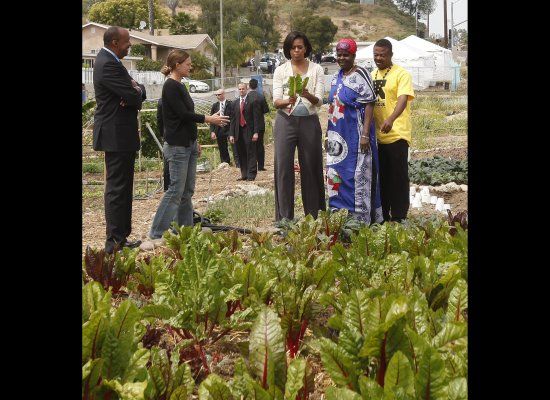
Michelle Obama on refugee gardening: “It’s a model for the nation, for the world”
Michelle O. visits refugee garden project in 2010. http://www.huffingtonpost.com/2010/04/16/michelle-obama-visits-san_n_540440.html
A reporter once asked me how on earth could these refugee resettlement contractors and their spin-off groups make much money out of resettling refugees by the head when they receive a one time flat fee for each refugee planted in your town. I explained that most of the income for the contractors and subcontractors come through the myriad grants they receive through the Office of Refugee Resettlement for administering everything under the sun—job training programs, English classes,refugee savings accounts, micro-enterprise loan programs, healthy marriage trainingprograms, and even refugee veggie growing projects like those described in an article at TakePart.
Knowing a bit about agriculture and how hard it is to make a profit (unless you are a corporate farm with millions invested in land and equipment) these feel-good gardening projects taxpayers pay for—you pay for!—can only survive with large infusions of federal cash.
There are now agricultural programs across the country—many of which have been bolstered by federal Refugee Agricultural Partnership Program grants—aimed at transitioning people into their new lives in the States by focusing on the agrarian background shared by many refugees. But these garden plots are also meeting the demand for niche produce, such as bitter melon, providing a local market for vegetables that are staples in a refugee’s country of origin but are harder to find in the U.S. and are often sold for a premium.
After a discussion about Cleveland, reporter Sarah McColl takes us to one of our favorite locations for refugee resettlement—Nashville, Tennessee where we learn about an $85,000 grant that the Center for Refugees and Immigrants of Tennessee received from the federal government for FY14-FY16.
So how many veggies can you grow with $85,000 in federal funding!
Somali Community Center becomes Center for Refugees and Immigrants of Tennessee
Some longtime readers may remember that the Center was originally the Somali Community Center in Nashville. Let’s take a minute and go down memory lane. Here is what we said about the name change back in 2009:
So they conveniently dropped the name, Somali Community Center, eh? Could it be they want to shed their bad image with federal granting agencies? We have heard of this before, some agency or volag gets into grant trouble and pretty soon they are going by another name, I suppose hoping that new federal or state grantors (or the public!) won’t link them to the former bad acts.
A reminder to readers, the Somali Community Center got into hot water with the federal government over misuse of grants and with a possible connection to terrorist activities back in 2007. Check out this important and shocking story from Nashville’s Channel 4 news at the time.
The link to the shocking story is gone, but visit our post where we had, thank goodness, preserved the original text.
Back to the gardening grant where you can be sure the Center gets to keep a certain amount of your money for administrative purposes.
Snake gourds trellised up a willow tree? (and you paid for it!)
Lauren Bailey: We grow crops without spending a lot of money. $85,000 is a lot of money!
It’s much the same in Nashville: There are plenty of international grocery stores, explained Lauren Bailey, director of agricultural programs at the Center for Refugees and Immigrants of Tennessee. Access isn’t the problem.
“It’s less that they’re not able to find it and more that it’s expensive,” Bailey said. “But the crops that we’ve grown this year, they’ve been able to grow prolifically without spending a lot of money.” One enterprising gardener told Bailey he’d earned $25 from his mustard greens haul, though most take what they grow home to their own kitchen. “I sense that they’re excited to be growing, but also excited to be providing for their families,” she said.
In its first year after receiving a 2014 federal Refugee Agricultural Partnership Program grant, the Nashville program now includes a community garden, ESL instruction, and a training garden that hosts an 18-week market gardening course that’s regularly attended by refugees from Burma and Bhutan. It’s not a simple matter of the students learning from the teachers, however. “At one training garden they were growing a snake gourd, and they trellised it up a willow tree, and I’ve never seen anything like it before,” Bailey said.
Supplemental income, language practice, fresh veggies, and marketable skills are all important aspects of resettlement that are easier to quantify than some of the other benefits Bailey and Fitzpatrick have observed in the garden.
“It’s not just that it might provide income,” Bailey said, “but that it might bring health or improve their quality of life. For a lot of our gardeners, it’s a sense of ownership and pride—the work that they’re doing, and what they’re able to accomplish.”
Again, check out the whole list of grants for refugee gardens. By the way, I see that the now defunct Indiana gardens that American volunteers had to try to save (when refugees tired of the work) are no longer on the list.
Someone needs to take one of these grants, get the original grant requirement and track the federal money and figure out how much it costs to produce the veggies and what the return on your investment is, photograph the gardens on a regular basis and see how many refugees are actually gardening. I suspect there is lots and lots of room for fraud in managing one of these federal warm and fuzzy give-away programs.
Update November 23rd: For some reason this month-old story is exploding on the internet, does anyone know why? See my post this morning.
Liberal by the way, is the name of the town!
Here we learn that an African-American killed one of his African ‘brothers’ apparently on the job at National Beef.
It was just last week that we reported on the on-going tension between African-Americans and Somali refugees in Minneapolis, here.
We have a whole raft of posts at RRW on problems in Kansas meat packing towns as ‘BIG MEAT’ continues to bring in refugee laborers. Click herefor that entire archive. See also ‘Globalists changing the Heartland’ as they look for cheap immigrant labor for big business (with a side benefit of creating more Democrat voters in traditionally red states).
This news from last week (thanks to a Kansas reader) doesn’t tell us what the altercation was about, but searching around there is some commentary that the police are keeping details hushed up. If anyone sees more news on the Liberal meatpacking murder, let us know.
Smith is charged with 2nd degree murder in meatpacking death of Somali refugee.
Jail logs issued Thursday by the Seward County Sheriff’s Office identify the man arrested for second degree murder of a man he had an altercation with last Friday as Michael Joel Smith.
Smith. 31, is listed as a resident of Guymon., Okla., and he was initially taken to Liberal Police Department headquarters for questioning on Oct. 10, after he had an “altercation” with Abdukadir Mohamed Dahir, 25, while both were working at National Beef. He was then released.
Dahir was airlifted that same day to a Wichita hospital for treatment of his injuries, where he died the following day, Saturday, due to “blunt force injuries of the head,” according to authorities.
After Dahir’s death, LPD Capt. Pat McClurg announced LPD had arrested Smith Tuesday evening and was seeking a second degree murder charge against Smith with the Seward County Attorney’s office.
Authorities have yet to release the cause of the injuries or any additional details of the altercation.
“No other suspects are being sought in connection with this incident,” McClurg noted Wednesday. “The investigation of this incident is ongoing.”
At the time, they called it a “food fight” that erupted in the cafeteria, got out of control, students were injured and the police were called in. We spent a lot of column inches reporting on it here in February 2013. Please read that post then come back here.
Now, reader Paul alerts us to a settlement reached when the Department of Education’s Civil Rights Division settled a claim by CAIR (Council on American Islamic Relations). The stunning thing about this “discrimination” story at the Minneapolis Star Tribune last week and analyzed by Scott Johnson at Powerline blog is that one would have to be clairvoyant to know thatthe original incident was between American blacks and Somali blacks—nothing racial about it!
By the way, over the years I have had readers tell me that Somalis think of themselves as superior to African Americans. Meanwhile the dumb resettlement contractors, thinking they are stirring the good ol’ American melting pot, merrily place the African refugees in low-income black neighborhoods thus helping further the cultural tension.
Somali students: don’t blame us! We don’t blame you, we blame the US State Department, Catholic Charities, Lutheran Social Services and World Relief. Photo: Star Tribune http://www.startribune.com/galleries/191328001.html
A cafeteria food fight turned into a riot at South High School in Minneapolis in February last year. The school’s security officers were insufficient to the task. Police officers dispatched to the scene sprayed mace and placed the school on lockdown to get a handle on the situation. Three or four students and a staff member ended up in the hospital.
What was all the excitement about? The Star Tribune discreetly reported that parents and students ascribed the hostilities to “racial tensions between Somali-American students and others.” Who might those others be? For some reason, the Star Tribune’s two reporters were unable or unwilling to get to the bottom of the story.
Fortunately, the British press was not quite so inhibited. The (London) Daily Mail reported that the fight was “between Muslim and black students.”
CAIR never lets a good opportunity go to waste and the media here acts as a willing accomplice by skirting the truth. I can just see the mainstream reporters’ heads spinning when the reality doesn’t fit their agenda. ‘But, but, but, they are all black African brothers, they are all supposed to just get along!’Right? ‘Islam is the religion of peace!’ (That is what they told me in college anyway says my imaginary reporter!). Blah, blah, blah.
Why so many Somalis in Minneapolis? See our January 2011 post to learn who brought them to the “welcoming” city in the first place.
Remember readers, if your town (or state—Wyoming!) is “welcoming” refugees (and is initially generous with social services) this is the inevitable outcome—aggressive refugees, once their numbers reach a sufficient level, will demand more from local taxpayers.
Community organizer Asad Aliweyd Director of the New American Academy in Eden Prairie: “…the need is huge.” http://metrostability.org/news/article.php?sid=Alliance_Welcomes_New_Board_Members
As an outer-ring, affluent suburb, Eden Prairie may seem an unlikely city to draw a growing refugee community. But 17 years ago, Somali-Americans like Asad Aliweyd moved there for its top-ranked schools, safe community and job opportunities.
Now, nearly two decades later, Eden Prairie has the third-largest Somali population in the Twin Cities, next to Minneapolis and St. Paul, according to the city, with an estimated 3,500 to 5,000 residents.
The Somali language is second only to English in Eden Prairie schools. The police department has its first Somali police reserve officer. And the city has Somali businesses, including a halal grocery store, and two mosques.
“Eden Prairie is more welcoming to Somalis than anywhere else,” said Aliweyd, a former math teacher who now runs a center providing classes for Somali youth and adults.
But he and other Somali leaders are pushing for more support from the city and school district, and for more affordable housing as the city plans for development along the future Southwest Corridor light-rail line. There, Aliweyd envisions a multicultural market like Minneapolis’ Midtown Global Market and more affordable apartments.
“In Eden Prairie, we are in an island,” he said of Somali resources. “If we weren’t here, no one would be doing this.”
City and school leaders say they are providing free resources to residents for everything from finding housing to filling out job applications, hosting a popular monthly program for Somali mothers and having Somali-speaking coordinators to help families.
“We’re trying to help them out the best we can with limited budgets,” City Council Member Brad Aho said. [Bend over!—ed]
There is a lot more in the article. Go here to continue reading.
Columbus, Ohio activists working hard on behalf of Somalis looking for good affordable housing, here.
See one of our top posts for all time, from 2011—Why so many Somalis in Minneapolis?—and thank the US State Department, Catholic Charities, Lutheran Social Services and World Relief Minnesota for dropping the original Somali seed community into the fertile ground of a generous, welfare-rich, state.