What about America’s needy, elderly, and disabled people?
Editors note: That is the question I hear all the time at the local level!
For some reason that I can’t explain, this post continues to be our top post—Tennesseans urging US Senators to block possible border surge to Tennessee—every day since it was published a week ago today. On July 16th we reported on an attackby Progressive Open Borders activists on the Tennessee citizens (and RRW) calling those who are concerned about Tennessee’s own needy people their favorite pejorative—“nativists.”
A Tennessee citizen responds (emphasis is mine):
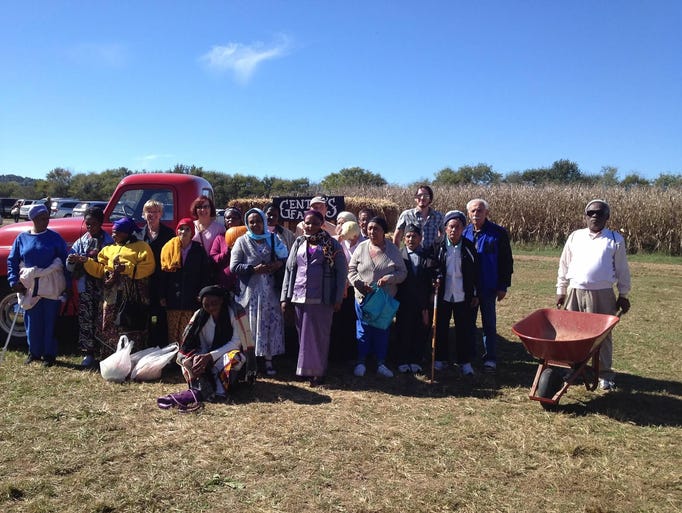
Elder refugees on a Catholic Charities field trip to a tourist site, an historic farm. CC of TN is worried about losing government funding for such projects.
It’s exactly what you expect out of these groups. Just as soon as you try to have a rational dialogue about fiscal impact, funding priorities and program sustainability, they resort to name-calling.
Despite their caterwauling of anti-this and anti-that, the truth is that the conflict in Tennessee started with simple questions of “what is the state cost for the voluntary federal refugee resettlement program?” and “what if those state dollars were used to pay for services that Tennessee’s disabled citizens are still waiting for?”
The disabled are the more than 7,000 Tennesseans with intellectual disabilities (what used to be known as mental retardation) who are unable to care for themselves.
The federal government has said repeatedly that it has deliberately shifted the costs of the voluntary resettlement program to the states and a 2012 GAO report disclosed that the federal resettlement contractors get paid for each individual person they bring to a state, so they have a built-in incentive to increase those numbers.
Catholic Charities of TN said in their resettlement proposal that TN schools provide “free” English Language Learner services even though in 2012 TN’s state and local governments spent a combined $70 million for English Language Learner services in the public schools.
In 2008 Tennessee opted out of the voluntary federal program. Now the resettlement program is run by a federal contractor who in 2011 said they were going to expand the program in TN – without any input from the state of course. This has resulted in more people, more money for the contractors and higher enrollment in the state’s Medicaid program.
The state passed a bill that simply codified the federal code provisions which require the refugee contractors to coordinate with the state and give advance notice when refugees are due to arrive.
The idea for a local moratorium on resettlement when capacity becomes an issue, came from a federal hearing, and Tennessee’s State Refugee Coordinator (federal contractor) running the program agreed that was okay.
Federal contractor data showed that of the about 4,500 people they brought to Tennessee over a three year period, Medicaid (TennCare) enrollment in this group doubled during that time. During this same period at least one-third of their clients were considered “non-employable” because they were either children or 65 and older.
Contractors enroll eligible seniors into SSI which is also funded in part with state dollars.
Way back when the federal government reimbursed states for the state funded portion of SSI, Medicaid and cash welfare. That stopped in 1991.
This information raised more questions about how state dollars were being spent for a voluntary federal program. In the absence of any state law, the federal contractors believed themselves unaccountable to the state.
The bill to address this would have required the contractors to report for example, how many people they enrolled into TennCare and the cash welfare program. The State Refugee Coordinator initially said the contractors couldn’t provide that information. Then they “remembered” that the Cooperative Agreements signed with the federal government require tracking how many people and into which publicly financed programs they are being enrolled.
The State Refugee Coordinator was also asked to report how many of the students they help enroll into public school also receive ELL services. Again they said there was no way to get this information even though the contractors are receiving school impact grants that they use to hire staff that liaison between the schools and the families.
Isn’t it ironic that while complaining about the possibility of ORR diverting refugee resettlement money to help the illegal immigrants crossing the border, the State Refugee Coordinator was quoted saying that the loss of funds would effect the contractor’s “children in schools” program.
In a more recent article we are told that if the funds get cut because of illegal immigration, the elder refugees (who they define as 55 and older), will lose the “special help” they get that includes bingo games, bowling, and field trips to the art museum and pumpkin patch. These are services which the federal contractors say enhance the “quality of life” for their clients.
What about the “quality of life” issues for Tennesseans with intellectual disabilities?Federal refugee resettlement contractors like to claim that the refugee resettlement program is fully funded by the federal government. They really believe that if they say it enough it will be true. Well, it simply isn’t – even the federal government says this isn’t true.
About the photo: It was published at USA Today(from the Tennessean) in a story about how Catholic Charities, which as a ‘Wilson-Fish’ ***agency calls the shots (along with the federal government) for all refugees going to Tennessee, complains that they might lose funding for their elder refugees if too much money is diverted to care for the ‘unaccompanied minors’ —- all part of a public relations campaign to get Congress to shell out a few more billions for the migrant tide to America.
Most sensible Americans are asking—what about our own needy, elderly, and disabled people?
***Is yours a Wilson-Fish state where Catholic Charities, Lutheran Social Services or other entities run the program with no state government involvement?
Editor: Every day since we posted the first action alert from Tennessee citizen activistswho want to make sure the ‘unaccompanied minors’ now surging across the Texas border don’t end up in Tennessee, it has been our Top Post every day (see right hand sidebar for Top Posts).
This is a follow-up alert for Tennesseans which readers in other states might use as a model. Tell your elected officials wherever you live—no illegal alien drops in your state!
And, tell them to suspend all other refugee resettlement in FY2014 and FY2015 until the border crisis is resolved.
2nd ALERT Re: Border Surge and Tennessee – New Information
Refugee resettlement contractors say don’t give their money to the children. They want the money for their businesses! These contractors are paid to bring refugees to Tennessee.
This year Congress increased funding for refugee resettlement contractor business to $1.489 billion, an increase from last year’s $1.12 billion but still short the additional $1.6 billion that refugee contractors demanded.
Federal refugee contractors like the TN Office for Refugees (TOR) operating in Tennessee, are complaining that the U.S. Office of Refugee Resettlement (ORR) may use some of the contractors’ money to help the children crossing the border. TOR says that if their money is reduced they won’t be able to help the refugees they have brought to Tennessee. To date, there has been no suggestion by TOR that they would reduce the number of people they plan to bring to the State.
The federal contractors have been directed by their leadership to lobby Congress for more money, which in part is why Pres. Obama’s original request of $2 billion in emergency spending for the border is now $3.7 billion. If Congress approves this request, the illegals will get to stay andTOR will get all its money. Why shouldn’t the contractors get to save their cake and eat it too?
A high percentage of minors are trying to reunite with family members living in the U.S. who may not be here legally. In 2013, President Obama directed immigration agents to try not to deport illegal immigrant parents in the U.S. who have minor children. The refugee contractors are paid to unite the minors with anyone claiming kinship regardless of whether that person is in the country legally.
Once these minors are released, they must attend public school. In Tennessee, K-12 education and all services including breakfast and lunch programs, must be provided. Under certain circumstances, TennCare must pay for their emergency medical care. Will Tennessee schools also have to ban the American flag to avoid offending non-citizens?
Eventually, the illegal minors are supposed to appear for an immigration hearing. Of the $3.7 billion Obama has requested, approximately $15 million would pay lawyers to represent the minors at their hearings. The ACLU has already sued to make sure the minors have lawyers, citing a report that says that immigrants with lawyers are five times more likely to win their cases than those who represent themselves.
On July 12th, Rep. Marsha Blackburn visited the Ft. Sill relocation facility in Oklahoma where approximately 1,100 illegal minors are housed. Is she considering a recommendation for TN?
Pals yuk it up on Inauguration Day 2013: Harry Reid, Lamar Alexander, Chuck Schumer and Barack Obama. http://abcnews.go.com/meta/search/imageDetail?format=plain&source=http://abcnews.go.com/images/US/ap_inauguration_ip_002_130121
Tennessee’s political establishment including Gov. Haslam, Lt. Gov Ron Ramsey and Speaker Beth Harwell and Tennessee’s Republicans in D.C. except Rep. DeJarlais, signed on as co-chairs of Lamar Alexander’s reelection campaign.
They agreed to help Lamar after he voted for amnesty.
Contact the D.C. politicians and tell them that if they plan to help the minors, then:
• TOR and other federal contractors must accept a reduction in federal money and suspend further FY2014 resettlement in Tennessee.
• Federal contractors must suspend all other FY2015 refugee resettlement until the border surge issues are resolved. Every year the U.S. resettles approximately 140,000 refugees and asylees; estimates of border crossers will well exceed these totals.
Sen. Bob Corker – 202-224-3344, http://www.corker.senate.gov/public/index.cfm/contactme
Sen. Lamar Alexander – (202) 224-4944, http://www.alexander.senate.gov/public/index.cfm?p=Email
Rep. Phil Roe – (202) 225-6356, http://roe.house.gov/contact/
Contact Gov. Haslam, Lt. Gov. Ramsey and Speaker Harwell and tell them that any plan to assist the federal government with the border surge must be approved in a special session of the Tennessee General Assembly:
Gov. Bill Haslam – (615) 741-2001, bill.haslam@tn.gov
Posted on the door of Catholic Charities office in Nashville. I wonder when the “and Child Welfare Program” was added to the sign?
Update July 19th: Tennessean responds to ‘Imagine 2050’ here.
Update July 16th: We learn that hard Left ‘Imagine 2050’ attacks Tennesseans calling them “nativists” here.
Update July 15th: New alert today in Tennessee, here.
Update July 12th: Every day since this was first posted (July 7) it has remained at the very top of our Top Posts!
Editor: This is an action alert making the rounds in Tennessee. Use it as a model for what you can do to protect your state and our national sovereignty!
Do Federal Contractors Plan to Bring Illegals Surging the Border to Tennessee?
Before Tennessee Sens. Bob Corker and Lamar Alexander voted YES on amnesty they were advised by border law enforcement that a YES on amnesty would likely result in a border surge.
Sen. Corker is the ranking member of the Senate Foreign Relations Committee that has jurisdiction over the U.S. refugee resettlement program. Illegal minors crossing the border are treated as conditional refugees pending a deportation hearing where they may or may not show up.
Sen. Alexander is on the Senate Appropriations Sub-committee that approved $1.94 billion to help Obama with his border surge problem; an increase of over a billion dollars from last year. This money will be diverted from other social service programs. Federal refugee resettlement contractors are now complaining that they will be losing public money they use to support their refugee resettlement businesses. They are advocating that more public money be appropriated for their use.
Federal refugee resettlement contractor Catholic Charities that runs the program in TN does not currently resettle “unaccompanied alien children” (UAC). These are the illegals currently surging the border. 90,000 UACs are expected this year with estimates up to 150,000 in 2015.
On July 10th, resettlement agencies that do not currently resettle UACs, will be on a conference call with the Federal Office of Refugee Resettlement.
Why? Historically in Tennessee, refugee resettlement agencies like Catholic Charities have not taken UACs. But, more federal refugee contractors are needed to handle the surge. So the federal government is trying to find places to set up “emergency shelters” where the UACs can be housed.
Catholic Charities of TN, has said they plan to expand the federal refugee resettlement program in Tennessee. Since taking over the program they have increased the number of people being brought to Tennessee by 66%. They are paid for each person they bring to Tennessee.
Then they enroll their clients into TennCare which the citizens of Tennessee subsidize.
The state of Tennessee has absolutely no say about whether or how many people the federal refugee contractors bring. If Catholic Charities decides to say YES and open emergency shelters in Tennessee, it will be one more example of the federal government trying to force the State to fix a problem created by federal policies.
California Democrat Sen. Diane Feinstein said, “…my staff learned that many of the children were smuggled across the border after hearing radio ads promising they would not be deported…[and that], religious organizations are spreading the same message.” Also, border agents have recovered “cheat sheets”of prepared answers that will help avert deportation. Evidence of communicable diseases and/or affiliation with gangs like MS-13 do not bar minors from U.S. entry.
Residents of Lawrenceville, VA protested loudly enough against the opening of a shelter in their community, so the federal government decided to go elsewhere. Democrat leaders in Baltimore, MD also rejected plans for an emergency shelter.
Will that “elsewhere” be in Tennessee communities? Make your voice heard:
Tennesseans need to contact pro-amnesty Senators Corker and Alexander and your House representative and tell them the following:
• Secure the border before any other action is taken
• No emergency shelters for UACs to be opened in TN
• All refugee resettlement to be halted until the surge at the border is resolved
• No to amnesty
Sen. Bob Corker: DC: 202-224-3344 Fax: 202-228-0566
to email: http://www.corker.senate.gov/public/index.cfm/contactme
Sen. Lamar Alexander: DC: (202) 224-4944 Fax: (202) 228-3398
to email: http://www.alexander.senate.gov/public/index.cfm?p=Email
Please pass this on
About that poster on Catholic Charities door: there doesn’t seem to be any mention of child welfare on their website. For the many new readers arriving here, remember Catholic Charities and the federal government make all the decisions regarding which refugees and how many are sent to Tennessee!
By the way, Tennessee has been labeled a “pocket of resistance”by the Office of Refugee Resettlement and its contractors.
See all of our coverage of the ‘unaccompanied minors’ invasion of America by clicking here. There are dozens of posts spanning several years in the archive.
***The Tennessee primary is August 7th, early voting begins on July 18th.***
Lamar Alexander: the next Eric Cantor beat down!
Anti-amnesty Tennessee state Rep. Joe Carr is challenging incumbent U.S. Sen. Lamar Alexander in what could be the another Brat-Cantor race. Honest post-election commentary summed up Cantor’s defeat in Virginia as “he was pro amnesty so he lost.”
Sen. Lamar Alexander voted YES, helping to pass the pro-amnesty “Gang of Eight” (S.744), last year even though asBreitbart, reports, Lamar was told less than a month before his YES vote, that a yes vote would create the overwhelming border surge we are facing today:
“On May 29, 2013, less than a month before the Senate would pass its amnesty bill, officials from the National Immigration and Customs Enforcement Council of the American Federation of Government Employeeswrote a letterto senators before the vote on the Senate’s comprehensive amnesty bill, warning them that passing a bill granting amnesty to illegal immigrants would be a magnet that attracts more while subjecting illegal immigrant youths to victimization.”
Lamar and others were warned:
“Driven by mere speculation that S. 744 may be enacted by Congress, illegal border crossings have spiked dramatically. Thousands of unaccompanied children, runaways, and families now attempt to illegally enter the United States in hopes of receiving legalization.”
Estimates for illegal minors (unaccompanied alien children, aka UAC), in 2015 are as high as 142,000. In response, the Senate Appropriations Committee on which Lamar serves, voted to give Obama $1.94 billion, to help the administrationwith the amnesty motivated rush at the border. Ironically, the Congressional Budget Office estimatesthat amnesty YES votes like Lamar’s which included $39 billion to increase border security will only improve border security by a mere 8%.
Lamar’s YES vote on amnesty is also helping to bring new emergency shelters for hundreds of illegal minors to places like Lawrenceville, Virginia. Angry citizens packed a school auditorium to tell federal officials they didn’t want the disease, government spending and crime that would go along with bringing the illegal immigrants to their community. Gang affiliation has long ceased to be a bar for unaccompanied minors even when they are tatted head-to-toe with MS-13 gang tattoos.
Lamar’s primary challenger, state Rep. Joe Carr has a voting record on illegal immigration that looks nothing like Lamar’s.
Carr was the sponsor of Tennessee’s successful E-verify law and other legislative measures prohibiting taxpayer benefits to illegal immigrants and banning sanctuary cities that serve as open invitations to illegal immigration.
Seems like an easy choice. Forget Lamar, VOTE CARR.
Editor: See Rep. Carr’s website by clicking here and help him defeat Alexander. Early voting begins July 18th so hurry! See all of our postson problems with refugees and immigration generally in Tennessee. See especially this oneabout turning red states blue. And, we have an entire category devoted to Nashville (click here), which is home to a well-established ‘pocket of resistance.’
Editors note: Here is one more testimony sent to the US State Department in response to their federal register notice for public comment on the “size and scope” of their Refugee Admissions program for Fiscal Year 2015. As readers know, the State Department is not allowing public review of any testimony submitted including the federal contractors’ *** testimony in which they invariably ask for more refugees. By the way, Tennessee is a Wilson-Fish stateand as such Catholic Charities of Tennessee calls the shots on who is resettled there.
May 27, 2014
Ms. Anne Richard
Asst. Secretary of State for Population, Refugees and Migration
US State Department
Washington, DC
Re: Federal Register Public Notice 8690
Dear Ms. Richard,
Please accept my written comments regarding FY 2015 U.S. Refugee Admissions Program. I recently learned that unlike prior years, there will be no public hearing this year. If ever there was a federal program that should be required to appear in public to answer questions and justify any funding, it is the one you oversee. The federal refugee resettlement program has increasingly operated without sufficient public scrutiny or meaningful input from all stakeholders.
As defined by the U.S. Office of Refugee Resettlement in the 2011 report to Congress(the last report submitted), resettlement stakeholders include: resettlement agencies, state refugee coordinators, refugee health coordinators, ethnic community-based organizations and ORR technical assistance providers.
The federal contractors’ proposed resettlement numbers are never made public prior to acceptance and award of federal funds. The very communities that are directly impacted are not considered stakeholders nor offered any opportunity prior to award for meaningful input into these decisions. This past year I spent a considerable amount of time and effort using FOIA and was still unable to have last year’s resettlement proposals disclosed.
This information should not be subject to FOIA. In fact, the information should be posted on the State Department’s website prior to acceptance and award of federal funds. There is nothing proprietary about how many people a federal contractor plans to bring to a community. Treating this information as “behind closed doors secrets” strongly suggests that the information is withheld from the public because of concern about community resistance to the federal government’s plans.
Years ago I served as a volunteer with a resettlement agency. Over time I have watched this program be transformed into an industry for government contractors with little to no oversight, transparency or accountability to taxpayers. The Cooperative Agreement which VOLAGs execute requiring that federal funds only “augment” privately raised funds is simply ignored. For example, Catholic World News reported in August 2012 that “Federal funds account for nearly 93% of USCCB’s migration/refugee budget…that over 92.5% of [their] $72.1 million budget came from federal grants and contracts while under $25,000 came from private donations.”
Nor is the USCCB the exception among the nationally contracted VOLAGs.
Federal grants include the likes of “Healthy Relationship and Marriage Research,” “Refugee Home Based Childcare Microenterprise Development Project” and “Preferred Communities” just to name a few. A rational approach to helping refugees and their children integrate more quickly into their new communities and Western culture, suggests that rather than using even more government funding to employ women in home-based childcare enclaves, the money would be better spent if at all, putting these children and mothers into existing community-based childcare settings.
While federally funded Ethnic Community Self-Help organizations and Mutual Assistance Associations are made to sound like good ideas, in reality they are yet one more avenue to funnel public dollars to refugee based organizations that use public dollars to claim refugee employment. Rather than assist refugees to integrate or even marginally, assimilate into their new communities, these organizations are designed to “ensur[e] that their charges retain strong ethnic and homeland ties.”
The per capita funding structure incentivizes resettlement contractors to increase their numbers regardless of whether it results in a lower standard of services provided to refugees. The 2012 GAO report “Greater Consultation with Community Stakeholders Could Strengthen Program” validates this position:
“Because refugees are generally placed in communities where national voluntary agency affiliates have been successful in resettling refugees, the same communities are often asked to absorb refugees year after year. One state refugee coordinator noted that local affiliate funding is based on the number of refugees they serve, so affiliates have an incentive to maintain or increase the number of refugees they resettle each year rather than allowing the number to decrease.”
Any attempt at objective discourse about how contractor resettlement business impacts the community in which they operate, is met with disdain. Local affiliate offices do not hesitate to publicly denigrate any taxpayer who raises legitimate questions about the functionality and cost of the program. Propaganda films like “Welcome to Shelbyville” are used to mislead the public and suggest that anyone who looks askance at the resettlement industry, is at best, just “unwelcoming” but more likely, a racist and a bigot.
The State Department’s blog entry dated May 27, 2011 notes that “Welcome to Shelbyville” was shown by your office, PRM, at the State Department on May 25 2011 to an audience of 120 that included representatives from NGOs, refugee resettlement agencies, the State Department, and other U.S. government agencies. Did you bother to share with them the other side of the Shelbyville story as reported in the local paper?
This “documentary” is pure propaganda for the federal program, obscures important facts about the program’s impact and worse, is used to silence legitimate concern about the resettlement industry. No federal agency should be permitted to use it.
States should have final control over resettlement activities within their state borders
Since states incur the on-going, long-term cost associated with refugees, states should have complete control over resettlement activities within their borders.
The 1981 Select Commission on Immigration & Refugee Policy (“Select Commission”), repeatedly addressed the financial impact on receiving communities. “Many state and local officials are concerned that the costs of resettlement assistance will continue beyond the period of federal reimbursement and that the burden of providing services will then fall upon their governments.”
The Select Commission seemed to well understand the fiscal issue for a federal program where the long-term costs would be passed to state and local governments. “Areas with high concentrations of refugees are adversely affected by increased pressures on schools, hospitals and other community services. Although the federal government provides 100 percent reimbursement for cash and medical assistance for three years, it does not provide sufficient aid to minimize the impact of refugees on community services.”
In 1982, just two years after the 1980 Refugee Act was passed, reduction in federal support started with federal cash and medical assistance reduced to 18 months. In 1988 it was reduced again to 12 months and again in 1991 to 8 months, which remains the current level. In 1986, the federal government began to reduce reimbursement to states for the state-funded portion of welfare, Medicaid and SSI, eliminating it altogether by 1991 and shifting these additional costs to the states.
The cost shift has been openly and repeatedly acknowledged by the federal government. And yet, these enduring costs are never acknowledged when calculating the true dollar cost of the program. The 2010 Senate hearing started to identify the significant costs states are forced to incur because of the federal program.
The U.S. Office of Refugee Resettlement places such a high premium on shifting refugee healthcare costs to states, that the 2013 ORR Voluntary Agencies Matching Grant Program Guidelines on page 9 states that: “ORR recognizes that weekly cash payments may make certain MG cases ineligible for the USDA Supplemental Nutrition Assistance Program (SNAP) and Medicaid. Thus, local Matching Grant Program service providers may give some of the weekly allowance in the form of vouchers if such a form of payment is in the overall best interest of the client and he/she concurs.”
In other words, circumvent the program’s rules to shift more cost to the state taxpayer. State governments that decided to expand their Medicaid programs probably did not anticipate that this year’s Department of Health and Human Services briefing on “Key Indicators for Refugee Placement” would so quickly advise considering Medicaid expansion when deciding refugee placements.
With regard to states that have withdrawn from the resettlement program, the federal government does not have the legislative authority to assign an NGO to continue the program in that state. This unconstitutional encroachment on the 10th amendment right of states is barred both by law and U.S. Supreme Court decisions and must cease.
Additionally, states should not be subject to the poor judgment exercised by the Obama administration’s decision to relax security screenings for certain groups of refugees.
“Self-sufficiency” terminology should be replaced with specific reporting on public assistance utilization, temporary v non-temporary employment and the number of refugees resettled each year who are considered to be “unemployable”
Despite documentation of high percentages of Medicaid and food stamp utilization, high “self-sufficiency” rates are reported by the refugee resettlement contractors. It is misleading to describe anyone, including refugees, as self-sufficient when they also receive publicly funded assistance in the form of food stamps, Medicaid and public housing. And still federal contractors are able to report high self-sufficiency rates for refugees as long as they do not receive cash welfare.
A January post on the “Friends of Refugees” blog posted the following about Bridge’s Knoxville resettlement operations: “A former case manager also sent us information about the agency and pointed out that the refugee employment figures are dishonest as most of the refugees have only temporary employment that does not help them to pay rent and be self-sufficient. The nature of the temp jobs also means that the refugees will be unemployed just a short time after the agency reports them employed to the federal Office of Refugee Resettlement (ORR) at 90 days and 180 days. (This, however, is a problem throughout the refugee program, and it doesn’t seem that the the ORR has much of an interest in requiring that resettlement agencies report if refugees are working at temporary or non-temporary jobs.)”
Public health issues should be resolved before funding more initial resettlement
TB among resettled populations has been a particular public health concern. It was reported in 2009 that the sharp increase in Minnesota’s active TB cases was tied to refugee resettlement. Because latent TB is not a bar to refugee admission, health officials have expressed concern about cases of drug-resistant TB being documented in communities with high refugee resettlement.
In 2012 the CDC reported that TB in “foreign-born persons increased to 63% of the national case total,” a percentage that has risen steadily since 1993.
More recently it was reported that “immigrants and those who travel to other countries frequently have the highest TB occurrence,” and that “many of these cases–approximately 450,000–are the drug-resistant form of TB that has developed from improper medication usage and medical protocols.”
In April, 2012, the U.S. Office of Refugee Resettlement circulated a grant announcement titled “Strengthening Surveillance for Diseases Among Newly-Arrived Immigrants and Refugees” since it appears that there is no comprehensive tracking of this particular segment of public health concerns. More government money to throw at a government created problem.
Reports of depression and PTSD are now being reported as reasons that some refugees are unable to work. Among Bhutanese refugees that are being resettled, the CDC has documented a troubling statistic; a suicide rate higher than the national and global average. One explanation offered has been the lack of jobs and the resulting stress of unemployment not matching expectations of life in the U.S.
Conclusion
Public funds are spent, hearings are held, reports are published and yet, nothing is done proactively to respond to the problems and issues that are highlighted.
The federal agencies involved in refugee resettlement have enabled the growth of an industry
layered with ever multiplying federal grants but extraordinarily lax on transparency and accountability. Currently, the U.S. refugee resettlement program is administered in derogation of a state’s right to withdraw from the federal program and a state’s right to set state level funding prerogatives.
Proposed resettlement plans should be made publicly available before any award of funding and be subject to public comments and public hearings. Moreover, the U.S. Office of Refugee Resettlement is at least two years delinquent in submitting the required annual report to Congress. No funding should be appropriated until all reporting requirements are met. Importantly, the last annual report dated 2011, noted the increased difficulty in finding employment for non-English speaking refugees, especially in light of higher unemployment rates among Americans, a situation that has not improved much since then.
Rather than compounding the problems already identified, it may be time to temporarily suspend the resettlement program and focus on the health and employment needs of refugees already here. At the same time, an objective examination of security screening measures should be undertaken.
Please ensure that a copy of the entire written record is timely made available to the public.
Respectfully submitted,
Joanne
Tennessee
Endnote: All of our posts on this year’s public comment period may be found in our category entitled “Testimony for 5/29/2014 State Dept. meeting” here.
If you have testimony you wish us to publish, see my e-mail address in the right hand sidebar.