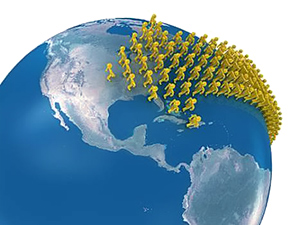
UN Security Council briefed on worldwide refugee problems

Yesterday, UN High Commissioner for Refugees(UNHCR) Antonio Guterres briefed the UN Security Council on refugees and displaced persons worldwide.    He said the number is growing (is it ever not growing?) due to conflicts, climate change(?) and economic recession.

The number of refugees worldwide had increased to more than 11 million over the last two years, and the number of people displaced internally as a result of conflict to some 22 million, António Guterres, United Nations High Commissioner for Refugees, said in a briefing to the Security Council today.

He said the increase in the number of refugees under the mandate of his Office -– not including the 4.6 million Palestinian refugees under the mandate of the United Nations Relief and Works Agency for Palestine Refugees in the Near East (UNRWA) -– had increased primarily due to the situations in Iraq and Somalia. Other sources of the growing number of refugees included Afghanistan, Sudan, Chad, Central African Republic and the Democratic Republic of the Congo.

Other causes of displacement besides conflict included climate change induced natural disaster, drought, rising sea levels and the current global economic recession, he said. “Conflict, climate change and extreme deprivation will interrelate, strengthening each other as causes of displacement.” As there was no legal framework addressing the situation of people displaced internally by persecution or armed conflict, there was a need to discuss seriously the new forms of forced displacement, emerging protection gaps and possible forms of collective response.

The report on the briefing is a long one, but quite informative.  Here are a few excerpts I found interesting.

The representative of the UK, Karen Pierce, told the gathering that the UK supported UNRWA (see Judy’s post on UNRWA and Hamas, then read on).

Karen Pierce (UK), echoing the High Commissioner’s admiration for UNRWA’s workers in the Gaza Strip, called for immediate humanitarian access in light of the immense suffering caused by the escalation of violence in Gaza and southern Israel. The United Kingdom called for an immediate ceasefire and condemned acts of terror and violence against civilians.

The Russian representative basically said that internally displaced people are the sovereign nations problem (so stay out of Russia):

Underlining the necessity of drawing a distinction between UNHCR providing assistance to refugees and to internally displaced persons, he noted that, for the latter group, interventions were only allowed if the relevant country had made a request in advance. Providing assistance to internally displaced persons was primarily the responsibility of the country concerned.

The Chinese representative mentioned “environmental degradation” as a contributing factor in creating refugees and internally displaced people.  China has such a fabulous environomental record (not!) that you wonder why someone representing China should even mention environmental degradation, but the UN is a place for talkers.

Indeed, conflict, political turmoil, economic stagnation, poverty and backwardness were the main causes that made the refugee problem intractable, in addition to environmental degradation and security challenges, which also exacerbated displacement.

The Libyan representative weighed in on Gaza (of course!) likening the Israelis to Nazis:

He went on to recount the disturbing events in Gaza, where the civilian Palestinian population was being displaced due to collective punishment with Nazi-like overtones. The people of Gaza could not flee and had no option but death. The Security Council remained silent while those preventing it from shouldering its responsibilities were evincing tacit approval of Israel’s operations.

Mr. Guterres wrapped up with his praise for UNWRA:

Expressing appreciation for the statements by the representative of the United Kingdom and others who had expressed concern about the situation in Gaza, he said he hoped the situation of displacement could be addressed in a concrete and comprehensive manner as soon as possible. UNRWA was doing laudable work under extremely difficult circumstances in and around Gaza. UNHCR’s main concern, from the perspective of its mandate, was that the enclave’s population could not flee, which made the humanitarian imperative that much more pressing.

But, Mr. Guterres they could be resettled to Muslim countries, could they not!

Asylum seekers head for Israel

Update January 12, 2010: Israel will build barrier along border with Egypt, here.

Update January 2, 2010: Israel’s African refugees keep coming, here.

Update November 29, 2009: Israel setting up asylum process for refugees, here.

Update October 20th: A million refugees are trying to sneak across Israel’s border from Africa, here.

Update July 4th:   Israeli government taking a larger role in dealing with asylees and refugees, here.

This is not a story about Gaza, for once. But the lesson is similar: Israel getting the short end of the stick because it tries to treat people decently, as it did when it evacuated Israelis from Gaza and turned over thriving greenhouse businesses, only to be rewarded with a constant barrage of rocket attacks.

In this case, Israel is a better deal for asylum seekers than Egypt, so it  has thousands of would-be migrants from Sudan, Eritrea, Ethiopia and other African countries going through Egypt and trying to enter Israel via the porous border between Egypt’s Sinai Desert and Israel. (Israel captured Sinai from Egypt in the Six-Day War but gave it back as part of the peace agreement between those two countries.)

The article in Egypt Today that recounts this is too long and complicated to summarize here, but the points I want to highlight are these:

Israel has thousands of African migrants already, and does not want to absorb any more. Check out this map of the Middle East to see one reason why. Israel is that tiny little sliver of yellow on the Mediterranean coast.

Israel is trying to work with Egypt to stop the border crossings. Egypt appears to be trying to solve the problem by shooting some of the people who try to cross. This doesn’t sit well with human rights groups, and doesn’t prevent more people from crossing.

Egypt used to be a desirable place for refugees, but is no longer because of a deteriorating economy and changes in policy by both the UN agency and Egypt’s government. Egypt’s constitution grants every foreigner the right of asylum, but is not living up to that promise (a pretty foolish promise, but there it is).

Here’s a point that we will be hearing more about, I’m sure.

The UNHCR budget is dependent on donor countries, and given the dire economic situation in many parts of the world, some donors are redirecting funds.

More chaos to come. And here’s a brief point that deserves a much more thorough treatment. The asylum seekers in this article are not groups of displaced people. They are economic migrants for the most part. They come from countries that have been devastated by war and political tyranny. Most importantly, the traditional social systems of these countries have been destroyed. We see two results of this here: First, when there is economic hardship, there is no organic, traditional safety net so people have to look for solutions apart from their own nonexistent social group. Second, the societies are so atomized that there is little feeling of belonging, sometimes even of belonging to a family. People become atoms, drifting around on their own and “free” to do whatever they want. They are free to migrate to alien lands in search of a better life. As chaos in the world increases, this fragmentation of societies increases, increasing the chaos in an ever-worsening spiral.

Batches of Bhutanese refugees arriving in Tennessee

….and elsewhere in the US.

We haven’t written much lately about the Bhutanese refugees who have been flowing into the US in greater numbers these days (lots of previous posts here).   I guess the kinks are being worked out and the spigot is opening wider.   The big hold-up has been the sometimes violent campaign within refugee camps in Nepal by some refugees to stop their fellow Bhutanese from leaving.   Those waging the campaign believe as refugees leave the pressure is off of Bhutan to take them back.

By the way, Bhutan is a Buddhist country and the refugees are primarily ethnic Nepalis and are Hindus.  Bhutan expelled them in a bout of ethnic nationalism. (See Judy’s post of last March on the enduring power of ethnic nationalism.)

Here is an article from the Tennessean about Bhutanese arriving in an already polyglot immigrant community.

The Bhutanese, people from a small Himalayan kingdom that is one of the last theocracies in the world, are the latest wave of resettled refugees in Middle Tennessee.

Seventy-two Bhutan refugees, resettled by local Catholic Charities, started arriving in Nashville over the summer, said resettlement coordinator Nancy Salyer.

Seventy-two is a drop in the bucket.  We have agreed to take 60,000!

Historically, Middle Tennessee has been a resettlement destination for many refugees, including Cubans, Kurds, Sudanese, Somalis and Ethiopians. It started with Cubans in the 1980s and later with the Kurdish who were fleeing Saddam Hussein’s regime in the early 1990s. Now, Nashville boasts the largest Kurdish community in the United States estimated at 14,000.

About 15,000 Bhutanese were admitted this year, according to the State Department and 20,000 more will arrive in the next several years.

The State Department announced in 2007 that the U.S. would admit about 60,000 Bhutanese over several years and resettle them across the nation. Other countries also have volunteered to take the Bhutan refugees, who are ethnic Nepalis and a Hindu minority.

US taking the easy way out?

Six weeks ago I came across this blog entitled “Durable Solution to Bhutanese Refugee Problem”  in which the writer suggests that the US and other western countries, instead of dealing with the government of Bhutan, the land of the Thunder Dragon, and negotiating the return of the expelled Bhutanese, have taken the easy way out by scooping up these refugees and scattering them to the four corners of the world.

Bhutanese refugees have urged their new king to allow them back home. They have asked the Nepalese government for help. But the Maoist-led government is in no position to save the Bhutanese; in fact, it is in no position to save itself. Bitter fighting among various political parties over the issue of integrating former Maoist fighters into the Nepalese Army could very well cause the government’s collapse.

Who is going to stand up and fight for the refugees then? At this time the answer is, sadly, no one. The international community, including the United States, has decided to take the easy route. They have decided to resettle the refugees in a third country. Already, some refugees have been taken in by the United States and Australia, and some will be going to Europe.

In light of the tanking US economy, I’m wondering if this (adding to the impoverished and unemployed) is the easy way out!

Look out! Millions of “environmentally persecuted” third worlders may be headed our way

I kid you not!   A movement is underway to get the UNHCR (UN High Commissioner for Refugees) to recognize the “victims” of climate change and have them designated persecuted “environmental refugees.”  

According to something called Climate Change Corp:

Millions of people are predicted to become climate refugees as global warming increases. A new international pact will be needed to protect their rights to live.

Here is a portion of this overly long article, if you want to laugh or cry you can read the rest yourself.

Global warming caused by human-induced greenhouse gas emissions has been linked to a host of environmental disasters. These include sea-level rise, flooding, spells of droughts and cold and other extreme weather conditions such as frequent hurricanes and cyclones. As such natural catastrophes push inhabitants to flee to safer places, environmental refugees are fast becoming an international security issue.

The Intergovernmental Panel on Climate Change (IPCC) estimates that there will be 150 million environmental refugees by 2050. The Institute for Environment and Human Security, affiliated with United Nations University, estimated the number of environmental refugees at 20 million in 2005 and predicted the number could be 50 million as early as 2010.

In spite of millions in danger of becoming refugees, at present there is no international law to protect their rights. UNHCR, the United Nations’ refugee agency, does not recognise climate or environment refugees as these categories are not included in the list of legal refugees under the UN’s 1951 Refugee Convention. The Convention currently defines a legal refugee as a person who has fled his or her country due to persecution by the state for reasons of race, religion, nationality, membership of a particular social group or political opinion.

Anthony Simms, head of the climate change programme at UK-based New Economic Foundation, and the author of a book titled “Environmental Refugees: The Case for Recognition” argues that environmental refugees should be given UN refugee status as environmental displacement of people amounts to “environmental persecution”. Simms argues that developed nations should take responsibility as climate change comes a result of their policies.

So far advocates of traditional “persecuted” refugees are resisting adding the climate refugees to the mix.

For a little balance, our friends at Blue Ridge Forum have a post tonight to help bring some sanity back to the climate debate with an article entitled, “Exposing the Dangerous Deceptions of Climate Extremists” here.

Japan begins to take refugees

For the first time, and becoming the first country in Asia to accept refugees through the United Nations, Japan accepts 30 Burmese refugees.

(Kyodo) _ Japan will accept around 30 refugees from Myanmar who are currently taking shelter in Thailand, in fiscal 2010 that starts April 1 that year, under a recent Cabinet agreement to introduce the so-called third-country refugee resettlement program, government officials said Thursday.

Representatives from justice, foreign affairs and nine other ministries and agencies will hold a meeting Friday at the prime minister’s office to decide on details, such as reception facilities for the Myanmar refugees, the officials said.

The refugee resettlement program calls for third countries to accept refugees who flee their conflict-stricken home countries to nearby states but find it hard to resettle in either of those nations.

Read my previous post on Japan here.