I’m posting this opinion piece by the former Democrat Representative from New York merely to continue to give ‘credit’ where credit is due to those who helped create the dysfunctional Refugee Admissions Program that turned forty last Tuesday.
Holtzman came out of the woodwork and used the occasion of the anniversary to pen yet another hit piece on the President with this, posted at CNN:
The Refugee Act reminds us to not forget our humanity — especially now
(CNN) As the global Covid-19 pandemic unfolds, it puts into sharp focus how the Trump administration’s harsh immigration policies may lead to (yet another) humanitarian crisis — this time along the US-Mexico border, where thousands of asylum seekers are living in overcrowded makeshift encampments, many without running water. If there were a coronavirus outbreak in one of these encampments — which are already short on medical supplies — the results could be catastrophic.
Elizabeth Holtzman says she and Teddy Kennedy created the Refugee Program 40 years ago.
Meanwhile, the President is describing Covid-19 as a “Chinese virus” on Twitter and in news conferences, stoking xenophobia and fear — and continuing to undermine the United States’ global leadership.
It wasn’t always this way. Forty years ago this week, when Sen. Ted Kennedy and I co-authored the Refugee Act of 1980, the United States was a different country. It largely welcomed asylum seekers and refugees, and the Refugee Act reflected that humane view.In the act, our country made a permanent commitment to admitting refugees, based on the international non-discriminatory standard of fleeing persecution, and established an asylum procedure inside the United States.
The Refugee Act was not controversial. It sailed through the Senate unanimously and won overwhelming approval in the House before President Jimmy Carter signed it into law on March 17, 1980.
Apparentlyit was controversialbecause here we learn that 62% of Americans did not want to welcome hundreds of thousands of refugees to America.
If Carter had a Twitter account at that time, I imagine he would have pointed to the United States’ proud tradition of welcoming the most vulnerable: the 360,000 people who fled Fidel Castro’s takeover in Cuba in the mid 1960s, the tens of thousands of Jewish refugees who fled the Soviet Union beginning in the 1970s, and the more than 400,000 refugees from Vietnam, Cambodia and Laos who arrived here by 1980.
I see now how they got their inside track to the federal treasury money spigot.***
From 1980 to January 2017 — for 37 years and under six presidents — the Refugee Act worked well. More than 3 million refugees were admitted and overwhelmingly became productive participants in our country, just as my family did. [I can play that game too!For every successful refugee I can find you one who is a criminal, terrorist, murderer or just a plain old mooch!—ed]
Yet every year since Trump took office in 2017, he has slashed the number of refugees admitted under the Refugee Act. For this year, it is 18,000, a historic low, reflecting his ongoing battle against admitting new refugees, immigrants and asylum seekers.
The US State Department has said that refugee arrivals will resume on April 6th. How many of you think the virus crisis will be abating by then. Show of hands!
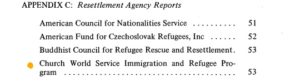
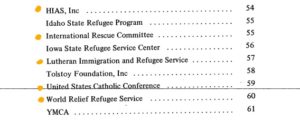
*** For fun I went back to the first Annual Report to Congress in 1980to see which resettlement contractors were operational (being paid by taxpayers to place refugees in your towns and cities) and found this list.
I’ve marked those that are still, 40 years later, receiving millions of your tax dollars. Six of nine have been in on the deal for those 4 decades. No wonder they are furious at the President for breaking their rice bowls.
Go here to the Office of Refugee Resettlement and see all of the Annual Reports to Congress. They are very informative and you might have a little extra time these days for reading ‘pleasure.’
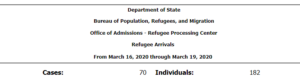
What the heck! We have been admitting 400-500 a week recently and so it seems we are right on schedule if 182 arrived in the last three days.
***Update March 20***Total since Monday is now 214, presume that is it until April 6th when they expect to resume the movement of third worlders to America. We will keep an eye on it!
When I checked the Refugee Processing Centerthis morning I expected to see the number of new refugee arrivals stalled at 69, not more than doubled!
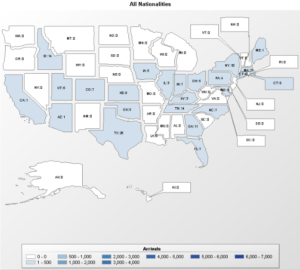
Of the 182 ‘new Americans’ arriving just this week, 124 are from the DR Congo.
Top ‘welcoming’ states are Texas, Massachusetts, Idaho, Tennessee and Georgia.
According to contractual arrangements with the State Department, workers and volunteers for resettlement ‘charities’ must meet the new arrivals at airports and get them settled in their new apartments and sign them up for myriad welfare and healthcare programs available to them.
Guess those do-gooders will be out and about while the rest of us are told to stay home!
Some refugees are in America for years and never learn to speak English, and indeed many arrive in America unable to read in their own language, so now refugee resettlement agencies are scrambling to get out instructions to immigrant communities while they close their own doors to avoid face to face contact with their “clients.”
Language a barrier in getting coronavirus information to all
Those who don’t speak English may have trouble getting updates about what coronavirus is and its spread. Local and state immigrant and refugee advocates are working to get resources to people in the language they speak and read.
As many Americans try to absorb all the information they can on the coronavirus and its spread in Ohio, some are left out of the conversation entirely.
Advocates for immigrants and refugees say about 200 languages are spoken in the state, and many of those advocates are working to make sure the individuals who speak those languages can get information about the rapidly spreading virus in ways they can understand.
[….]
Advocates aren’t the only ones trying to make sure that everyone is reached.
The Ohio Department of Health is linking to CDC resources in other languages on its website, coronavirus.ohio.gov, spokeswoman Melanie Amato said. The agency is also reaching out to local organizations for translation resources and the Ohio Hispanic Coalition is working to translate press releases.
At US Together, a local refugee resettlement agency, staff members began being trained last week on how to prepare themselves and their clients for the virus, Emily Locke, a communications specialist with US Together, said in an email.
The training focused on what the virus is, how it spreads and which communities are vulnerable. They also addressed how to identify symptoms, prevent the virus and prepare food and supplies to deal with the outbreak.
On Monday, the resettlement agency closed its offices to the public and said its employees will work with clients by phone, email and other technology. [So much for looking out for the newly arrived refugees!—ed]
By the way, yesterday I wondered if refugee agency volunteers were still meeting refugees at airports (new refugees were arriving up to last Thursday), but it sure looks like either the State Department has now wisely cut off the flow of new arrivals or those that do arrive are on their own!
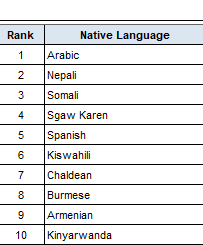
Top Ten Languages spoken by refugees arriving in America.
It’s been a long time since I reported on this information available at the Refugee Processing Center. This is a good time to tell you about it.
Don’t forget! According to aClinton-era Executive Orderyour local and state governments are on the hook for the cost of interpreters.
(By the way, the growing cost of interpreter services, especially involving medical services, is something I never see calculated in any economic study of whether immigrants/refugees benefit the economy.)
Kiswahili is a Bantu language spoken in East Africa. Kinyarwanda is a Rwandan language. Sgaw Karen is a Burmese language.
For my recent posts onCOVID-19see that I have a tag for it.
Editor’s note: As RRW approaches its 13th birthday, there are over 10,000 posts archived here at Refugee Resettlement Watch. Unfortunately, it is just me here with no staff and so it has become virtually impossible to answer all of the basic questions that come into my e-mail inbox or to RRW’s facebook page every day. I don’t want to appear rude—I simply haven’t enough hours in the day.
Please take time tovisit RRW (don’t just read posts in your e-mail) and use the search window in the right hand sidebar and see if you can find the information you need. Also see my series that I wrote in recent months entitled Knowledge is Powerwhich explains some basic principles of how Refugee Resettlement is carried out in the US.
And, lastly, I don’t write that much every day, so if you made a habit of reading my posts here on a daily basis, you would eventually catch on to what is happening because I do link back to previous posts as much as possible. LOL! Thank you for helping me not go crazy!
I’ve reported this news previously, but still get questions about it.
It is wonderful that the President is making it harder for people who would be a burden on our social services (aka welfare system) to stay in the US, but the new rule does not apply to perhaps the heaviest users of our social safety net—refugees.
Factors Government Will Consider under New Public Charge Rule
On the same day the Public Charge Rule went into effect (February 24, 2020), immigrant advocates held a teach-in at Boston City Hall to try to lessen the uncertainty and fear that has been spreading through immigrant communities.
The Administration has stated that the Public Charge “[R]ule will protect hardworking American taxpayers, safeguard welfare programs for truly needy Americans, reduce the federal deficit, and re-establish the fundamental legal principle that newcomers to our society should be financially self-sufficient and not dependent on the largess of United States taxpayers.” However, immigration advocates view the rule as “penalizing poverty”and taking the chance to become self-sufficient away from immigrants, a group of individuals who historically has been an important part of our country and our economy.
Previously, this rule primarily affected those who accepted cash welfare benefits. However, the new rule makes admission to the U.S. more difficult for low-income immigrants and non-immigrants who use other, non-cash welfare benefits. The Department of Homeland Security (DHS) has said that the public charge rule is meant to determine whether a person is likely to use of certain government benefits in the future.To make that determination, officers will review the totality of the circumstances, including an applicant’s income, age, health, family status, assets, credit scores, liabilities, education, and skills (including English language), visa classification sought, and receipt of public benefits. Some factors serve as “negative” factors, others as “positive” factors.
[….]
These groups of individuals will not be subject to the public charge test:
[….]
~Applicants for Temporary Protected Status (TPS), asylee or refugee status, special immigrant juvenile status, or U or T visas.
Editor’s note: As RRW approaches its 13th birthday, there are over 10,000 posts archived here at Refugee Resettlement Watch. Unfortunately, it is just me here with no staff and so it has become virtually impossible to answer all of the basic questions that come into my e-mail inbox or to RRW’s facebook page every day. I don’t want to appear rude—I simply haven’t enough hours in the day.
Please take time to visit RRW (don’t just read posts in your e-mail) and use the search window in the right hand sidebar and see if you can find the information you need. Also see my series that I wrote in recent months entitled Knowledge is Powerwhich explains some basic principles of how Refugee Resettlement is carried out in the US.
And, lastly, I don’t write that much every day, so if you made a habit of reading my posts here on a daily basis, you would eventually catch on to what is happening because I do link back to previous posts as much as possible. LOL! Thank you for helping me not go crazy!
Here are the first few paragraphs of the CIS study:
The Fiscal Impact of Refugee Resettlement
No Free Lunch for Taxpayers
Advocates of expanding the number of refugees admitted to the United States have lately portrayed their position as a win-win — refugee resettlement not only assists the refugees themselves, it also allegedly improves our nation’s fiscal health. The fiscal claim is unsupportable.
Although refugees from earlier generations were often well educated, today’s refugees have fewer than nine years of schooling on average.
Because of their low earning power and immediate access to welfare benefits, recent refugees cost the government substantially more than they contribute in taxes, even over the long term.
Our best estimate of the average refugee’s lifetime fiscal cost, expressed as a net present value, is $60,000, with those entering as adults (ages 25 to 64) costing $133,000 each.
Perhaps this is a price that the United States should be willing to pay to further its humanitarian goals. However, resettlement in the United States may not be the most cost-effective means of aiding displaced people.
I think you will see some cost items that were not considered including costs that may have been shifted by the federal government to state and local tax payers.
460,000 Southeast Asian Refugees Living in Poverty in US!
To illustrate the general point, that refugees are not contributing in any great way, and are not revitalizing cities, but are costing us a bundle (and not just financially, but socially) as they struggle with poverty in America, see this report with a politically-incorrect title from NBC!
But, keep in mind that those pushing the report want even more taxpayer dollars spent on the Southeast Asian refugee ‘community.’
Largest U.S. refugee group struggling with poverty 45 years after resettlement
It’s been 45 years since thousands of Southeast Asian refugees settled in the United States, yet, as a group, they continue to face major socioeconomic challenges that have long been masked under the “model minority myth,” which portrays all Asian Americans as successful, according to a new report.
One of the key findings is that across the country, nearly 1.1 million Southeast Asian Americans are low-income, and about 460,000 live in poverty.Hmong Americans fare worst compared to all racial groups across multiple measures of income.
Read it all. So much for the magic melting pot mythology. And, each and every one cost the US taxpayers a bundle—and they are still costing us 45 years later!
Note to PayPal donors! I want to thank all of you who send me donations for my work via PayPal. I very much appreciate your thoughtfulness. However, PayPal is making changes to their terms of service and I’ve decided to opt-out beginning on March 10, 2020.



 It’s been a long time since I reported on this information available at the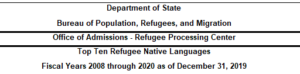



 Note to PayPal donors! I want to thank all of you who send me donations for my work via PayPal. I very much appreciate your thoughtfulness. However, PayPal is making changes to their terms of service and I’ve decided to opt-out beginning on March 10, 2020.