Reader ‘Jan Sobieski’ has launched a new blog critical of the Refugee Admissions Program of the US State Department and the Office of Refugee Resettlement (HHS) entitled Refugee Racket Exposed!
Editor: I’ve been complaining lately about the fact that this subject is becoming way too big for just a few of us to keep up with and report on, so we welcome Mr. Sobieski’s entry into the fray. As a matter of fact, I haven’t said it lately but we need MORE bloggers following all of our LEGAL misguided (insane!) immigration programs. I’m thinking particularly of the Diversity Visa Lottery and Temporary Protected Status and of course Refugee Resettlement. Please consider joining the blogger army—your help is desperately needed.
Here is what Mr. Sobieski says about his mission (emphasis is mine):
The purpose of Refugee Racket Exposed(RefugeeRacket.com) is simple – Expose the refugee and asylum system that has developed in the US and make Congress investigate the fraud and corruption and the negative impact the refugee racket industry has on America and Americans.
The Refugee Racket system is a multibillion dollar racket and controls the importation and/or settlement of over 150,000 refugees and asylum seekers into the US at taxpayer’s expense. I intend to expose the players who game and corrupt the system and to educate Congress about this abused program. Congress needs to dramatically scale back and reform the refugee and asylum industry. Taxpayers are on the hook for the refugees and asylum seekers resettlement in more ways than you can imagine. You pay for all of it. The Refugee Racket is the perfect example of the adage ‘The road to hell is paved with good intentions.’ In America today, it is dangerous to rock the boat. You will be attacked, and in some cases, physically harmed by those within the refugee racket. For this reason, I post under the pseudonym Jan Sobieski to protect myself and my family from harm. If you don’t know who Jan Sobieski is, google it.
Also, please see Mr. Sobieski’s excellent letter to Congress about why an investigation of the whole program must be forthcoming.
Visit Refugee Racket Exposed! You can reach Mr. Sobieski at refugeeracketwebteam@gmail.com.
We are adding Refugee Racket Exposed to our blogroll.
Center for Immigration Fellow, Don Barnett, predicted (in 2004!) the “crisis” we are now seeing before our eyes as tens of thousands of illegal alien minors (mostly male teenagers) are flooding our border and are being treated as asylum seekers and refugees.
Don Barnett: Time for refugee program to come out of the shadows! http://trib.com/opinion/columns/barnett-time-to-bring-refugee-program-out-of-the-shadows/article_b3e35008-b3e1-5552-b0cc-7b72b6ccec5d.html?comment_form=true
There is so much news this morning on the “invasion of America” that I almost don’t know where to begin. So we will start at the beginning—in 2004 during the Bush Administration!
Barnett wondered at the time: Is the U.S. government an active participant in human smuggling operations?
Hereis Barnett in a backgrounder for the Center for Immigration Studies:
When the old Immigration and Naturalization Service (INS) was reorganized as part of the new Department of Homeland Security (DHS), it lost one of its immigration enforcement functions.
The Office of Refugee Resettlement (ORR), part of the Department of Health and Human Services, is now in charge of custody, identification, and release policy for “unaccompanied minors” caught trying to cross the border or caught in the interior.
ORR likes to remind its contractors that their mission is no longer “just about refugees.” The federal agency is a social services agency which dispenses grant money and manages benefits and services for a range of entitled immigrants that now extends well beyond those who come over on the U.S. refugee program. Its clients are eligible for all forms of welfare, but, as well, there is grant money from virtually every program the federal government has ever created (including funds from the tobacco settlement and the president’s “marriage initiative”), to be managed for successful asylum seekers, “Cuban/Haitian entrants,” and holders of “Trafficking” and “Battered Women” visas—all of whom need merely get themselves to U.S. shores with the correct label to qualify for ORR care.
Read it all, it is everything you need to know about the origin of this tragedy for America. It took frankly an evil Administration (using children for their political gain) to bring us to this place ten years later.
Several people reported this headline to me: For First Time Since WWII There Are More Than 50 Million Refugees.
My first thought was directed at the UN—“liar, liar, pants on fire!”—but maybe I should be directing my annoyance at the AP reporters and the headline writer because I wondered how that 50 million “refugees” jives with the Pew study (using UN numbers)that says the number of refugees is down to between 10 and 12 million from a peak in the early 90s of 18 million. (see graph below right)
Iraqis on the move (again) this week. The US takes 20,000 Iraqis a year. Iraqis make up the largest ethnic group we are resettling right now. http://www.newser.com/article/3296c869af544477b0c782c8dd35b352/ap-photos-a-look-at-daily-lives-of-refugees-as-global-count-surges.html
Here is the story, hat tip Judy, that I wasn’t going to waste my time on, but since it is everywhere, I will (waste my time) and post it:
TAZA KHORMATO, Iraq (AP) — In a battered car loaded with blankets and clothes, Hassan Abbas and his mother left a dusty town in northern Iraq, fleeing this week’s violence and joining what the United Nations says is the largest worldwide population of displaced people since World War II.
The U.N. refugee agency’s latest annual report, released Friday, found more than 50 million people worldwide were displaced at the end of last year, reflecting an ever-expanding web of international conflicts.
Last year’s increase in displaced people was the largest in at least two decades, driven mainly by the civil war in Syria, which has claimed an estimated 160,000 lives and forced 9 million people to flee their homes. Now Iraq is adding to that tide.
Notice the word “displaced”—that does not mean they are by definition all “refugees.” Twenty paragraphs into the story we learn this:
Of 51.2 million displaced people worldwide last year, 16.7 million were refugees outside their countries’ borders. More than half of the refugees under UNHCR’s care — 6.3 million — had been in exile for more than five years, the agency said.
That 16.7 million is likely inflated as well, but even so it is still LESS than the peak in the early 1990’s of 18 million.
LOL! This is what I would have picked out of the story for my headline!
On World Refugee Day: Violence in Muslim countries producing most of world’s refugees.
Just a few paragraphs from the end of the AP story:
By country, the biggest refugee populations were Afghan, Syrian and Somali, the report said. [and now Iraqis again, of course—ed]
You know stories like this one from AP are used as propaganda (often effectively with naive Americans and dumb politicians) to soften them up. But, besides the usual do-gooder verbiage about “vulnerable” people, “humanitarian” gestures, and “welcoming” communities would someone please tell me….
What good does it do America to bring a relative handful here? And, why do we want to bring any of their Islam-driven violence and squabbles to America anyway?
This week, as World Refugee Day approaches on Friday (and as Iraq unravels), your news will be filled with much wailing and gnashing of teeth by the humanitarian industrial complex over the plight of millions of refugees on the move around the world (and the only way to save them is for Western nations to fling open their borders).
The Pew Research Center tells us in a useful analysis of the data that the number of refugees on the move is actually down since the peak at the beginning of the decade of the ’90s. Who would have thought it!
Unrest in Ukraine, Syria and Iraq has prompted renewed attention about refugees across the world in recent weeks. But in the face of such news stories, long-term refugee trends are often overlooked.
According to the 1951 Refugee Convention, refugees flee their home country because of political, ethnic or religious tensions.Although millions of people may move within a country to avoid conflict and violence (they are often described as internally displaced people), people must cross international borders to be counted as refugees. (And although generations of Palestinian refugees are counted as part of the United Nations Relief and Works Agency for Palestinian Refugees in the Near East, Palestinian refugees are not included in estimates by the Office of the United Nations High Commissioner for Refugees.)
Using trend data from the UNHCR for 2002 to 2012, here are five facts – in marking of World Refugee Day on June 20 – that shed light on the changing shape of refugee populations around the world.
The number of refugees has fallen:
The number of refugees living in a foreign country who are either waiting to return or be resettled peaked in the early 1990s at about 18 million. During the 1990s peak, most of the world’s refugees were leaving Afghanistan, Iraq and other countries in sub-Saharan Africa. In 2012, Afghanistan, Somalia, Iraq and Syria were top countries of origin for refugees [mostly Muslims—ed].But despite the ongoing conflicts in these countries, the number of refugees around the world is considerably less than it was two decades ago, numbering between 10 million and 12 million in recent years.
And, remember, this week the push is on on Capitol Hill to persuade your elected officials that we need to take more refugees and throw more money to the contractors***. See, for example, Lutherans bring 50 refugee lobbyists to Washington. This is also the week for you to let your Member of Congress and US Senators know how you feel. Let Rep. Trey Gowdy know too!
Editors note: Here is one more testimony sent to the US State Department in response to their federal register notice for public comment on the “size and scope” of their Refugee Admissions program for Fiscal Year 2015. As readers know, the State Department is not allowing public review of any testimony submitted including the federal contractors’ *** testimony in which they invariably ask for more refugees. By the way, Tennessee is a Wilson-Fish stateand as such Catholic Charities of Tennessee calls the shots on who is resettled there.
May 27, 2014
Ms. Anne Richard
Asst. Secretary of State for Population, Refugees and Migration
US State Department
Washington, DC
Re: Federal Register Public Notice 8690
Dear Ms. Richard,
Please accept my written comments regarding FY 2015 U.S. Refugee Admissions Program. I recently learned that unlike prior years, there will be no public hearing this year. If ever there was a federal program that should be required to appear in public to answer questions and justify any funding, it is the one you oversee. The federal refugee resettlement program has increasingly operated without sufficient public scrutiny or meaningful input from all stakeholders.
As defined by the U.S. Office of Refugee Resettlement in the 2011 report to Congress(the last report submitted), resettlement stakeholders include: resettlement agencies, state refugee coordinators, refugee health coordinators, ethnic community-based organizations and ORR technical assistance providers.
The federal contractors’ proposed resettlement numbers are never made public prior to acceptance and award of federal funds. The very communities that are directly impacted are not considered stakeholders nor offered any opportunity prior to award for meaningful input into these decisions. This past year I spent a considerable amount of time and effort using FOIA and was still unable to have last year’s resettlement proposals disclosed.
This information should not be subject to FOIA. In fact, the information should be posted on the State Department’s website prior to acceptance and award of federal funds. There is nothing proprietary about how many people a federal contractor plans to bring to a community. Treating this information as “behind closed doors secrets” strongly suggests that the information is withheld from the public because of concern about community resistance to the federal government’s plans.
Years ago I served as a volunteer with a resettlement agency. Over time I have watched this program be transformed into an industry for government contractors with little to no oversight, transparency or accountability to taxpayers. The Cooperative Agreement which VOLAGs execute requiring that federal funds only “augment” privately raised funds is simply ignored. For example, Catholic World News reported in August 2012 that “Federal funds account for nearly 93% of USCCB’s migration/refugee budget…that over 92.5% of [their] $72.1 million budget came from federal grants and contracts while under $25,000 came from private donations.”
Nor is the USCCB the exception among the nationally contracted VOLAGs.
Federal grants include the likes of “Healthy Relationship and Marriage Research,” “Refugee Home Based Childcare Microenterprise Development Project” and “Preferred Communities” just to name a few. A rational approach to helping refugees and their children integrate more quickly into their new communities and Western culture, suggests that rather than using even more government funding to employ women in home-based childcare enclaves, the money would be better spent if at all, putting these children and mothers into existing community-based childcare settings.
While federally funded Ethnic Community Self-Help organizations and Mutual Assistance Associations are made to sound like good ideas, in reality they are yet one more avenue to funnel public dollars to refugee based organizations that use public dollars to claim refugee employment. Rather than assist refugees to integrate or even marginally, assimilate into their new communities, these organizations are designed to “ensur[e] that their charges retain strong ethnic and homeland ties.”
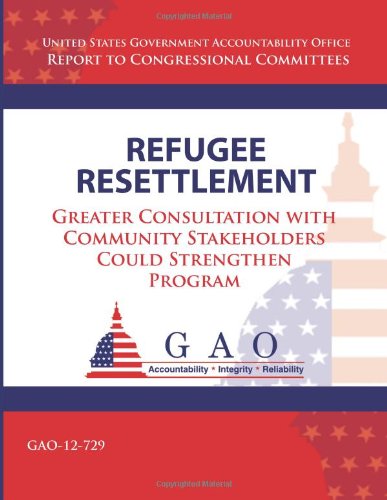
The per capita funding structure incentivizes resettlement contractors to increase their numbers regardless of whether it results in a lower standard of services provided to refugees. The 2012 GAO report “Greater Consultation with Community Stakeholders Could Strengthen Program” validates this position:
“Because refugees are generally placed in communities where national voluntary agency affiliates have been successful in resettling refugees, the same communities are often asked to absorb refugees year after year. One state refugee coordinator noted that local affiliate funding is based on the number of refugees they serve, so affiliates have an incentive to maintain or increase the number of refugees they resettle each year rather than allowing the number to decrease.”
Any attempt at objective discourse about how contractor resettlement business impacts the community in which they operate, is met with disdain. Local affiliate offices do not hesitate to publicly denigrate any taxpayer who raises legitimate questions about the functionality and cost of the program. Propaganda films like “Welcome to Shelbyville” are used to mislead the public and suggest that anyone who looks askance at the resettlement industry, is at best, just “unwelcoming” but more likely, a racist and a bigot.
The State Department’s blog entry dated May 27, 2011 notes that “Welcome to Shelbyville” was shown by your office, PRM, at the State Department on May 25 2011 to an audience of 120 that included representatives from NGOs, refugee resettlement agencies, the State Department, and other U.S. government agencies. Did you bother to share with them the other side of the Shelbyville story as reported in the local paper?
This “documentary” is pure propaganda for the federal program, obscures important facts about the program’s impact and worse, is used to silence legitimate concern about the resettlement industry. No federal agency should be permitted to use it.
States should have final control over resettlement activities within their state borders
Since states incur the on-going, long-term cost associated with refugees, states should have complete control over resettlement activities within their borders.
The 1981 Select Commission on Immigration & Refugee Policy (“Select Commission”), repeatedly addressed the financial impact on receiving communities. “Many state and local officials are concerned that the costs of resettlement assistance will continue beyond the period of federal reimbursement and that the burden of providing services will then fall upon their governments.”
The Select Commission seemed to well understand the fiscal issue for a federal program where the long-term costs would be passed to state and local governments. “Areas with high concentrations of refugees are adversely affected by increased pressures on schools, hospitals and other community services. Although the federal government provides 100 percent reimbursement for cash and medical assistance for three years, it does not provide sufficient aid to minimize the impact of refugees on community services.”
In 1982, just two years after the 1980 Refugee Act was passed, reduction in federal support started with federal cash and medical assistance reduced to 18 months. In 1988 it was reduced again to 12 months and again in 1991 to 8 months, which remains the current level. In 1986, the federal government began to reduce reimbursement to states for the state-funded portion of welfare, Medicaid and SSI, eliminating it altogether by 1991 and shifting these additional costs to the states.
The cost shift has been openly and repeatedly acknowledged by the federal government. And yet, these enduring costs are never acknowledged when calculating the true dollar cost of the program. The 2010 Senate hearing started to identify the significant costs states are forced to incur because of the federal program.
The U.S. Office of Refugee Resettlement places such a high premium on shifting refugee healthcare costs to states, that the 2013 ORR Voluntary Agencies Matching Grant Program Guidelines on page 9 states that: “ORR recognizes that weekly cash payments may make certain MG cases ineligible for the USDA Supplemental Nutrition Assistance Program (SNAP) and Medicaid. Thus, local Matching Grant Program service providers may give some of the weekly allowance in the form of vouchers if such a form of payment is in the overall best interest of the client and he/she concurs.”
In other words, circumvent the program’s rules to shift more cost to the state taxpayer. State governments that decided to expand their Medicaid programs probably did not anticipate that this year’s Department of Health and Human Services briefing on “Key Indicators for Refugee Placement” would so quickly advise considering Medicaid expansion when deciding refugee placements.
With regard to states that have withdrawn from the resettlement program, the federal government does not have the legislative authority to assign an NGO to continue the program in that state. This unconstitutional encroachment on the 10th amendment right of states is barred both by law and U.S. Supreme Court decisions and must cease.
Additionally, states should not be subject to the poor judgment exercised by the Obama administration’s decision to relax security screenings for certain groups of refugees.
“Self-sufficiency” terminology should be replaced with specific reporting on public assistance utilization, temporary v non-temporary employment and the number of refugees resettled each year who are considered to be “unemployable”
Despite documentation of high percentages of Medicaid and food stamp utilization, high “self-sufficiency” rates are reported by the refugee resettlement contractors. It is misleading to describe anyone, including refugees, as self-sufficient when they also receive publicly funded assistance in the form of food stamps, Medicaid and public housing. And still federal contractors are able to report high self-sufficiency rates for refugees as long as they do not receive cash welfare.
A January post on the “Friends of Refugees” blog posted the following about Bridge’s Knoxville resettlement operations: “A former case manager also sent us information about the agency and pointed out that the refugee employment figures are dishonest as most of the refugees have only temporary employment that does not help them to pay rent and be self-sufficient. The nature of the temp jobs also means that the refugees will be unemployed just a short time after the agency reports them employed to the federal Office of Refugee Resettlement (ORR) at 90 days and 180 days. (This, however, is a problem throughout the refugee program, and it doesn’t seem that the the ORR has much of an interest in requiring that resettlement agencies report if refugees are working at temporary or non-temporary jobs.)”
Public health issues should be resolved before funding more initial resettlement
TB among resettled populations has been a particular public health concern. It was reported in 2009 that the sharp increase in Minnesota’s active TB cases was tied to refugee resettlement. Because latent TB is not a bar to refugee admission, health officials have expressed concern about cases of drug-resistant TB being documented in communities with high refugee resettlement.
In 2012 the CDC reported that TB in “foreign-born persons increased to 63% of the national case total,” a percentage that has risen steadily since 1993.
More recently it was reported that “immigrants and those who travel to other countries frequently have the highest TB occurrence,” and that “many of these cases–approximately 450,000–are the drug-resistant form of TB that has developed from improper medication usage and medical protocols.”
In April, 2012, the U.S. Office of Refugee Resettlement circulated a grant announcement titled “Strengthening Surveillance for Diseases Among Newly-Arrived Immigrants and Refugees” since it appears that there is no comprehensive tracking of this particular segment of public health concerns. More government money to throw at a government created problem.
Reports of depression and PTSD are now being reported as reasons that some refugees are unable to work. Among Bhutanese refugees that are being resettled, the CDC has documented a troubling statistic; a suicide rate higher than the national and global average. One explanation offered has been the lack of jobs and the resulting stress of unemployment not matching expectations of life in the U.S.
Conclusion
Public funds are spent, hearings are held, reports are published and yet, nothing is done proactively to respond to the problems and issues that are highlighted.
The federal agencies involved in refugee resettlement have enabled the growth of an industry
layered with ever multiplying federal grants but extraordinarily lax on transparency and accountability. Currently, the U.S. refugee resettlement program is administered in derogation of a state’s right to withdraw from the federal program and a state’s right to set state level funding prerogatives.
Proposed resettlement plans should be made publicly available before any award of funding and be subject to public comments and public hearings. Moreover, the U.S. Office of Refugee Resettlement is at least two years delinquent in submitting the required annual report to Congress. No funding should be appropriated until all reporting requirements are met. Importantly, the last annual report dated 2011, noted the increased difficulty in finding employment for non-English speaking refugees, especially in light of higher unemployment rates among Americans, a situation that has not improved much since then.
Rather than compounding the problems already identified, it may be time to temporarily suspend the resettlement program and focus on the health and employment needs of refugees already here. At the same time, an objective examination of security screening measures should be undertaken.
Please ensure that a copy of the entire written record is timely made available to the public.
Respectfully submitted,
Joanne
Tennessee
Endnote: All of our posts on this year’s public comment period may be found in our category entitled “Testimony for 5/29/2014 State Dept. meeting” here.
If you have testimony you wish us to publish, see my e-mail address in the right hand sidebar.