WSJ Opinion piece: we need immigration stimulus

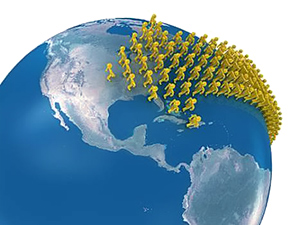
Gordon Crovitz writing in the Wall Street Journal  this week argued for increased immigration to stimulate the economy.  Frankly his argument makes no sense to me.  If he were arguing for allowing some of the world’s best and brightest, then that makes some sense but he also argues for more unskilled laborers and amnesty for the illegal aliens already here.    Read his whole argument, here.   And consider it in light of yesterday’s post on the CIS study about the very high levels of unemployment among immigrants in the US right now—even the highly educated are not working.

One thing (of many things he said!) that I found puzzling was this comment:

It usually pays to be skeptical about immigration reform, given the alliance between nativists and labor unions for tighter borders. Still, an economic downturn is the right time to move on immigration, one of the few policy tools that could clearly boost growth.

I don’t know what alliance he is talking about, we see labor unions eager to get immigrant labor members.   The SEIU (Service Employees International Union) is organizing Somalis as just one example.

New Report: Immigrant unemployment at record high

We knew this anecdotally, but now comes a report out today from the Center for Immigration Studies to confirm it.

WASHINGTON (April 30, 2009) – A new report from the Center for Immigration Studies finds that immigrants have been harder hit by the recession than natives. Unemployment among immigrants (legal and illegal) was higher in the first quarter of 2009 than at any time since 1994, when immigrant data was first collected separately. This represents a change from the recent past, when native-born Americans had the higher unemployment rate.

Read all the findings here.  Especially take note of the findings that confirm that highly educated immigrants are having a harder time finding jobs too.  We knew that already from our extensive coverage of the Iraqi refugees.

How many are in the U.S. from each country?

I came across this interesting chart that lists the percentages of countries’ native populations residing in the U.S.  It’s an odd metric, because a large country such as Mexico has a higher number of its native-born people living here (11.7 million!) than a smaller country such as Guyana (244,000), while Guyana’s percentage is 31.8 percent versus Mexico’s 10.8 percent.  The numbers seem to be more useful to the other countries than to us.  From our point of view, it’s more important that there are over 11 million people here who were born in Mexico than what the percentage is; from the Guyanese point of view, it would seem a desperate matter that almost a third of the people who were born there have moved to the United States, even though the absolute number is a small fraction of Mexico’s.

Hat tip: John Derbyshire, via The Audacious Epigone.

CAIR orders Muslims: no more cooperation with FBI

When I reported on Somalis in Minneapolis balking at cooperating with the FBI, I didn’t realize this is probably connected to the policy of CAIR (Council on American-Islamic Relations) not to cooperate with the FBI.  The Los Angeles Times reports Some influential Muslim groups question FBI’s actions. The subhead reads:

Revelations that the agency has been surveilling popular leaders and infiltrating mosques and schools has many organizations turning away from their post-9/11 cooperation.
The piece begins:
As they sipped tea and nibbled on dates, more than 100 men and women listened to a litany of speakers sounding the same message: The FBI is not your friend.

“We’re here today to say our mosques are off limits,” Hussam Ayloush, executive director of the Council on American-Islamic Relations for Greater Los Angeles, told the crowd last month at an Anaheim mosque.

“Our Koran is off limits,” Ayloush said. “Our youth, who they try to radicalize, are off limits. Now is the time to tell them, ‘We’re not going to let this happen anymore.’ “

Such strong words from a man who once was a vocal advocate of ties with federal law enforcement was yet one more signal that the fragile relationship between Muslim American groups and the FBI is being tested.

….On Sunday, a coalition of the nation’s largest Muslim organizations, including the Council on American-Islamic Relations, the Muslim Public Affairs Council and the Islamic Society of North America, issued a statement demanding that the Obama administration address FBI actions, including what they describe as the “infiltration of mosques,” the use of “agent provocateurs to trap unsuspecting Muslim youth” and the “deliberate vilification” of the council.

It appears from the article that the Muslims were cooperative until the FBI actually found terrorist activities among them, including in their mosques. So no more cooperation. And imagine, it surveilled “popular leaders.” I guess if a leader is popular he can’t be involved in terrorism. Or maybe it just doesn’t matter.
 
The Somalis must have gotten the word. They might be concerned about their missing youths, but not enough to cooperate with the FBI in finding out what’s going on.
 
Hat tip: Robert Spencer.

Somali reports on aggrieved Somalis and FBI

The University of Minnesota newspaper ran an article last week titled FBI continues questioning U students.  It begins:

The disappearances of young Somali men from Minneapolis, including two students from the University of Minnesota, have resulted in numerous students being questioned by the FBI, both on and off campus.

The federal agents have been visiting students in high schools, colleges and the University for information about the missing Somali men.

The Council on American-Islamic Relations is calling on colleges to provide more legal help for students and also says students have been approached by the FBI while walking to class and in the library. Students have also received calls from investigators.

The piece goes on to focus on one student who was interviewed, who said federal agents are “terrorizing” her family, and the rights of students not to talk to law enforcement. It concludes:

 The FBI did not return a call for comment on this story.

Not too much context is provided, I thought as I read it. Kind of one-sided. And then I looked at the author’s name: Ibrahim Hirsi, a Somali name. Is that how it works? Reporters from an aggrieved group get to do the reporting on the grievances?