
Maine: Gee, no jobs for educated refugees, what a surprise!

Nor are there jobs for your college graduate kids!

Just now as I turned off the TV, President Obama was being interviewed about how to create more jobs and yesterday the Republicans were announcing their plan to flood the job market with both uneducated and educated immigrants for their big business donor friends, yet here is a story from Maine boo-hooing about no jobs for educated refugees!
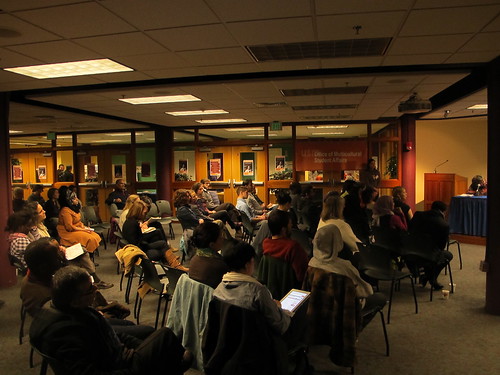
University of Southern Maine audience listens to plight of refugees who can’t find work!

From Maine Public Broadcasting Network.  (Hat tip: ‘pungentpeppers’)  An Iraqi with a college degree from Iraq took part in panel discussion on jobs hosted by Catholic Charities of Maine among others.  I guess there are no more struggling job-seekers among the Americans in Maine!

Portland resident Sarah Mahdi came to the U.S. with a college degree, but, like many immigrants, has had trouble getting it recognized in the U.S. It’s not an unusual problem. Maine educators and other service providers are now looking for ways to make it easier for educated immigrants to find suitable jobs or further their educational opportunities.

[…..]

“When I first came to the States I just wanted to study,” said Mahdi, who was among a handful of immigrant students sharing their experiences Wednesday night at a panel discussion in Portland. The panel was organized by the University of Southern Maine’s Office of Multicultural Student Affairs, and Catholic Charities Maine.

New Mainers Resource Center uses tax dollars to help immigrants prove they actually have a legitimate college degree.

One place immigrants can turn to is the newly-established New Mainers Resource Center, one of the several service providers on hand at Wednesday night’s event to offer advice. The center’s program co-ordinator, Sally Sutton, is talking to George Dakonsa, who arrived here from the Democratic Republic of Congo seeking asylum four months ago.

“I have a bachelor’s degree in economics and finance,” he says. “I’d like it if they can help me to evaluate.”

The center was recently opened by Portland Adult Education with the aim of specifically helping college-educated immigrants in their search for suitable employment or further education. Co-ordinator Sutton says with immigrants like Dakonsa come an opportunity to breathe new economic life into the state.  [Would someone please explain exactly how they are breathing new economic life into the state!—ed]

That bad ‘ol Maine governor is at it again—-how dare he try to balance the state budget!

The New Mainers Resource Center, however, may end up being a short-lived venture. It’s meant to be a two-year pilot project funded at $75,000 a year.

But the program could be eliminated after its first year – just one small part of the nearly $34 million in spending cuts being recommended in a report commissioned by the LePage administration, looking for ways to balance the two-year budget.

Governor LePage needs to continue working on something else!  Maine has become a go-to state for asylum seekers.

Check out this article from The Free Press from earlier this month:

Maine has become known to many central African asylum seekers as a place where they can find community support as well as temporary financial assistance while they have their visas and work permits approved. Often they arrive on tourist or business visas, sometimes with forged documents. While many asylum seekers are well educated and come from financial means, the money doesn’t last long and many end up in homeless shelters while their applications are being processed.

Maine happens to be one of a handful of states that does not require proof of citizenship. All asylum seekers must show is that they are applying for asylum. Unlike official refugees, such as many in the Somali and Sudanese populations who are resettled in Maine by the U.S. State Department [and Catholic Charities—ed], asylum seekers do not qualify for any other state or federal benefits while they are applying for asylum. The whole asylum approval process can take from one to two years and it typically takes at least 150 days for asylum seekers to be eligible to legally work once approved for asylum.

See also, Maine the welfare magnet one of our top posts of all time.

One more thing….so much for the importance of educated refugees!

Reader ‘tomasrose’ sent us this comment to our earlier post about Bhutanese low-skilled laborers and the US State Department (as headhunters) bringing them in for businesses:

I spoke with a refugee from the middle east just last week and he confirmed, of course, refugees are coached in what to say to improve their chances at coming to the U.S.. One of the things he said is they hide any education they might have. If the U.S. thinks you are educated your chances of moving to the U.S. are lower. He cited an M.D. from Baghdad who told refugee officials he was a menial laborer and, presumably, would be happy to work the same jobs in the U.S.. Had he advertised his credentials as a doctor, he would have a better chance at going to one of the Scandinavian countries, but to get the U.S. he had to really dumb his resume down.

Bhutanese refugees, depressed, accuse UN of separating families

We have written a lot lately about Bhutanese refugees in America with a very high rate of suicide. Here is one story I’ve had kicking around from New Hampshire that I never got around to posting.

But, this was a big surprise to me.  It seems that refugees left behind in camps in Nepal are also depressed and are developing serious mental illnesses.   This is just a reminder to the do-gooders who think bringing refugees to the West and dropping them off in troubled city neighborhoods to work as cheap laborers is always an act of kindness, consider this news:

From ekantipur.com (emphasis is mine):

 Though third-country resettlement of Bhutanese refugees has provided relief to many, the initiative has been the cause of pain for some.

Durga Devi Odari, who was once a lively, happy person, has been on medication for the past three years. Odari went into a state of depression when her parents were flown to the USA and her brother to New Zealand. Her dreams of settling abroad, for which she even divorced her husband, were shattered.

She can’t find her parents!

“I am not sure about finding my parents and I do not know if I will ever be able to find my loved ones,” said Durga.

Durga’s case is not an isolated one: many refugees awaiting resettlement are battling with depression. As the number of people in the camps decreases, depression is becoming a serious issue for those remaining.

Though the United Nations High Commissioner for Refugees (UNHCR) and Transcultural Psychosocial Organisation (TPO) has not officially confirmed the numbers of those with depression, mental disorders, and drug dependency inside the camps, the increase in activity of the TPO, which specialises in providing counselling services, has fuelled speculation that the number of those facing depression is increasing.

Refugees claim UN has separated families!

While the UNHCR has made assurances that they would not separate families without parental consent, some refugees claim that the UNHCR’s actions demonstrate otherwise.

The UNHCR has been working with TPO since 2008, two years after the initiation of the resettlement process.

According to Sanchahang Subba, Secretary of the Beldangi Camp, he receives hundreds of letters per day by those seeking the whereabouts of their loved ones.

How did we come to bring 70,000 Bhutanese to America?    

In 2007: Ms Sauerbrey blamed the refugee leaders in the camps in Nepal for the “intimidation”.

We’ve been writing about this subject since 2007 when then Asst. Secretary of State Ellen Sauerbrey (a Bush appointee) announced the decision to help the UN clean out its camps for Bhutanese/Nepalese in Nepal.  Here is one re-cap.   Keep in mind the UN and our State Department were never in a hurry to clean out the Palestinian “refugee” camps.

Just now I was looking around further on the history of all of this and was reminded that camp leaders were furious when the third country resettlement began and I suspect the woman in our story above, who divorced her husband to try and be resettled with her parents, was probably married to a camp political leader.  The leaders wanted to keep the pressure on Bhutan to take them back until we stepped in and brought tens of thousands of them to the US to work in meatpacking and other menial labor jobs.

Other than our need for cheap labor (and the contractors’ needs for refugee numbers because they are paid by the head!), what was our national interest in getting involved in a dispute involving Nepal and Bhutan?

Here is another writer a year ago on the same topic.

The photo is from this BBC story where Sauerbrey said sending the Bhutanese to western countries (the US took the lion’s share) was all done for “humanitarian” reasons.

Ann Coulter: GOP crafts immigration plan to wreck the country

Coulter: Will they bundle contributions for Eric Cantor’s re-election, as well-heeled donors will?

Author and columnist Ann Coulter has long maintained that immigration both legal and illegal is the most critical issue facing America today.  Yesterday she penned this column blasting Republicans (this includes elected officials like Sanderson in Tennessee) who can’t see that what they are doing will kill America as we know it with the Republican Party as the first casualty.

Coulter (hat tip: Ed):

As House Republicans prepare to sell out the country on immigration this week, Phyllis Schlafly has produced a stunning report on how immigration is changing the country. The report is still embargoed, but someone slipped me a copy, and it’s too important to wait.

Leave aside the harm cheap labor being dumped on the country does to the millions of unemployed Americans. What does it mean for the Republican Party?

Citing surveys from the Pew Research Center, the Pew Hispanic Center, Gallup, NBC News, Harris polling, the Annenberg Policy Center, Latino Decisions, the Center for Immigration Studies and the Hudson Institute, Schlafly’s report overwhelmingly demonstrates that merely continuing our current immigration policies spells doom for the Republican Party.

Immigrants — all immigrants — have always been the bulwark of the Democratic Party. For one thing, recent arrivals tend to be poor and in need of government assistance. Also, they’re coming from societies that are far more left-wing than our own. History shows that, rather than fleeing those policies, they bring their cultures with them. (Look at what New Yorkers did to Vermont.)

This is not a secret. For at least a century, there’s never been a period when a majority of immigrants weren’t Democrats.

At the current accelerated rate of immigration — 1.1 million new immigrants every year — Republicans will be a fringe party in about a decade.

Ruling class Republicans like the cheap labor too!

Republicans have no obligation to assist the Democrats as they change the country in a way that favors them electorally, particularly when it does great harm to the people already here.

Yes, it’s great for the most powerful Americans to have lots of cheap, unskilled labor. Immigration definitely solves the rich’s “servant problem.”

You lose!

It’s terrific for ethnic lobbyists whose political clout will skyrocket the more foreign-born Americans we have.

And it’s fantastic for the Democrats, who are well on their way to a permanent majority, so they can completely destroy the last remnants of what was once known as “the land of the free.”

The only ones opposed to our current immigration policies are the people.

There is much more! Read the whole column here.

Professor: War on poverty should include refugees

But, but, but….we are told that refugees are self-sufficient very quickly—that they are not costing federal, state and local taxpayers much! In fact, we are told repeatedly that they are actually adding to the local economy!

Although it’s an overt pitch for more taxpayer dollars for refugee resettlement, there are a couple of points worth making about this opinion piece by Dr. Jill Koyama at The Huffington Post.

Dr. Jill Koyama: “…refugees funneled into pipelines of poverty.”

First, for long time readers, you know that the Resettlement contractors are always bragging about how quickly refugees become self-sufficient and get off welfare.  You know it can’t be true or why would this author and others suggest refugee programs need more money from the US taxpayer.  The contractors can’t have it both ways!  Either refugees are in poverty or they are quickly self-sufficient.  Which is it?

If they need more money from the taxpayer to survive, then we are led to two obvious questions:  WHY ARE WE IMPORTING POVERTY?  And, if we can’t afford them, why not lower the numbers being admitted to the US each year?

Dr. Koyama, in her op-ed, is pushing for more English language training and says of the system now:  “…refugees are funneled into pipelines of poverty, with little hope of upward mobility.”

Here she makes a point we often make on these pages—a driving force behind refugee resettlement, for all its talk of helping the world’s downtrodden, is driven to a large degree by employers wanting cheap reliable laborers.  Once the first refugees move upward, employers need to import more at the lower rungs.

My two-year anthropological study, ending last March, of the educational and employment networks of 100 refugees in upstate New York confirms that a lack of English proficiency pigeon-holes refugees into low-wage service and shift work with limited possibilities of promotion. In fact, one fourth of the 12 employers interviewed preferred to hire refugees with “just enough” English skills who were, as one employer stated, “less likely to leave when they landed better paying jobs with more English.” According to the director of a refugee resettlement agency in the area, the focus on getting a job quickly leads many refugees to accept positions below their abilities, especially because refusing any job can jeopardize the receipt of benefits used to support their families, especially their children. This has multi-generational effects on educational outcomes and livelihoods for refugee children and children born in the U.S. to refugees.

A reminder to readers, the Refugee Act of 1980 also foresaw a public-private partnership where the contractors were supposed to use some of their own resources and not use the federal taxpayer as a piggy bank.  I am fully convinced that contractors could, if they worked at it, find enough people willing to do charitable work to teach refugees English without further dipping into the US Treasury.

Update from Appleton: community meeting puts refugees on display

They say it was planned before the latest uproar about Appleton, Wisconsin and whether it could support more needy refugees, but this—a show and tell of sorts—is a standard practice for refugee contractors like World Relief.  They know if they can showcase some happy refugees it becomes easier for them to demonize anyone who objects to more resettlement as motivated by racism and xenophobia when residents are simply concerned with the economic viability of the plan.

Be sure to see our previous post on Appleton a few days ago, but don’t miss this morning’s post, also from Wisconsin, about Somali gang fights coming across the border from “welcoming” Minneapolis.

Myriam Mwizerwa appears to have moved from Nashville World Relief to direct resettlement from Oshkosh.

From Post-Crescent Media:

The long-scheduled educational panel came on the heels of a weeklong controversy after Alderman Jeff Jirschele raised concerns about preparations for the 75 refugees due to arrive this year from Congo, Iraq and Myanmar.

[….]

Myriam Mwizerwa, the Oshkosh director for World Relief Fox Valley, explained that refugee status is a narrow classification determined by the United Nations. Rounds of interviews determine if individuals meet the persecution requirements based on race, nationality, religion, political opinion or social affiliation.

“A refugee is not someone who has fled due to an economic or natural disaster,” Mwizerwa said. “Only refugees whose lives are threatened and that have crossed into another country for asylum qualify.”

Regarding the above comments, many of the refugees we are accepting into the US are not in danger for their lives.  I’d like to know how many rounds of interviews convicted murderer Esar Met had before being granted permission to enter the US.  And, keep in mind the Senate-passed Comprehensive Immigration Reform bill would do away with refugees having to prove they are persecuted personally at all.  If S.744 (which World Relief lobbies for) should become law, whole classes of people will be considered eligible.  For example, just being a Somali, an Afghani, or a Rohingya would get you in automatically.

Ms. Mwizerwa continues:

After achieving the status, host countries begin resettling the refugees. Last year the U.S. took 70,000 refugees — a number set by Congress that will remain the same for 2014.

Congress does not set the number the President does in his annual determination letter.  Congress could change the numbers, but as far as I know they just rubber-stamp whatever the President wants.

U.S. communities accept 80 percent of the world’s refugees, Mwizerwa said, but that’s less than 1 percent of the 14 million worldwide refugees seeking a move.

After the two-year vetting process by the U.S. State Department and Federal Bureau of Investigations, the refugees are handled by the contract agency, in this case World Relief.

Two years?  I have never heard an exact time-frame for vetting.

“We have 90 days to help make people self-sufficient,” Mwizerwa said. “In that time we do the airport reception, help with housing, food, basic needs and do a community orientation.”

Almost none are self-sufficient in 90 days.  She only means that the federally-supplied contractor’s bucks start to run out.  It pretty much means they have 90 days to get the refugees signed up for welfare.  There is nothing that says World Relief can’t find private money to keep them afloat.

And, if refugees are becoming self-sufficient in 90 days, why do we have articles published like this one just yesterday at The Huffington Post—In the war on poverty, don’t forget the refugees!

The airfare for refugees is considered a loan, and eventually paid back. Each refugee receives about $925 for the 90-day period for essentials, a one-time gift, Mwizerwa said.  [A gift from the US taxpayer—ed]

Again, not the whole truth.  Yes, the refugees are required to pay back the airfare, but how many do so is a tightly held secret at the State Department; and World Relief takes a cut of whatever they can wring out of the poor refugees as their reward from the State Department for their collection agency services.

Refugees are eligible for permanent residency status in the U.S. after a year, and after five years can apply for citizenship. They only face deportation if they are convicted of a crime.

I would love to know how many are ever deported, even the rapists and murderers get to stay.  We did have some reports of Somalis being deported, but I’ll bet its a tiny handful.

Mwizerwa said the decision on a specific community is largely based on history.

The decision is really based on whether they (State Dept and its contractors) can get away with flooding a city with impoverished people before the local complaints get too noisy.  I call it the “squawk factor.”  The squawk factor seems to be coming into play in Appleton.    And, it depends on how demanding the local business community is for cheap laborers.  By the way, the State Department, the Office of Refugee Resettlement and their contractors are always out scouting now for new “welcoming” territory in which to drop off refugees.

Photo is here at World Relief Nashville unless there is more than one Myriam Mwizerwa.

If you’ve never checked out our Refugee Resettlement fact sheet, check it out here now.