
Kentucky considers extending highschool graduation age to refugee teens

And, it would mean more expense for the “welcoming” community and “welcoming” Kentucky thanks to Catholic Charities of Louisville.*
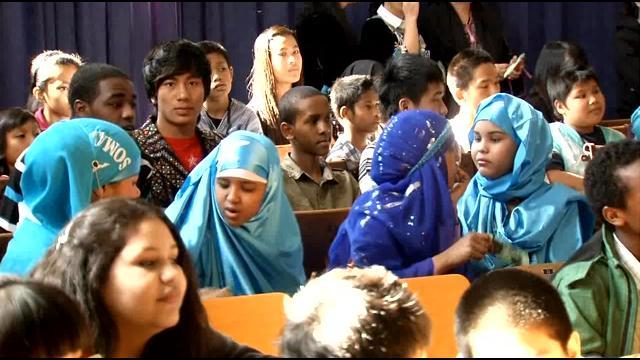
Refugee kids in Louisville’s Newcomer Academy.
http://www.wdrb.com/story/21818015/global-homecoming-at-the-jcps-newcomer-academy

From WFPL News (hat tip: Robin):

Thang Lian is a resettled Burmese refugee student who attends Jefferson County Public Schools’ Newcomer Academy. In March, he turns 21, which means the district can no longer financially support his education.

So he’ll have to choose another path.

“My parents and my counselor were talking about next year I move to GED,” he says.

For some the GED high school equivalency diploma is an option; others may enroll in Jefferson County’s online alternative program.  [Take it from me, there is nothing wrong with going the GED route!  And, some one of the refugee contractor organizations could provide charitable tutoring along the way!—ed]

On Tuesday, Kentucky’s House Education Committee approved bill that would give refugee students like Lian an additional two years to graduate, extending state spending for these students to age 23.

Concerns center on additional costs and the fairness issue.  Although not raised here, do we want 23-year-olds in school with 14-year-olds?

But the Kentucky Department of Education is concerned about parts of the bill. For example, there could be additional costs to the state and local districts and equity issues could arise, like not providing the same opportunity for special education students, education department officials say.

Refugee overload in Jefferson County?

As WFPL previously reported, officials estimate more than 500 school-age children have been resettled in Jefferson County alone over the past year. That number is expected to rise, officials say.

[…..]

Further, data from the Kentucky Office of Refugees (aka Catholic Charities) shows over 100 refugees between the ages 14 and 17 have been resettled each year throughout the state over the past several years.

* Louisville is the center of Jefferson County.

Thank Catholic Charities!

So who is bringing all the refugees to Louisville?  Why it’s none-other than Catholic Charities of Louisville which is coincidentally also the Kentucky Office for Refugees.  Gee, sounds like Tennessee where Catholic Charities calls the shots on the demographic change for the state.   Progressive Catholics are busy changing the South!

We wrote about them just last month here.

Check out a recent Form990 for Catholic Charities of Louisville.  On page 9 note that their income was $13,179,017 and you (taxpayers) gave them $11,349,920 of that through government grants.

Thank Catholic Charities too for bringing all the Muslims to Louisville where 8 mosques now serve the growing Muslim community….

… including thousands of refugees from such lands as Afghanistan, Iraq, Somalia and the former Soviet Union and Yugoslavia.

A trip down memory lane:  In 2007, then Bush Asst. Secretary for refugees, Ellen Sauerbrey, told an audience in Louisville that we bring refugees to America to keep them from becoming terrorists!  Funny in light of the fact that Kentucky should have been the home for those two Iraqi refugee terrorists subsequently caught there.

See yesterday’s post about how many refugee teens are not finishing high school.  Maybe Catholic Charities could offer tutoring services through private charitable giving (of time or money) by local Catholics, or better still, give all those refugee kids free tuition to private Catholic schools until age 23!

Pittsburgh: Bhutanese have more health problems

Last week we reported on the mental health issues plaguing America’s 70,000-strong Bhutanese refugee population and now according to reporter Erika Beras, here at New America Media, it seems they are also being plagued by diabetes they got after arriving in America.  Type II diabetes is associated with too much weight gain.   Sure is a good thing Obamacare has come along to take care of them!

And get this!  Pittsburgh now has 4,000-5,000 Bhutanese (mostly Hindu) refugees.   That population growth is only since 2008!

Bhutanese family in Pittsburgh sees first snow! Reporters love these refugee snow stories! http://www.alleghenyfront.org/story/new-natural-world-bhutanese-refugees-brave-pa-weather

From New America Media:

On a typical weekday morning, 47-year-old Tek Nepal is moving about the Mount Oliver duplex he shares with his wife, sons, daughter-in-law and grandchild.

He works nights, so he gets his family time in the mornings. And often, that time centers around eating. Those meals used to consist of lots of starches. But since a Type 2 diabetes diagnosis last year, they have changed.

“I don’t eat rice at all. I don’t eat potatoes. I try to eat a lot of green vegetables like lettuce, spinach … carrots, and I don’t eat totally fried things,” he said, showing off a chart of appropriate foods on his kitchen wall.

Nepal is ethnically Nepalese. He was resettled in California as a refugee, moved to Tennessee, then Pittsburgh, which has a lower cost of living and boasts a growing Bhutanese-Nepalese population. Before coming to the U.S., he spent 17 years in refugee camps in Bhutan.

About 4,000 to 5,000 ethnically Bhutanese-Nepalese refugees call Pittsburgh home. Having migrated in the last six years, it’s a new population that is falling into an old immigrant paradox.

Nearly 26 million Americans have diabetes, and another 79 million are pre-diabetic, up sharply over the last few decades. Included among those statistics are newer Americans, people such as Nepal who came here as refugees. According to a study published in the journal Human Biology, an immigrant’s risk of obesity and hypertension — indicators of diabetes — grow with every year they are here.

At the Squirrel Hill Health Center, a federally qualified facility that provides the bulk of initial and follow-up care to refugees, Chief Medical Officer Andrea Fox is perpetually busy. She spots trends in her patient population. Rarely do the Bhutanese come to the U.S. with a diabetes diagnosis, but they’ve found a high prevalence of the disease in those they treat.

[…..]

The Centers for Disease Control and Prevention monitors refugee populations. Among their priority health conditions for the Bhutanese are anemia, B12 vitamin deficiency and mental health. They haven’t been tracking diabetes numbers.

There is a lot more.  Check out the nice kitchen!

See our ‘health issues’ category for 191 previous posts on refugee health problems.  We have them all—HIV/AIDS, TB, intestinal parasites, mental health issues, and now diabetes.

Utah medical examiner: Little girl suffered “excruciating pain” before dying from tear to heart

For new readers, visit our previous post on the case of a Burmese Muslim (Rohingya?) refugee, Esar Met, who is charged with the 2008 murder of a 7-year-old Christian (Karen) refugee girl in their Salt Lake City apartment building.

Esar Met in 2012 when he was ordered to stand trial.
http://www.4utah.com/s/d/story/JGtHquvxrE-9U39U45sspQ

This is the latest on the trial that is expected to run until January 24th.  From The Salt Lake Tribune:

Hser Ner Moo suffered more than a dozen painful injuries in the hour before she died, an autopsy revealed, but it was a tear to her heart that sealed the girl’s fate, the state’s chief medical examiner testified Monday.

Dr. Todd Grey took the stand on the fifth day of the trial of Esar Met, a Burmese refugee accused of kidnapping, assaulting and killing the 7-year-old girl in 2008.

He walked the 11-person jury through the child’s injuries, several of which he described as “excruciating.”

Grey ruled that the sum of these injuries caused the child’s death, but noted the wound to the girl’s heart — a tear in the right atrium — was the most lethal.

“This would have been excruciating pain,” Grey said. “This was a homicide, a death due to an intentional action by another person.”

Met, 27, who calmly sat through the graphic testimony Monday morning, is charged in 3rd District Court with first-degree felony child kidnapping and aggravated murder. If convicted, he could spend the rest of his life behind bars.

Read the rest of the graphic details yourself.

Met had only been placed in the apartment building a month before the murder presumably as a newly arrived refugee from the camps in Thailand.   This murder did not have to happen.

If he is found guilty the cost of his incarceration for life will fall on the taxpayers of Utah.  Every “welcoming” city should be demanding that the US State Department and its contractors—in this case Catholic Charities or the International Rescue Committee (which just last week was begging for the US to admit 12,000 Syrians)—be sure they screen very well the ‘refugees’ they drop-off in your city!

Imagine also what this trial is costing the taxpayers.

Maybe some Member of Congress or Senate could introduce legislation that says when refugees commit crimes the cost is not borne by the local jurisdiction, but by the feds.  Of course that is taxpayer dollars too, but at least it would send a message!

Writer challenges assumptions in Tennessee study of cost to state of refugee resettlement….

…..calls the study “a completely innumerate and illogical financial analysis.”

Here is the opinion piece in its entirety written by Don Barnett of Nashville that appeared in The Tennessean on Saturday.   Please visit The Tennessean for the comments which are enlightening, readers want answers to fundamental questions like, why are we doing this? Who decides? Doesn’t the state have the power to say NO!

Holly Johnson, left, of Catholic Charities in Tennessee calls the shots along with the US State Department about which refugees come to the state. http://www.isedsolutions.org/blog/wilson-fish/wf-workshop-highlights

Barnett:

Struggles over state versus federal power relations are still not settled about 225 years after the signing of the U.S. Constitution. The left and right have launched movements to alter the Constitution, with progressives tending to support change that would assign more power to the federal government, while conservatives and libertarians would give more influence to states.

Tennessee legislators established the Joint Legislative Oversight Committee for the purpose of exploring this question.

Examples of possible federal overreach of constitutional authority abound, and the committee will, presumably, get to each of them in turn, but it has seemingly run aground on its first choice for study: the federal Refugee Resettlement Program.

The federal government assumed there would be a cost to states when it established the resettlement program in 1980. That’s why it promised three years of support for refugees, reimbursing states for their social-service costs. That period quickly shrank from three years to eight months, and there is no longer any reimbursement for state costs. The federal government has repeatedly documented the fact that refugee program costs are being shifted to states.

The bulk of support for refugee resettlement now comes from welfare programs, all of which are available to refugees upon arrival.

The main program cost falls to the federal taxpayer, but states have costs, as well. When the main private refugee resettlement contractor in Tennessee places 59 percent of its refugee arrivals into TennCare, as it did in 2011, it imposes a cost on state taxpayers, who cover 30 percent of TennCare.

The oversight committee asked for a report from the legislature’s Fiscal Review staff on just what the costs are and who pays them.

The review identified costs totaling $753 million from 1990 to today that were paid by the state of Tennessee. According to their analysis, however, tax receipts from refugees, mostly from the state sales tax, totaled $1.3 billion since 1990. For most of the media, the main finding was that refugees contribute “nearly twice as much” in state taxes as they take out in state-funded public services.

Now, for the fine print. The study considered only the cost of English Language Learning (ELL) and TennCare, but new arrivals were credited with paying 100 percent of the taxes the average Tennessean pays. Further, it assumed refugees were exactly like the average Tennessean with regard to income, TennCare use and tax remittances. Are these assumptions logical?

According to the latest data available — a federal study of refugees who have been in the country five years or less as of 2010 — the unemployment rate for refugees was 21 percent, compared with 9 percent for overall U.S. population. Twenty-six percent were dependent on cash assistance, 63 percent were in the food stamp program and 48 percent were in Medicaid (TennCare) or short-term federal refugee medical assistance. Those refugees who were placed in employment in Tennessee after arrival earned an average wage of $8.79 per hour in 2010, according to the study.

Of course, wages will go up and welfare dependency will go down with length of time in the country, but there is considerable evidence pointing to long-term dependence, and there are social services other than ELL and TennCare that Tennessee provides.

The federal welfare program SSI is a good indicator of long-term welfare dependency rates. It is generally a lifetime entitlement and usually includes Medicaid and other social services. The federal study of arrivals over the previous five years found an 11.6 percent rate of usage — about 2.5 times the national average.

None of this should be unexpected or surprising. What is surprising is that the conclusions from a completely innumerate and illogical financial analysis would become the story.

The oversight committee should insist on a realistic financial impact analysis and get back to the questions it originally set out to explore.

Some of you will be surprised to know that Nashville is considered by some to be the fastest growing immigrant city in the US, here.

Catholic Charities runs the refugee program in Tennessee—not the state government!  It’s my view that the progressives, the Leftists, have to win the south demographically and that is what this is all about.

Catholic Charities rolling in your dough!

Just for fun, visit the most recent Form 990 that Catholic Charities of Tennessee submitted to the IRS, here.

Out of a total revenue stream (p. 9) of $11.4 million dollars, government grants (YOUR money!) amounted to $7.4 million, so like all of these ‘religious’ non-profits they could not exist without federal tax dollars.  While you are perusing the form, see page 10 and see how your money is spent:  salaries, pensions, employee benefits, compensation to officers, office and rent expenses, travel, conferences, etc. etc.    And, with your money they are also busy advocating in Washington, DC.

Any wonder then why “progressives” want a larger federal role in governing you through their little fiefdoms!

For your reading pleasure, we have written 60 previous posts on Nashville/Tennessee archived in a special category.

Endnote:  It defies logic that if refugees are doing so well, as the Tennessee study indicates, then why are refugee contractors begging for more payola from Washington.  See post yesterday.

Eeeek! Crisis for CRIS! Refugee contractor(s) out of money AGAIN

How many times have we heard this over the years!  It is the same old story.  The federal contractors and their subcontractors (hundreds of them) are begging for more taxpayer dollars for refugees (and themselves!).  When the Refugee Act of 1980 was signed into law by Jimmy Carter, the VOLAGs (He! he! voluntary agencies) were supposed to form public-private partnerships with government, but increasingly over the years, the contractors raise little money themselves and depend on the federal government for larger and larger shares.  Some contractors are now more than 90% funded by tax dollars.

AND, as much as they tell you the refugees are working and becoming self-sufficient within a few months it’s a lie (sorry to be so blunt!).   That is why they are now lobbying like heck to get more federal funding as this Ohio subcontractor of Episcopal Migration Ministries is doing (they were previously affiliated with another contractor, Church World Service).  Hat tip: Joanne

Angela Plummer Executive Director of CRIS (right) met with Somali President Mohamud when he spoke in Columbus in September of last year.
http://criscommunity.wordpress.com/2013/10/11/a-presidential-visit/

See action alert below directly from the website of Community Refugee and Immigration Services (CRIS).  They even supply a script for their followers to use when calling Congress.   Interesting we just reported on advocacy (aka lobbying) in our previous post.   For legal sticklers out there, we know they can legally do this, but it’s morally wrong in my view for religious organizations, like the Episcopalians, to run to Congress for payola. 

Are they doing this from the pulpit too?  Do they have a Washington DC lobbyist like the Lutherans, Evangelicals and Catholics do to tell them it’s time to gin up the grassroots?  Of course they do!

Here is CRIS’s action alert:

Calls Urgently Needed for Refugees and Unaccompanied Children

BACKGROUND: The U.S. Refugee Admissions Program provides persecuted refugees with safe haven and a chance at a new life. Additionally, the United States must care for a growing number of children fleeing violence in Central America who arrive within our borders alone. The U.S. Department of Health and Human Services (HHS)’ Office of Refugee Resettlement (ORR) urgently needs additional funding for FY 2014 to serve all of the vulnerable migrants under its care – refugees, asylees, victims of human trafficking and torture, Cuban-Haitian entrants, Iraqi and Afghan Special Immigrant Visa holders, and unaccompanied alien children (UAC). If ORR is not able to secure more funds, the road to self-sufficiency and integration could be hampered for thousands of refugees and other populations assisted by ORR. In addition, the ORR funding that states, counties, and cities rely on would also be at risk.

Take a moment to call your TWO Senators and your Representative by dialing (202) 224-3121 to encourage them to support. Calls are especially needed to members of the appropriations committees, which can be found here http://appropriations.house.gov/about/members/ and here http://www.appropriations.senate.gov/about-members.cfm

Here is a sample script you can use to tailor your personal message, describing your own work or relationships with refugees, unaccompanied children and other vulnerable migrants:

Hi, my name is [NAME], from [CITY, STATE]. May I please
speak with the staff person who handles appropriations issues?
I am calling to urge the [SENATOR OR REPRESENTATIVE]
to support increased funding in the Labor-HHS appropriations
bill, specifically for the Department of Health and Human
Services’ Office of Refugee Resettlement. Without Congressional
intervention to increase this funding, America’s ability to
provide persecuted refugees and vulnerable unaccompanied
children with safe haven and a chance at a new life would be
compromised. Funding for this program is an investment in the
safety and self-sufficiency of people we welcome to American
communities. Please ensure that Congress appropriates
sufficient funding for HHS’s Office of Refugee Resettlement for
FY 2014.

If you think they don’t need more money, why not have some fun, use their script and tell Senators and Members of Congress to not increase their funding—they should be raising private money for any shortfalls they have (it’s mostly for their offices and salaries anyway!).

CRIS is in Columbus, Ohio.  I wonder how many Somalis they resettled in probably the second largest Little Mogadishu behind Minneapolis?