One of the reasons I am glad to be back with a functioning Refugee Resettlement Watchblog is that I can continue to post on some subjects that have long interested me and this is one:
Michelle Obama fawned over Nelson Mandela (the father of the Rainbow Nation) in 2011. Supreme Court Justice Ruth Bader Ginsburg also famously praised the nation of South Africa and its Socialist constitution.
South Africa, the “Rainbow Nation,” so celebrated by communists and the international Left, has been busy demonstrating the tribal nature of black South Africans—heck, they don’t like the whites in S. Africa, but they hate other Africans too!
(See dozens of previous posts on South Africa here.)
You can’t call it racism as South African blacks attack black African foreigners, so the word ‘xenophobia’ fits the bill!
The reports are so numerous this week that I couldn’t pick one to snip.
Black on Black violence erupts again in South Africa!
What the Xenophobic Violence Gripping South Africa Means for Future of Country
Just so you know, we are taking some of those ‘foreigners’ (the ones that South African blacks hate) as refugees to America!
Do you remember a year or so ago when there was much talk from the White House that we might take some South African white farmers (some have been attacked and killed by the blacks who want their farmland).
I checked the data just now and see that in the first ten months of this fiscal year we admitted 46 ‘refugees’ from South Africa. When I checked another data base at the Refugee Processing Center I learned that we took ZERO South Africans. Therefore those 46 had to be other migrants originally from other African countries that were being persecuted by black South Africans.
Bottomline, white South Africans in the ‘Rainbow Nation’ are not being protected by the UN and the US Refugee Admissions Programwhile black Africans are!
South Africa’s xenophobia is thus creating more refugees for taxpaying Americans to support!
We have admitted almost 240,000 refugees including interpreters and others who supposedly helped us in Iraq and Afghanistan since 2006 and some former military leaders say it isn’t enough and are pushing for more ‘new American’ Muslims for your neighborhoods.
It sure ticks me off!
Recently one of the nine federally-funded refugee contractors—the International Rescue Committee—crowed that former military leaders had sent a letter to the White House telling the Prez that it was imperative to bring in tens of thousands of additional refugees to help them—the military—around the world.
One of the signers of the letter to Trump is Ret. Gen. Wesley Clark who openly supported the Presidency of Barack Obama.
You cansee the letter here. For anyone who knows even a little about the refugee industry you will immediately recognize the language in the letter as boilerplate refugee industry lingo.
You might also notice that the military brass is mixing apples and oranges when discussing refugee admissions.
There are two major flows for legal ‘refugee’ admissions.
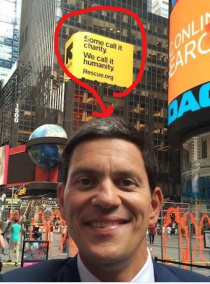
As CEO of the International Rescue Committee, the wealthiest of nine federal refugee contractors, Miliband crowed about the military support for more refugee admissions. Does he want to be sure to preserve his partially-federally funded salary of over $900,000 per YEAR?***
One is the original program set up by the Refugee Act of 1980 that is at present admitting around 30,000 refugees from places like the DR Congo, Burma, the Ukraine and some other African countries. Our military isn’t actively engaged in those places. That is the program approaching a critical decision point in the coming days and weeks.
Then there is the newer Special Immigrant Visa Program that admits the supposed military helpers from Iraq and Afghanistan. It seems that those are the primary places of concern to top brass who have made promises of a ticket to America in exchange for their help.
The numbers of Afghan and Iraqi SIVs are separate from the Refugee Act of 1980refugees.
[An aside: I argue that if you bring every last Iraqi and Afghan supporter of America to live in the US, what have you left in those countries—only those that hate us!]
Before I even get to the news—An important meeting is scheduled at the White House on Tuesday to discuss setting the cap for refugee admissions in FY2020—ponder these numbers.
Since October 1, 2006, we admitted 10,917 regular refugees from Afghanistan and 58,371 Special Immigrant Visas through August 26, 2019 for a total of 69,288.
During that same time period we admitted 143,082 Iraqi refugees and 18,508 SIVs from Iraq for a total of 161,590.
Total interpreters for the two hotbed Islamic countries was 76,879!
Really! That many were doing translation services for us? Or did anyone who took out the trash qualify to become your new neighbor?
Isn’t that enough? And, how many of the military brass who are shilling for the refugee contractors (like moneybags Miliband) are inviting Afghans and Iraqis to their homes, or to their neighborhoods?
Sorry this is getting long, but here is the story you need to read. From the New York Times(hat tip: Joanne):
Trump Administration Considers a Drastic Cut in Refugees Allowed to Enter U.S.
WASHINGTON — The White House is considering a plan that would effectively bar refugees from most parts of the world from resettling in the United States by cutting back the decades-old program that admits tens of thousands of people each year who are fleeing war, persecution and famine, according to current and former administration officials.
There is much discussion in the NYT article about Trump aide Stephen Miller and his dastardly deeds (like placing loyal Trump supporters at the State Department) to slow the refugee flow into America.
In meetings over the past several weeks, one top administration official has proposed zeroing out the program altogether, while leaving the president with the ability to admit refugees in an emergency.
Another option that top officials are weighing would cut refugee admissions by half or more, to 10,000 to 15,000 people, but reserve most of those spots for refugees from a few handpicked countries or groups with special status, such as Iraqis and Afghans who work alongside American troops, diplomats and intelligence operatives abroad.
Both options would all but end the United States’ status as a leader in accepting refugees from around the world.
The issue is expected to come to a head on Tuesday, when the White House plans to convene a high-level meeting in the Situation Room to discuss at what number Mr. Trump should set the annual, presidentially determined ceiling on refugee admissions for the coming year.
[….]
Advocates of the nearly 40-year-old refugee program inside and outside the administration fear that approach would effectively starve the program, making it impossible to resettle even those narrow populations. The advocacy groups say the fate of the program increasingly hinges on an unlikely figure: Mark T. Esper, the secretary of defense.
Barely two months into his job as Pentagon chief, Mr. Esper, a former lobbyist and defense contracting executive, is the newest voice at the table in the annual debate over how many refugees to admit. But while Mr. Esper’s predecessor, Jim Mattis, had taken up the refugee cause with an almost missionary zeal, repeatedly declining to embrace large cuts because of the potential effect he said they would have on American military interests around the world, Mr. Esper’s position on the issue is unknown.
The senior military leadership at the Defense Department has been urgently pressing Mr. Esper to follow his predecessor’s example and be an advocate for the refugee program, according to people familiar with the conversations in the Pentagon.
[….]
A senior Defense Department official said that Mr. Esper had not decided what his recommendation would be for the refugee program this year. As a result, an intense effort is underway by a powerful group of retired generals and humanitarian aid groups to persuade Mr. Esper to pick up where Mr. Mattis left off.
A reminder to all! Even if the number of refugees drops to nearly zero (it won’t!), the program will still be in place for a future President to simply put it on steroids to make up for what they will call the “lost Trump years.”
There must be a complete overhaul of the program while Trump is in the White House!
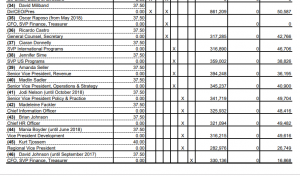
*** I hadn’t checked British national David Miliband’s salary for awhile so imagine my shock to see this from the most recent Form 990 for the IRC.
The IRC received over $500 MILLION from the US Treasury (from you!) in this one year!
Look at these salaries!
You shouldcontact the White Houseover this weekend and on Monday and tell the President what you think he should do!
The refugee industry is everywhere these days claiming that one of the most important reasons to import hundreds of thousands of refugees is that they revitalize crumbling cities.
We need refugees to save dying cities!
In fact,. as I write this US refugee resettlement contractors, hoping topressure Donald Trumpto set a high ceiling for refugee admissions for FY2020 (which begins October 1 of this year), are hammering the big lie—refugees save dying cities.
Bashing Trump….
Here is just one example, the Washington Post recently published an opinion piece by two leaders of World Relief(one of nine federally-funded refugee contractors) claiming just that and saying the Trump is hurting cities by reducing the numbers of impoverished refugees being admitted to the US.
But, get this, the New York Times ,in an extensive expose in August, tells us that yes, Bill Clinton’s Bosniansdid bring some economic revitalization to St. Louis, but it didn’t last. The primary reason for the unfolding failure—Democrat-run cities are crime infested. (There has been no Republican mayor in St. Louis since 1949.)
‘It’s Not the Same’: Why War Refugees Who Helped Revive St. Louis Are Leaving
[Article opens with some economic success stories. BTW, a large number of Bosnians are Muslims.]
For St. Louis, a city that had bled population for decades — it had about 400,000 residents in 1990, down from more than 800,000 in the 1950s — the influx of what was estimated to be the largest population of Bosnians outside Bosnia seemed to work magic. For the first time in generations, the urban narrative of abandoned houses, stagnant business and vanishing people appeared to be changing.
But it didn’t last.
Today, St. Louis, like some other Midwestern cities, is battling a new round of contraction, with a stagnant economy, challenged schools and one of the highest murder rates in the country. And over the past few years, the people who fled brutal violence and concentration camps in their homeland and created Little Bosnia have been fleeing again, to the suburbs.
The beginning of the end for the Bosnian community of St. Louis and the melting pot myth was the murder of a Bosnian young man by a gang of thugs. See my 2014 post about the murder.
Black and Hispanic teens sentenced to long prison terms for Begic’s murder. The NYT never mentions who the killers were.
A deadly hammer attack in Bevo Mill — in which Zemir Begic, a young Bosnian man out with his fiancée, was killed by four teenagers — shook the community in 2014. Bosnians marched in the streets, arguing that the police had not done enough to keep the neighborhood safe.
[….]
Similar stories have been playing out in American cities since the Baby Boom decades of the 20th century, and have proven hard to reverse. After mass flights to the suburbs, even heavy investment in urban centers, with shiny new business districts and rapidly changing downtowns, have often failed to help cities, particularly in the Midwest, replace the residents they had lost.
In St. Louis the process has been particularly painful, because the people who were fleeing were the very ones who had been seen as saviors.
[….]
At its peak in the late 1990s and early 2000s, the Bosnian population, including American-born Bosnians, reached about 70,000 in the city of St. Louis and the surrounding county, according to the International Institute of St. Louis, a charitable agency that sponsors many of the region’s refugees. Now, with some Bosnians having left the state entirely, the agency estimates that the figure is less than 50,000.
The International Institute of St. Louis is a subcontractor of the US Committee for Refugees and Immigrants (USCRI), but you can bet USCRI is still peddling the myth that refugees will save dying cities—maybe for a few years in the case of industrious Bosnians, but it won’t happen at all with extremely impoverished Africans.
140 Million ‘climate refugees’ will need new homes by 2050, says the World Bank!
This has been coming for a long time.
Longtime readers may remember that I have a whole category on so-called ‘Climate refugees’ here at RRW. (Go here for over 50 previous posts on the topic.)
But now comes news that Democrat candidate for President, Julian Castro, wants to make it legally possible for hundreds of thousands of migrants (millions!) on the move around the world to claim refugee status due to changing weather patterns.
Battle over the word “refugee.”
Although Vox doesn’t say too much about it in this story, know that there is not uniformity among Progressive activists on the subject.
The ‘humanitarian’ wing of the refugee industry fears that the world’s persecuted might be drowned by the hundreds of thousands of third worlders who might claim asylum in the first world because the weather changed in their home country.
Julian Castro’s climate change plan would recognize a new class of refugees
Democratic presidential candidate Julián Castro’s climate plan, released Tuesday, calls for the US to create a new category of refugees to welcome people displaced by the warming planet.
The US only accepts refugees who have been targeted based on their race, religion, nationality, politics or affiliation with certain social groups. As climate change threatens everything from crop production to coastal cities, tens of millions of migrants are expected to be pushed out of areas that will no longer be habitable in the coming decades.
The World Bank estimates more than 140 million migrants will be displaced as a result of climate change by 2050. Castro’s plan is meant to address that growing crisis. But other experts worry it will come at a cost for people who are fleeing persecution in their home countries.
Migrants displaced by climate change have no formal rights in the US and internationally. While 164 countries signed a United Nations agreement in 2018 to work together to resettle those migrants, the pact is not legally enforceable and depends on voluntary participation.
The US and its international partners, however, are running out of time to determine how they will support such migrants. [Says who!—ed]
Glaciers are melting and sea levels are rising, flooding low-level coastal areas where migrants have already started to flee. Increasing global temperatures have led to the desertification of farmland just as growing populations demand higher food production, making the terrain unlivable. Droughts cause local conflict over control of water resources and are the biggest killer among weather-related catastrophes, according to the UN.
Castro’s plan acknowledges that the existing criteria for refugees in the US may cover some migrants who have been persecuted in “climate-driven conflicts,” but ultimately, he says it’s not enough. The US must be proactive and “cannot wait for climate change to destabilize a society before providing assistance,” he writes.
[….]
Most of the Democratic presidential candidates call for the US to prepare for mass migration as a result of the climate crisis, but none have gone so far as Castro in proposing to create a whole new category of refugees.
“I feel hurt by the fact that a specific demographic at Wellstone has been taken away from us.”
(Aimee Fearing, former Wellstone principal)
When I read this storyat Minnesota Public Radio I couldn’t help but think about buggy whips. You know the expression about how as times change, so too do industries when the demand for certain commodities disappears.
But, the big difference is that with government programs, those benefiting certain people personally (with jobs etc.), instead of dying a natural death, taxpayer dollars are found to keep the government equivalent of the buggy whip industry alive.
At one time Wellstone High School, a special school for immigrants, was 65% Somali, today it is 30%, and those benefiting from the refugee industry generally in Minnesota are crying the blues.
As refugee admissions hit record low, one Minneapolis school fights to adapt
[Big opening section featuring a Somali success story to appeal to readers’ emotions before launching into the difficulties ahead for a special school for special people.]
For nearly two decades now, Wellstone has served as a training ground for hundreds of young refugee and immigrant students, many of whom grew up to be economists, health professionals and engineers — even as its population has fluctuated with each stroke of a presidential pen that expanded or reduced refugee admissions to the United States.
In recent years, though, not many people like Mah are entering the country because of the Trump administration’s crackdown on immigration and the sharp reduction in refugee admissions. As a result, Wellstone is bracing for one of the lowest student enrollment years in its history.
But it’s not just Wellstone that’s witnessing the ripple effect of the dwindling number of refugees entering the country. Refugee-serving agencies in Minnesota have also seen a dramatic decline in the number of refugees coming to their doorsteps for resettlement services.
Here it is—they must keep the infrastructure alive—another way of saying that they must keep the taxpayer dollars flowing their way!
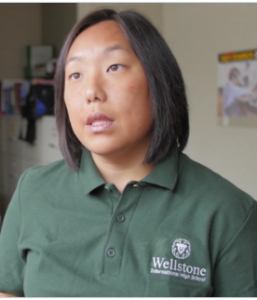
Former Principal Aimee Fearing
To keep the infrastructure alive, Wellstone and service agencies are finding new ways to adapt to the changing refugee-services landscape — by shifting resources and tapping into new demographics.
Donald Trump is to blame….
After he took office in 2017, the president followed through with many of his promises. For example, he barred people from certain predominantly Muslim nations, including Somalia, from entering the U.S. and reduced refugee admissions to the lowest level since the program was created in 1980.
Those restrictions have affected the refugee stream to Minnesota, which for years has been one of the top states for refugee resettlement. More than 3,000 primary refugees arrived in Minnesota in 2016, but only 1,000 came in 2017, and 660 last year, according to figures from the Minnesota Department of Human Services.
The dramatic reduction in refugee admissions will be felt this school year at Wellstone, where the student population has dropped from 400 four years ago to 180 now, according to school counselor Ali Kofiro.
[….]
Though the students at the school have come from all over the world, including East Africa, Southeast Asia, Central America and Mexico, Somalis typically were the majority. In 2015 and 2016, for instance, 65 percent of the students were Somalis. Today, that number is less than 30 percent.
“I feel hurt by the fact that a specific demographic at Wellstone has been taken away from us,” said Aimee Fearing, former Wellstone principal who now serves as the executive director of K-12 academic programming at Minneapolis Public Schools.
For Deqa Muhidin, an ESL teacher at Wellstone, the shrinking number of refugee arrivals hangs as a question mark over the future of the school. “Our school’s future will definitely be up in the air,” said Muhidin. “And my role will definitely be up in the air.”
[….]
The reduction in refugee admissions is also affecting nonprofit organizations and resettlement agencies that often rely on serving refugees to get funding.
Continue reading here. It is a long article, but useful especially for Minnesotans as it goes on to discuss the refugee contractors operating in the state and how they are adjusting (or not!) to the loss of much federal funding.
Endnote: One wonders about assimilation if the immigrant kids are kept separate and treated as special people in their own special school.