But, continue reading! There is good news too! Wait for it!
Remember that I told you herethat North Dakota Republican Governor Doug Burgum went down the wimpy middle and said the state would take more refugees if local jurisdictions agreed. So it looks like Cass County has given the governor his green light.
Cass County Commissioners Vote Yes to Refugee Resettlement
Unless the governor changes his mind, North Dakota taxpayers will be continuing to prop up a 4-decades-old federal program that was never supposed to be a burden on local and state taxpaying citizens.
If you are a new reader, be sure to see animportant post yesterdaywhere I explain what the Open Borders Left is doing to smash the President’s September Executive Order that gives state and local government an opportunity to opt-in or opt-out of being a refugee placement city or county.
Now to some good news!
Cass County might have caved, but the citizens of Bismarck came out in force to urge their county commission to say NO! to more refugees and the commissioners decided to postpone the decision.
Before I give you the news, know that it was 11 degrees in Bismarck last night! Can you pull this off where you live?
BISMARCK — People came from all over Monday evening in the hopes of making their voice heard to the Burleigh County Commission.
Bismarck Mayor Steve Bakken was in attendance.
With a heavy police presence, you could feel the tension in the air as most of the crowd was there to convince the commission to vote against giving consent to Lutheran Social Services of North Dakota for a refugee settlement.
The consent is necessary after President Donald Trump signed an executive order in September that requires state and local governments to give consent to whether they will accept refugees or not.
Some people KX News spoke with did not want that to happen.
“124 people statewide does not have an impact, however, if the 124 do a chain migration that could easily be 1,200. And in a state of 750,000 people, 1,200 is a lot,” said local resident Phillip Cohen, who’s against allowing the consent.
The problem was so many people turned up to the meeting, they couldn’t fit everyone inside, so in the interest of fairness, the commission decided to table the matter until a larger venue could be secured in the near future.
County Commission Chairman Brian Bitner
Brian Bitner is the chair of the commission and said he also has reservations about granting the consent for financial reasons.
“I haven’t seen anything in this package, anywhere, that tells me that we’re consenting to five or 50 or 500 or anything. So North Dakota is already the highest per capita state for refugee resettlement in terms of number of citizens, so in the absence of any sort of number, there’s no way we could know the cost to the state or the county, and I simply can’t support that,” said Bitner.
Opponents of the news said an increase in refugees could lead to a drain on government services and an increase in crime, something the pro-refugee crowd overwhelmingly denied.
[….]
But with no decision Monday, the clock is ticking, because agencies must submit their written consent by Jan. 21 or lose federal funds that could be used to reunite families and place refugees in places with jobs, and other supportive means.
As for the January 21 deadline, it is for the nine resettlement contractors and their subcontractors to have their plans submitted to the US State Department in order to get their federal funding. At that time they need to have written permission from the governor and from the county government, or the city (if applicable), in hand.
They are shooting to get those approvals by Christmas, so you must get moving where you live! As I’ll tell you in an upcoming post, the Leftwing refugee contractors and others in the Open Borders movement are putting every county in play! (Not just those withexisting sites, like these.)
This is not just a bureaucratic exercise!
The Left has made it into a referendum on Donald Trump’s refugee policies in an election year. The President is correct that state’s can choose whether to be a resettlement state or not. For us it is a referendum on state’s rights and whether local citizens will have a say in whether their communities will be changed (forever!).
Editor: Thanks to David James for another excellent analysis of the vital question about the resettlement of refugees in the US—do states have any right to say no to the placement of UN/US State Department selected refugees within their borders?
James says yes, and explains that a Migration Policy Institute paper by a legal expert confirmed that in 2011.
Indeed the original Refugee Resettlement Act of 1980 foresaw an opt-in and in practice that opt-in has been ignored for nearly 4 decades, Trump is attempting to fix that as I have been explainingin recent days.
The primary reason you should be involved now is that you should have a say in how your state and local taxes are spent (not some federally funded NGO operating out of New York City, Washington or Baltimore).
Soros Funded Immigration Think Tank Said States Can Reject Refugees
The self-described non-partisan Soros-fundedMigration Policy Institute (MPI), was light years ahead of President Trump about the limited authority of the federal government to force refugee resettlement in states which say no thanks.
In 2011, the MPI issued apaper titled, The Faltering U.S. Refugee Protection System: Legal and Policy Responses to Refugees, Asylum Seekers, and Others in Need of Protection, written by lawyer Donald Kerwin, Exec. Dir. of Center for Migration Studies and former ED of the Catholic Legal Immigration Network, a subsidiary of the US Conference of Catholic Bishops.
The USCCB is also one of the busiest federal resettlement contractors whose last available financial statement in 2017 showed $50 million dollars in federal grants comprising 94% of the USCCB budget for migration and refugee services.
States have rights!
Kerwin wrote that states need to say yes to refugees before the State Department’s Bureau of Population, Refugees & Migration (PRM) resettles refugees in any state:
Resettlement agencies (many affiliated with VOLAGs] meet with state and local officials on a quarterly basis regarding the opportunities and services available to refugees in local communities and the ability of these communities to accommodate new arrivals. They also consult with the state refugee coordinator on placement plans for each local site. PRM provides ORR and states with proposed VOLAG placement plans. If a state opposes the plan, PRM will not approve it.
During a 2010 U.S. Senate Foreign Relations Committee hearing, testimony from Fort Wayne, Indiana and Clarkson, Georgia city officials stated that they had never been consulted or given notice by resettlement agencies or PRM about upcoming resettlement plans.
There’s plenty of evidence that even if these consultations actually take place, they only happen between like-minded bureaucrats and not with say, state legislators on the finance committees.
Remember too, that in states which have withdrawn from the resettlement program, the state refugee coordinator is typically an NGO which has its own refugee resettlement program heavily dependent on keeping the federal cash flowing to its bank account.
Another dirty little secret about refugee placements is that decisions about “capacity” at the local level for resettlement is left up to the federal contractors whose financial well-being is directly tied to how many refugees they can bring in during the fiscal year.
The US General Accounting Office found that “capacity” can pretty much mean anything the contractor wants it to mean including its own “long-term funding needs.”
It’s not clear what Kerwin’s basis was for his concession to a state’s authority to reject a proposed refugee resettlement plan. But Tennessee’s lawsuit offers a legally viable and coherent explanation – the federal government’s admission to shifting the costs of its refugee program to state governments in violation of the Tenth Amendment and U.S. Supreme Court precedent.
Not only that, but the refugee resettlement program was designed originally as an opt-in. The 1980 Act has no language authorizing a replacement after state withdrawal but is structured as an opt-in program for states just like other federal spending programs. It wasn’t until 1994, that the state withdrawal/ORR replacement provisions were added to the regulations.
When a state chooses to withdraw from the federal program ORR, gave itself, by regulation, what the enabling legislation didn’t – the authority to appoint a replacement state designee. Importantly, appointing a replacement state designee, is permissive, not mandatory. In each state that has chosen to withdraw, however, ORR has appointed an NGO resettlement agency as the state’s replacement designee. This has resulted in forced state participation and forced state expenditures for the federal program.
President Trump’s Executive Order reads as if a state can override consent by local governments to bring in refugees. However, the operating details won’t be known until HHS and the State Department issue their guidance on the consent.
Of course, the activist judge who will be deciding the lawsuitbrought by the VOLAGs challenging Trump’s order will have to choose between following the law or legislating from the bench.
Local activists would do well to explain the real fiscal implications to their state legislators and governor of the state being forced to pay the federal freight that Congress has chosen to shift to the state, taking state funding priorities away from the state’s most vulnerable citizens.
As I have said innumerable times over a dozen years, the Refugee Council USAis the lobbying arm of the refugee industry. The nine federal refugee contractors*** are at the heart of it, and all funding for it flows through Church World Service. (See CWS and CAIR,here)
Don’t forget! The refugee contractors, like Church World Service here are not just refugee placement contractors, but are political advocates for the entire Open Borders movement. They shouldn’t be receiving any of your tax dollars!
Needless to say they are mobilizing their networks of Open Borders Activists to defeat Trump’s refugee slowdown andSeptember Executive Orderby getting your governors and local government officials to go on record saying they welcome more refugees.
If you are just learning the news that the President is attempting to make a fundamental change in how the US Refugee Admissions Program has operated for nearly 4 decades by giving some say to local and state governments about whether they want more refugees (that will be costing state and local taxpayers millions of dollars to take care of) here are some recent posts you should see.
Now that you are up-to-speed, see that the Refugee Council USA whose members have a huge financial stake in continued large scale refugee migration to America are working to generate action by their grassroots (and media lackeys) to follow the recent funding guidance from the US State Department.
(Although they claim the EO is illegal and are suing, they tell their followers to do this anyway!)
RCUSA’s Handy Tool Kit should be handy for you too!
Toolkit for Engaging Elected Officials on the “State & Local Resettlement Ban” Executive Order
Background: On September 26, the White House issued an Executive Order(EO 13888)that may drastically reduce, if not entirely stop, the resettlement of refugees in your community. The EO is already creating chaos and confusion about where refugees can be resettled, will lead to family separation for refugee families, and will leave refugees, former refugees and United States citizens without supportive services. To make matters worse, the administration proposed a refugee admissions goal of 18,000 refugees for the next year, a shamefully abysmal number for the world’s most powerful nation that stands in stark contrast to the historic average goal of 95,000 refugees.
Together, these actions are likely to destroy the bipartisanrefugee resettlement program for years to come. It’s critical that we work together to demonstrate nationwide, bi-partisan support for refugees and ensure our state and local officials publicly declare welcome for refugees. We need you to make your voice heard at the local level and reach out to your governors, mayors, and county officials and ask them to support refugee resettlement.
Why is the EO harmful? The EO fundamentally alters the structure of the U.S. resettlement program by transferring decisions about who can resettle and where from the federal government to state and locally elected officials. Not only will this ultimately lead to a patchwork of conflicting policies running contrary to the purpose of a national resettlement program, but it will also leave thousands of refugees, former refugees, and U.S. citizens without consistent and routine access to integration services and other supports. The EO subjects families and our community members to the whims of politics and exacerbates uncertainty for refugee families and communities alike by requiring local officials to provide written consent before refugees can be resettled. This is an unprecedented and harmful procedure, particularly given that resettlement agencies already consult regularly with state and local stakeholders regarding community needs. In addition, U.S. citizens, immigrants, refugees, and visitors alike are constitutionally allowed to move freely between cities and states. We do not need explicit permission from cities to travel – or relocate.
What We Know: Governors and local officials must provide written consent to opt into resettling refugees in their states and localities. Resettlement agencies are responsible to obtain written governor and local consent – the administration will not be communicating directly to governors or local officials. Consent letters will be publicly available on the State Department’s website. Consent is needed from the governor of a state in order to continue refugee resettlement anywhere in that state. If a governor gives consent but a locality does not, refugees may be resettled in a different locality where consent is provided. Some family reunification cases that use the “follow to join” Visa 93 process may be exempted from parts of this EO. The EO does not directly apply to Special Immigrant Visa (SIV) holders.
In terms of local consent, the administration has referred to the county or county-equivalent. In some cases, there are no counties, and in others, counties do not have the authority. Ultimately, the administration will defer to local community’s determination of who has authority. If you have already reached out to a mayor’s office, please continue to get that consent letter. Our understanding is that in many places, that will suffice. When at all possible, please also obtain consent from a county official as well. The administration is requiring that a list of cities/towns that fall under the jurisdiction of the local body be included within or attached to the letter of consent. This can be prepared by the resettlement office or the official providing the letter, but it must be certified by the consenting official.
Your State & Local Officials Need to Hear From You
When you engage your local officials, we encourage you to educate them about the existence and content of the EO and ask whether they will provide written consent to resettle refugees. Here are the top two ways to take action:
Tell Your Governor to Declare Welcome for Refugees: Click here to contact your governor and tell them to declare that they welcome refugees in your state. Ask them to provide the necessary written consent to the federal government stating that refugees are welcome. A template letter that can be adapted to your state is available here.
Letters should be addressed to: Secretary Michael R. Pompeo, U.S. Department of State; and Principal Deputy Assistant Secretary Carol T. O’Connell, Bureau of Population, Refugees, and Migration, U.S. Department of State.
The following language should be included in order to provide consent: “As [Governor/Mayor] of [state/city], I consent to initial refugee resettlement in [state/city] as per the terms of the Executive Order. This consent is valid unless or until withdrawn.”
An important note / disclaimer: Since we do not want our communications to imply that we endorse or agree with the EO, it would be helpful to include the following disclaimer in correspondences: “Communication about, or participation in, the implementation of Executive Order (EO) 13888 is not an endorsement of the legality of the EO.”
Steps to Organize Meetings with State & Local Officials
Template Letter to Officials: Click here for a template letter from community members, click here for a template letter from faith leaders, click here for a template letter from businesses and click here for a template letter from Members of Congress, to governors and state and local officials to invite them to declare welcome for refugees.
Step-by-Step Guide: Click here for guidance on how to prepare and organize meetings with governors, mayors, county executives, and other local officials.
Bring Handouts: Bring copies of this letter that is collecting signatures from state and local officials – governors, mayors, state/local legislators, etc. You can also adapt this template letter for your state and local officials for your meeting.
Provide Feedback: Don’t forget to tell us how it went! Click here to fill out a survey with feedback from your meeting. Contact Elissa Diaz at ediaz@cwsglobal.org if you would like help in preparing for and/or following up with your meetings with officials.
Additional Resources to Help You Talk to State & Local Officials
Talking Points and Messaging Guidance: For talking points on the executive order and the proposed refugee admissions goal of 18,000, please visit our Talking Points primer: http://bit.ly/EOPDTalkingPoints. Additional resources debunking the administration’s harmful “resettlement vs. asylum” narrative is available here: http://bit.ly/PDFactsheet.
EO Factsheet: Click here for a one page backgrounder and here for analysis about the EO and its impact.
Power Map: Who can make the decision you need to influence (your primary target)? Who influences them (your secondary targets)? Who uses influence for/against this decision? A power map is a simple yet powerful tool to map decision makers and focus your energy where it makes the greatest impact. Click here for a basic template to construct your power map, and click here for some tips on how to research and map targets.
Letters from State & Local Officials: A template letter from state and local officials to the administration that can be easily adapted to your state / locality is available here. Feel free to reach out to Elissa Diaz at ediaz@cwsglobal.org for help crafting a tailored letter for your specific officials. In addition, we are still seeking state and local officials – governors, mayors, state/local legislators, etc. – to sign on to this letter. Here are additional statements declaring welcome for refugees by Governor DeWine (R-OH) and Mayor Ben Walsh (I-Syracuse, NY).
Local Resolution Template: Template resolution language for local municipal, county, or other government bodies that authorize, support, or otherwise give a nod in favor of continuing to resettle refugees in response to the refugee EO can be found here.
We’ve been reporting daily (just scroll back and see what I mean!) about the President’s September Executive Orderthat requires that refugees be placed in cities/counties where the elected officials have said in writing that they welcome more refugees, or in the case of new sites where the city or county wants a new site.
It is no wonder the federal resettlement contractors heads are exploding! They are going to have to work really hard to get their federal boodle!
I’ve been wondering how they are going to accomplish this goal by a deadline supposedly later this month.
In fact, I’ve been seeing a reference to a June 1 date that had me scratching my head. What happens then?
This morning, I opened my alerts to yet another sob story about how refugee families are suffering because they were expecting to bring their whole families here soon and now face a longer wait because of that meany in the White House.
The story is this one from Missoula, Montana—which hosts a very new resettlement site operated by the filthy rich International Rescue Committee.***
‘You pray, you pray’: Trump refugee cap places strain on Missoula families
It contains many column inches of stories the Left loves to tell—the stories that count on moving people emotionally. But, it also contained this brief paragraph:
Trump also signed an executive order, set to take effect next summer, that requires resettlement agencies like Missoula’s IRC to obtain state and local government consent before accepting more refugees.
So what is that all about?
There must be guidance published somewhere on how the Executive Order is to be implemented.
Sure enough, here it isand it is evident that the reason for the contractors hitting the panic button is that their FUNDING AFTER JUNE 1 IS TIED TO THEIR COMPLIANCE WITH THE EXECUTIVE ORDER.
FY 2020 Notice of Funding Opportunity for Reception and Placement Program
They must jump through a lot of hoops! They have to explain how they involved the public in their decision making about who and how many they want to place in a community; they need to say how much private money they have collected toward the project; and of course must have letters from the governor AND the local elected officials apparently by Christmas.
The funding guidance mentions the 50-100 mile radius around each resettlement site that I referenced in my post yesterday. If you missed it be sure to go back and see if you live near a site.
You are going to have toread the guidance yourself, and I’ll see what I can do to get a lawyer’s opinion on what appears to me to be a massive bureaucratic undertaking for the contractors. Boo hoo! It is about time they are being made accountable!
Just so you know, I don’t think there can ever be real reform of the UN/US Refugee Admissions Program until this entire contracting system that relies on nine Leftwing ‘non-profits’ largely funded by taxpayers (and who hate the President!) to place refugees throughout America.
***Note to Montanans! You must put pressure on your governor because you know the refugee industry there is mobilized! Additionally, if Missoula is lost, see what you can do to put some political pressure on county government.
Update!Be sure to see my post hereas a followup—we found the instructions that the other side is using to help their people how to get mobilized. You can use this too!
As I have been saying for days and weeks now, thanks to the President you will have an opportunity to have a say in whether refugees will be placed in your communities going forward.
The President heard your concerns and has taken an important step to rein-in the refugee contractors. It isn’t perfect, but it is up to you to speak up where you live. He has your back, do you have his?
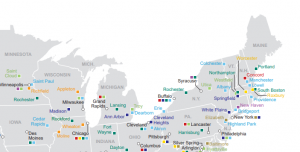
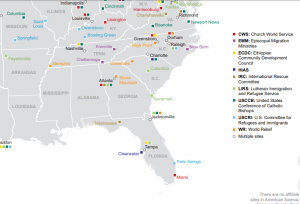
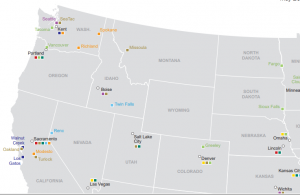
I have a lot more details for you about how it will work and how the nine federal contractors are trying to stop the President’s Executive Order, but first you need to know where the major resettlement sites are in the nation.
But, never forget these points!
The contractors have been placing refugees in a 50-100 mile radius of their offices. Don’t think you are off the hook if your city isn’t on the map.
See Virginiafor example. They have less than ten main refugee contractor offices, but have placed refugees over the last ten years across the entire state.
(In my next post you will see why the 50-100 mile radius is important.)
Also, the new requirements allow them to place new arriving family members with their spouse and children, and you can’t control that.
And, most importantly, refugees can move! There is nothing to say they can not simply move to the next town or next state and there is nothing you can do about that either.
At this point you are likely saying, why bring any? Get Trump re-elected and maybe he will be able to do more!
I’ve chopped it up so that I could enlarge the text. In case I have edited the screenshot in the middle of a city, see it whole here.
Are you within 50-100 miles of an office? If so, you must speak up now.
The refugee industry has pulled out all the stops to mobilize their supporters (they have well-established community organizing networks in each of these locations) to tell city/county elected officials that they want refugees and of course the governor must concur. (More on that in an upcoming post. No wonder the contractors are suing Trump!)
Six governors (so far) want more refugees. I’ll be tracking them as I see news. See my right hand side barfor the list so far.
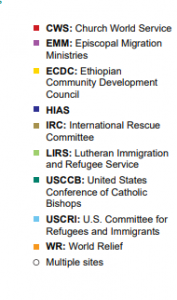
This is the legend for the map. These are the nine contractors, but they all have many subcontractors working under them.
We know there has never been a resettlement agency operating in Wyoming and that Hawaii only gets a handful in some years. West Virginia did have a resettlement office until recently.
Refugees have been placed in Mississippi, Louisiana and Alabama in recent years, including in 2019. But, the number is extremely low, so I am assuming they were family reunifications.
However, Oklahoma City does have a resettlement agency, so I’m not sure why it isn’t on the map.
Update! I should have thought to look at the map for 2017 at the time Trump became the President. Check out that mapand see how many more resettlement sites were in operation at that time! Yikes! And, I remember that toward the end of the Obama administration, his State Department was looking at another 40 or so possible sites. Progress is being made!